
Did an Asteroid Kill the Dinosaurs? Separating Scientific Fact From Myth
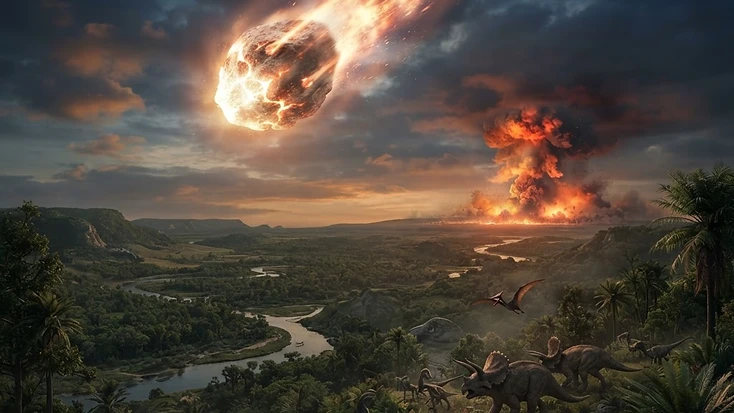
Claim being checked
"Did terrestrial land-based dinosaurs really become extinct because of asteroids?"
The scientific consensus confirms that a catastrophic asteroid impact 66 million years ago was the primary driver behind the extinction of non-avian dinosaurs, though the story is more nuanced than simple total annihilation. While the Chicxulub impact fundamentally reshaped life on Earth, it is important to remember that avian descendants survived to become the birds we see today.
What the Claim Says
The claim suggests that terrestrial land-based dinosaurs became extinct specifically due to an asteroid impact. This statement captures the popular understanding of the end-Cretaceous mass extinction event.
Flarient Fact Checker Rating
This claim is accurate but requires minor clarification or additional context.
The Verdict
Mostly True. While the asteroid remains the widely accepted primary cause, the claim lacks biological precision regarding the survival of avian dinosaurs—which are taxonomically classified as dinosaurs. Additionally, while the impact was the decisive factor, some researchers study environmental stressors like Deccan Traps volcanism as secondary contributors.
Decomposition
- An asteroid impact caused the extinction of non-avian dinosaurs.
- Dinosaurs as a complete biological group went extinct.
- The Chicxulub impact was the sole factor in this global event.
Evidence Analysis
Multiple lines of evidence, including iridium anomalies and shocked quartz, confirm a massive asteroid impact at the Chicxulub site in Mexico. NASA and the Natural History Museum corroborate this as the primary extinction trigger. Current paleontology, supported by studies in PNAS, confirms that while volcanic activity occurred, it did not have the same immediate, catastrophic impact as the asteroid. Importantly, modern biology classifies birds as living descendants of theropod dinosaurs, meaning the entire dinosaur lineage did not perish.
Rationale
The verdict is classified as 'Mostly True' because the core premise—that an asteroid killed the giant land-based dinosaurs—is scientifically accurate. The label stops short of 'True' only because the claim fails to acknowledge the survival of the avian dinosaur lineage and ignores the minor supporting role of climate-altering volcanic activity during that era.
The Facts
- The Chicxulub crater spans 180 kilometres in diameter.
- The extinction event occurred approximately 66 million years ago.
- Global geological evidence, such as iridium layers, confirms a major impact event.
- Birds are direct descendants of theropod dinosaurs.
Context
Organisations like NASA and the Natural History Museum lead research into planetary defence and paleoclimatology. Understanding past extinction events is vital for modern space exploration, helping scientists model potential future risks from near-Earth objects.
Bottom Line
Yes, an asteroid ended the age of the giant land-based dinosaurs, but life found a way to persist through avian evolution. Always look for the distinction between non-avian dinosaurs and their modern bird descendants when discussing extinction history.
Live Space Weather Dashboard
Powered by Flarient — embed this on your site →
Sources
About this fact check: This verdict was generated by the Flarient Fact Checker using live space weather data from NOAA, NASA, and JPL, cross-referenced with AI analysis. It is not an official NOAA or government forecast. Always consult official space weather agencies for critical decisions.
Seen another space weather claim that seems off?
Submit a claim