
The Scientific Truth Behind the Moon’s Gravitational Field
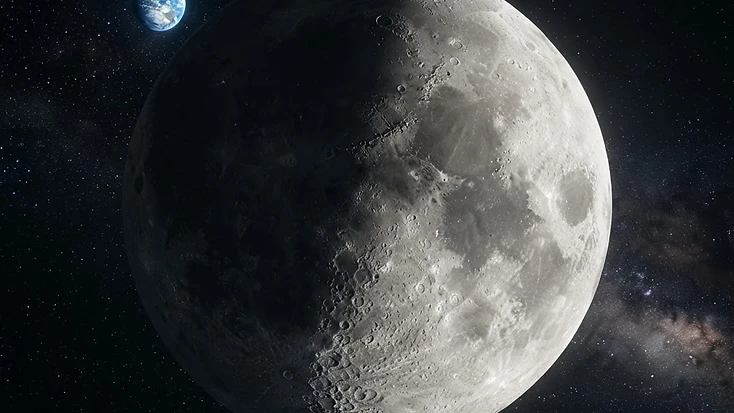
Claim being checked
"The Moon does not possess a gravitational field"
Despite persistent myths claiming otherwise, the Moon exerts a measurable gravitational pull that is fundamental to the mechanics of our solar system. This claim that the Moon lacks a gravitational field is scientifically inaccurate and contradicted by decades of observational data.
What the Claim Says
The claim asserts that the Moon does not possess a gravitational field, suggesting that lunar gravity is non-existent or purely theoretical.
Flarient Fact Checker Rating
This claim is entirely inaccurate or unsupported by facts.
The Verdict
False. The Moon possesses a distinct gravitational field that is approximately one-sixth of the strength of Earth’s gravity, measured at 1.62 m/s². This is a direct physical consequence of the Moon's substantial mass.
Decomposition
- The Moon has no gravitational field: This is the core claim. - Gravitational fields are optional for celestial bodies: This is the underlying false assumption.
Evidence Analysis
According to Newton’s law of universal gravitation, any object with mass exerts a gravitational field. NASA confirms that the Moon’s mass of approximately 7.34 × 10²² kilograms creates a gravitational pull strong enough to influence Earth’s ocean tides. Furthermore, missions like the Gravity Recovery and Interior Laboratory (GRAIL) have mapped lunar gravity with high precision, identifying anomalies known as mascons.
Rationale
The claim is objectively false because it ignores the fundamental laws of physics that apply to all matter. Gravity is an inherent property of mass; as long as the Moon possesses mass, it must possess a gravitational field.
The Facts
- The Moon’s surface gravity is 1.62 m/s². - Lunar gravity is the primary driver of Earth’s ocean tides. - NASA’s GRAIL mission mapped the lunar gravity field, showing variations based on subsurface mass.
Context
The Gravity Recovery and Interior Laboratory (GRAIL) mission was specifically designed to study the interior of the Moon by measuring its gravitational field. These missions have provided unprecedented data that confirms the Moon is not a gravity-free zone but a dynamic celestial body with a complex geological structure.
Bottom Line
Gravitational forces are universal constants. Claims suggesting that the Moon lacks gravity disregard the foundational principles of physics and the verifiable data collected by space agencies over the last century.
Live Space Weather Dashboard
Powered by Flarient — embed this on your site →
Sources
About this fact check: This verdict was generated by the Flarient Fact Checker using live space weather data from NOAA, NASA, and JPL, cross-referenced with AI analysis. It is not an official NOAA or government forecast. Always consult official space weather agencies for critical decisions.
Seen another space weather claim that seems off?
Submit a claim