
2026-08-12 · near asteroid
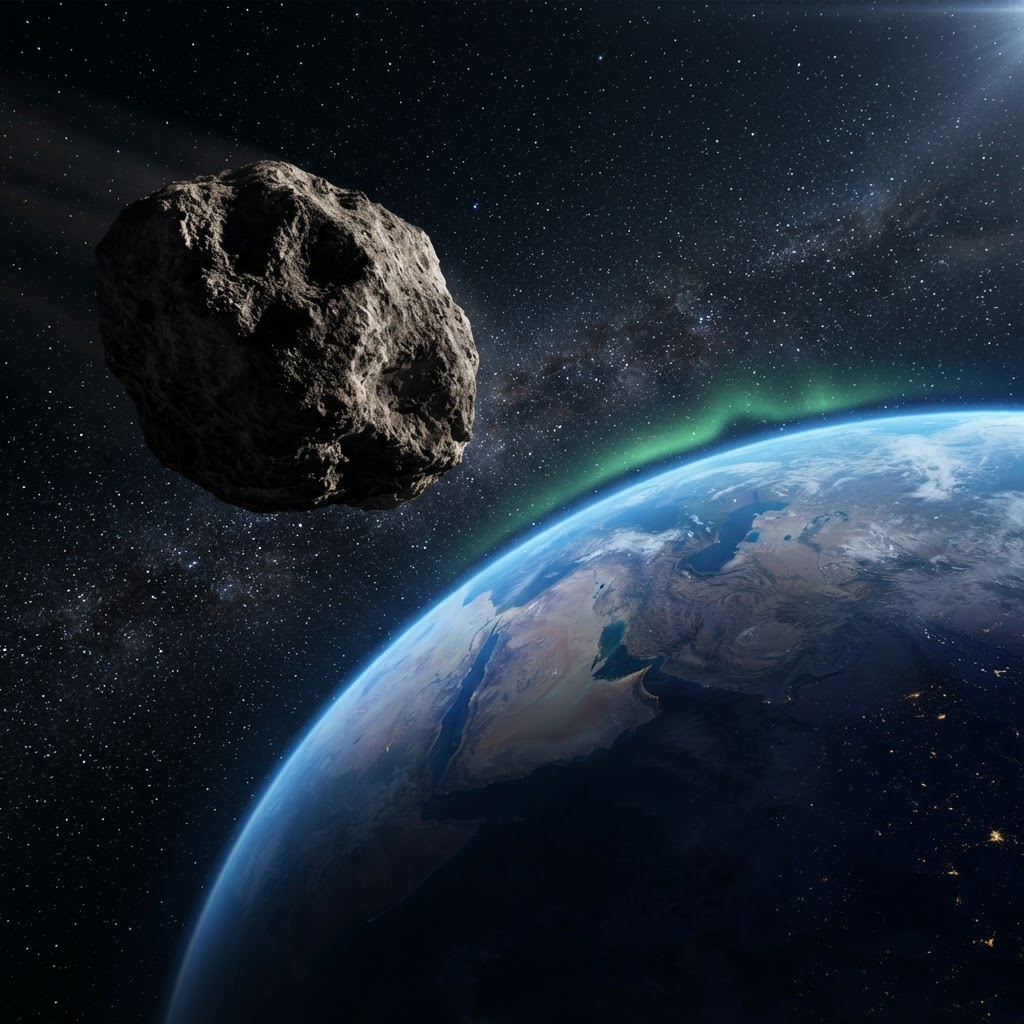
Asteroid 2025 AL2 Skims Past Earth
A quiet space weather day is punctuated by a close asteroid flyby as geomagnetic conditions remain subdued across the planet.
Daily Statistics Brief
On 12 August 2026, the world turned its gaze toward the Arctic and Western Europe for the total solar eclipse. By 13 August 2026, the quiet returned to the ionosphere. The planetary K-index remained unremarkable, peaking at 2.3 early in the day before settling to a stagnant 1.3. Geomagnetic conditions stayed well below the threshold for storms that have historically disrupted orbital infrastructure, a welcome reprieve when measured against the volatile archive data of previous cycles.
Solar wind speed tracked at 423 km/s, while the interplanetary magnetic field component, Bz, measured -1.9 nT. These values offered little in the way of atmospheric excitement. Consequently, the aurora power dissipated entirely, registering 0 GW across both hemispheres. Data provided by the NOAA SWPC confirmed that solar activity remained muted, with only minor B-class flares observed on the disc. The Dst index hovered at -20 nT, signalling a stable magnetosphere.
For those tracking near-Earth objects, 2025 AL2 held the position of the nearest asteroids in proximity to our planet. According to NASA CNEOS, the object maintained a safe trajectory, posing no threat to the surface. Observers who missed the celestial theatre of the previous day’s eclipse—which reached a magnitude of 1.04 and lasted 2 minutes and 18 seconds across Greenland, Iceland, and Spain—could still access imagery of the event online.
As the sun settled into a period of low-level activity, the local forecast for terrestrial radio propagation remained steady. Scientists continued to analyse the lack of anomalous readings, ensuring that no stray UAP signatures or unexpected interference patterns marred the telemetry. While the spectacle of the 12th dominated the headlines, the 13th served as a masterclass in the mundane mechanics of our star. It was a day defined by equilibrium, offering a brief window of stability before the next solar cycle shifts the dial.
Aurora Oval — Peak Kp 2.3
Quiet — aurora near polar regions only.
Auroral power: 0 GW
Space Events on This Day
The Daily Briefing
Read the full daily briefing — written from the live data — on its dedicated page.
Read full briefing →