Defining the Boundaries and Realities of Deep Space
Deep space is more than just a distant void. Learn how scientists define the boundary beyond Earth's influence and why this vast frontier impacts our lives.
Defining the Boundaries and Realities of Deep Space
Space often feels like an abstract concept, but it has clear, albeit scientific, boundaries. While the Kármán line at 100 kilometres marks the start of space, deep space is a far more elusive region that begins long after we leave the proximity of our own planet.
Understanding this frontier is essential for modern technology and long-term exploration. By analysing the forces that shape our solar system, we gain better perspective on Earth's place in the cosmos.
The Science Behind It
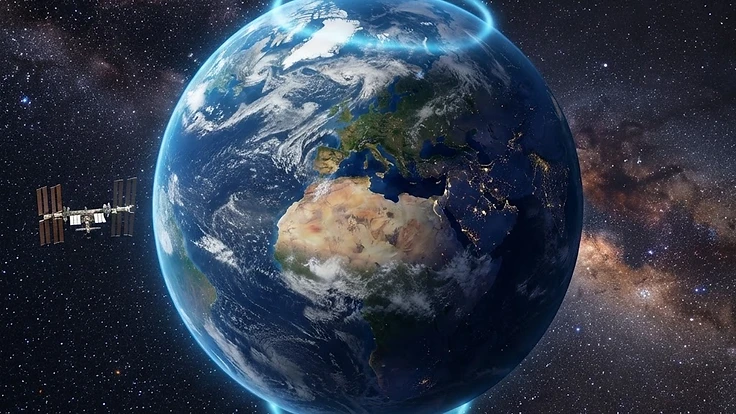
Deep space is generally considered the region beyond the cislunar environment, which is the space between Earth and the Moon. While low Earth orbit hosts the ISS at roughly 408 kilometres altitude, true deep space exists where Earth's magnetic influence and gravitational pull cease to dominate navigation.
This is the realm of solar wind, where particles travel at speeds between 400 and 700 kilometres per second. Coronal mass ejections can push these speeds to 3,000 kilometres per second, causing dramatic shifts in the G-scale.
Beyond this, the environment is governed by complex interplanetary dynamics. These include the heliosphere, the vast bubble created by the sun that protects us from interstellar radiation.
Real-World Implications
Deep space affects us through the movement of objects and the flow of energy. A near-Earth asteroid represents the closer end of this spectrum, but understanding the void beyond helps us map risks that might one day affect planetary defence.
Our communication systems depend on satellites operating in various orbital shells. These systems are constantly monitored for geomagnetic storm activity, which can disrupt signals and damage critical infrastructure.
We also see the impact of deep space events through the beautiful aurora displays at our poles. These light shows are direct evidence of solar particles interacting with our atmosphere after travelling millions of miles.
What You Can Do
Staying informed about the current state of our cosmic neighbourhood is easier than ever. You can view solar imagery to see how the sun is behaving or track potential threats in the archive to see how historical events shaped our modern understanding.
For those interested in experiencing the results of these interactions firsthand, there are many guided aurora tours across places like Iceland, Norway, Canada, and Finland. Seeing these lights is a powerful reminder of how connected we are to the broader solar system.
If you want to keep tabs on conditions from home, you can easily use embeddable widgets on your own website. These tools pull live data so your audience can see the same metrics that experts use to monitor space weather.
Key Takeaways
Deep space is not just empty distance, but a dynamic region that shapes our technology and global environment. From solar wind speeds to the intensity of geomagnetic storm events, every measurement we take helps refine our models of the solar system.
By leveraging tools that provide real-time data, we can move from passive observers to active participants in space situational awareness. Understanding this vastness is a continuous process of discovery and careful observation. Staying curious about the physics of our universe ensures we are prepared for whatever the sun sends our way.
People Also Ask
Is the Moon considered deep space?+
The Moon resides within the cislunar region, which is the immediate space environment surrounding Earth. While it is certainly in space, scientists typically categorise deep space as the area beyond the Moon and the influence of Earth's magnetosphere, where interplanetary dynamics become the primary driver of conditions.
How does solar wind reach Earth?+
Solar wind is a stream of charged particles released from the upper atmosphere of the Sun. It travels through the vacuum of interplanetary space at high velocities. When these particles encounter Earth's magnetic field, they are funnelled toward the poles, creating the auroral displays we see in the sky.
Why is the Kármán line significant?+
The Kármán line, located at an altitude of 100 kilometres, serves as the internationally recognised boundary between Earth's atmosphere and outer space. It is a vital milestone for aerospace engineering, marking the point where atmospheric flight becomes impossible and orbital flight begins.
Continue Reading
Forecast These Questions
View all →Express your probability on these active forecast questions.