Understanding Coronal Holes on the Sun
Coronal holes are vast, darker regions on the Sun that release high-speed solar wind into space. Learn how these solar phenomena influence our space weather and trigger geomagnetic activity here on Earth.
Coronal Holes Are Essential Solar Structures
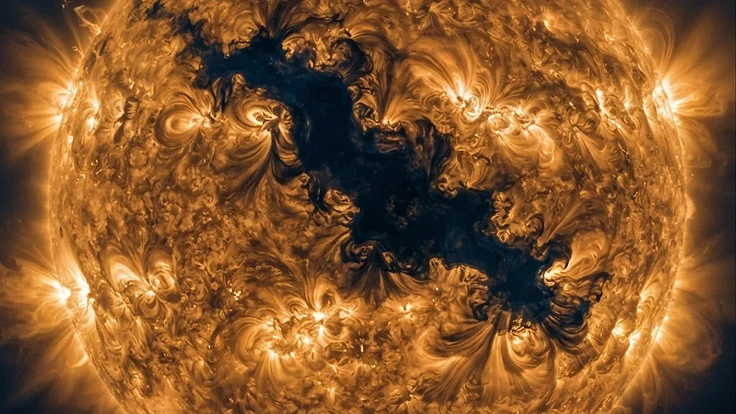
Coronal holes are not literally holes in the physical body of the Sun. They are regions where the solar corona is significantly cooler and less dense than the surrounding atmosphere.
These structures appear dark in extreme ultraviolet solar imagery, like those captured by the SDO. They play a vital role in regulating the outflow of solar material into the heliosphere.
The Science Behind It
These regions form where solar magnetic field lines extend directly out into space instead of looping back down toward the surface. This open magnetic structure acts as a highway for particles.
Live Solar Wind Monitor
Powered by Flarient — embed this on your site →
Charged particles escape these regions at much higher velocities than the ambient solar wind. While normal solar wind travels at 400 km/s, wind from coronal holes can reach speeds of 700 km/s or more.
Because the Sun rotates, these fast-moving streams often collide with the slower wind ahead of them. This interaction is a primary driver of recurrent geomagnetic activity throughout the solar cycle.
You can learn more about how magnetic fields function in our glossary for a deeper understanding of solar physics. Scientists often study these regions to model the long-term behaviour of our host star.
Real-World Implications
When these high-speed streams reach Earth, they interact with our planet's magnetosphere. This interaction can trigger geomagnetic storms that disrupt satellite operations and power grids.
While coronal hole streams rarely produce the extreme G5 storms seen during intense flares, they frequently cause prolonged periods of G1 or G2 activity. This extended pressure on the magnetosphere can affect radio communications and navigation systems.
These events are often responsible for the aurora displays seen at higher latitudes. The interaction between the solar wind and Earth's magnetic field accelerates particles into the upper atmosphere to create those shimmering lights.
Unlike flares, which are sudden, coronal hole streams are predictable. They corotate with the Sun, meaning we often know they are coming several days before they impact Earth.
What You Can Do
Monitoring these streams is straightforward if you know where to look. By keeping an eye on solar data, you can anticipate periods of increased auroral activity in your region.
For those travelling to witness the phenomenon firsthand, consider booking guided aurora tours in countries like Iceland, Norway, Finland, Sweden, or Canada for the best experience. Experts there can interpret the conditions in real time.
You might also find it useful to keep track of current conditions by using embeddable widgets on your own website or dashboard. These tools provide a clear view of the current solar environment without the need for constant manual checks.
If you are interested in broader space threats, such as a near-Earth asteroid passing by, you can view our archive of past events for historical context. Staying informed is the best way to enjoy the wonders of our solar system safely.
Key Takeaways
Coronal holes are a natural and constant feature of the solar atmosphere. They represent open magnetic field lines that allow high-speed solar wind to escape into the solar system.
While they lack the explosive intensity of solar flares, their persistent nature makes them a major influence on Earth's space environment. Understanding them is essential for anyone interested in space weather.
By tracking these streams, we gain valuable insight into the constant flow of energy from the Sun. Whether you are an enthusiast or a professional, there is always more to learn about our dynamic star.
People Also Ask
How long do coronal holes last?+
Coronal holes are long-lived solar features. They can persist for several solar rotations, which is roughly 27 days each, as the Sun rotates. Some stable coronal holes may remain visible on the solar disk for several months before they finally close or dissipate.
Are coronal holes dangerous to humans?+
Coronal holes are not dangerous to humans on Earth. The planet's atmosphere and magnetic field provide a robust shield against the solar wind particles released by these holes. While they can affect technology like satellites or radio systems, they pose no direct threat to biological life.
Can I see a coronal hole without a telescope?+
No, you cannot see a coronal hole with the naked eye or standard amateur telescopes. They are only visible in specific wavelengths of extreme ultraviolet light, which are blocked by Earth's atmosphere. You must view them through space-based solar observatories like NASA's Solar Dynamics Observatory.
Continue Reading
Forecast These Questions
View all →Express your probability on these active forecast questions.