Understanding the Maximum Usable Frequency
The Maximum Usable Frequency dictates how well long distance radio signals travel around the globe. Learn how solar conditions shape this critical limit.
The Maximum Usable Frequency Defines Long Distance Communication
The Maximum Usable Frequency, often called the MUF, is the highest frequency at which a radio wave can be transmitted between two points by reflecting off the ionosphere. If you attempt to transmit above this frequency, your signal will punch straight through the atmosphere and escape into space.
HF Radio Conditions
Powered by Flarient — embed this on your site →
This threshold acts as a gatekeeper for global communications. Understanding it is essential for anyone interested in amateur radio, aviation, or maritime operations that rely on the ionosphere for long distance links. As solar activity fluctuates, so does this critical limit, making it a dynamic part of our connection to the world.
The Science Behind It
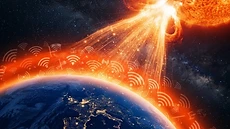
The ionosphere contains layers of ionized particles created by solar radiation. These layers act like a mirror for specific radio frequencies, allowing signals to bounce back to Earth rather than disappearing into the void. When you send a signal, it enters this region and refracts, bending back toward the ground.
Physics dictates that higher frequencies are less easily bent than lower ones. Once a frequency exceeds the electron density capacity of these ionospheric layers, refraction fails to return the wave to the surface. This cut off point is exactly what we call the MUF.
Solar activity drives the intensity of this ionization. During periods of high sunspot count, the sun produces more ultraviolet and X-ray radiation, which thickens the ionosphere and allows for much higher MUFs. You can learn more about how this cycle influences your radio signals in our guide to the solar cycle and its impact on high frequency radio communication.
Real-World Implications
When the MUF is low, radio operators struggle to establish reliable contacts over thousands of kilometres. Lower frequencies must be used, which are often crowded and subject to higher levels of atmospheric noise. This limitation impacts everything from international shortwave broadcasting to emergency response coordination in remote areas.
High MUF conditions open up the airwaves for long range communication. Signals can travel halfway around the world using relatively low power. This reliability is vital for global infrastructure, especially when satellites are unavailable or out of range.
If the ionosphere becomes too disturbed by a geomagnetic storm, as measured by the Kp index, these paths can shift, fade, or collapse entirely.
What You Can Do
Tracking the MUF requires a mix of real time data and local observation. You should check current solar indices to estimate whether the upper frequency bands are likely to be open. Using reliable glossary terms will help you interpret the reports you find online.
Integrating technology into your workflow makes this process much easier. You can use embeddable widgets on your own website or dashboard to keep the latest space weather data at your fingertips. Staying informed allows you to adjust your equipment and frequencies before you sit down to operate, ensuring you do not waste time on dead bands.
For travellers who want expertise over guesswork, guided Northern Lights excursions in Sweden, Scotland and Alaska pair you with photographers who read the aurora oval in real time.
Key Takeaways
The MUF is not a static number, but a living measurement of the upper atmosphere. It rises and falls with the solar cycle, governed by the same forces that create the aurora. By monitoring these conditions, you gain control over your ability to communicate across vast distances.
Keep an eye on solar flux and ionospheric health to predict your success in radio propagation. While the ionosphere remains a complex and sometimes unpredictable partner, the tools we have today make it easier than ever to work with nature rather than against it. Understanding this limit is the first step toward mastery in long range communication.
People Also Ask
How does the sun affect radio communication?+
The sun emits radiation that ionizes Earth's upper atmosphere, creating layers that reflect radio waves. Changes in solar activity, such as flares or geomagnetic storms, can either enhance these layers to improve long-distance communication or disrupt them, causing radio blackouts and signal degradation across the globe.
What is the difference between MUF and LUF?+
The MUF is the Maximum Usable Frequency, representing the upper limit for signal reflection. The LUF is the Lowest Usable Frequency, which is the minimum frequency where a signal remains strong enough to overcome atmospheric noise and absorption. Together, they define the usable window for radio communications.
Can I predict the MUF at home?+
You can estimate the MUF by monitoring solar indices like the SFI and tracking real-time ionospheric soundings from monitoring stations. Many software tools and online dashboards now integrate these data feeds to provide live MUF predictions based on current solar activity and atmospheric conditions in your region.
Continue Reading