Monitoring Solar Storms to Protect Satellite Infrastructure
Solar storms pose a constant challenge to satellite operations. Understanding the mechanics of these events allows operators to safeguard critical technology.
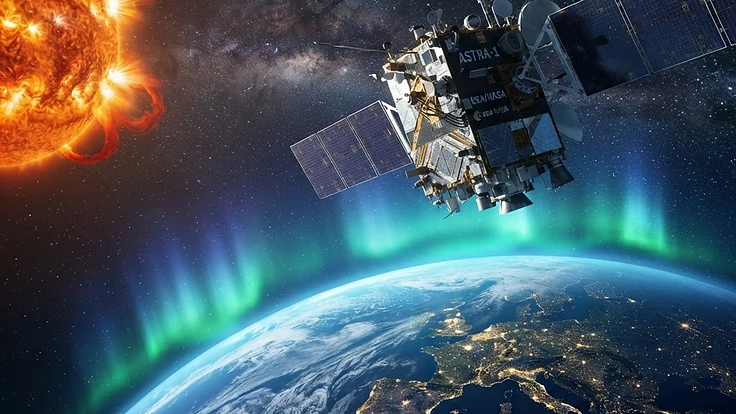
Monitoring Solar Storms to Protect Satellite Infrastructure
Satellite technology underpins modern life, from global navigation to instantaneous communications. Yet, these assets orbit within a volatile space environment influenced directly by the Sun. Solar activity, specifically the emission of charged particles and magnetic disturbances, can disrupt sensitive electronics and degrade orbital trajectories.
Live Solar Flare Monitor
Powered by Flarient — embed this on your site →
Understanding how to monitor these events is essential for anyone responsible for space-based assets or simply interested in the resilience of our technological society.
The Science Behind It
The Sun operates on an approximate 11-year cycle of magnetic activity, with Solar Cycle 25 having commenced in December 2019. During these cycles, the solar atmosphere releases plasma and magnetic fields in phenomena known as coronal mass ejections. These clouds of solar wind typically travel at speeds between 400 and 700 km/s, though faster eruptions can reach 3,000 km/s.
When these particles strike the Earth magnetosphere, they cause geomagnetic disturbances often measured by the Kp index. This scale, ranging from 0 to 9, quantifies the intensity of these magnetic fluctuations. A more detailed glossary of these terms helps distinguish between mild disturbances and severe events that can cause significant drag on satellites orbiting at altitudes like the 408 km mark occupied by the ISS.
Real-World Implications
Geomagnetic storms exert pressure on the ionosphere, leading to increased atmospheric density at low-Earth orbit altitudes. This heightened density creates drag, which can force satellites off their intended paths and necessitate fuel-intensive station-keeping manoeuvres. Beyond orbital decay, solar energetic particles can cause deep charging within satellite components, potentially leading to permanent damage or circuit malfunctions.
These impacts extend to the ground as well, as discussed in our deep dive into how geomagnetic storms impact global power grids. Understanding the solar flares and their impact on Earth helps planners build more robust systems. When we observe high levels of solar radiation, we are not just looking at a pretty light show, but at a physical force capable of altering the operational lifespan of multi-billion pound assets.
What You Can Do
Effective monitoring begins with reliable data sources such as the NOAA SWPC.
Many operators rely on real-time data feeds to adjust satellite orientations and reduce exposure during peak activity.
You can keep track of current solar conditions using tools like the Flarient live dashboard, which provides a comprehensive overview of space weather indices.
If you are interested in how these storms manifest on the ground, you can check the [local aurora forecast](/#local) to see if high-latitude events are likely. For those developing their own systems, consider integrating our embeddable widgets to display real-time space weather data directly on your own platform. Monitoring these variables ensures that you are never caught unprepared when the Sun decides to become active.
Rather outsource the chase? Guided Northern Lights tours in Tromsø, Fairbanks, Rovaniemi and the Isle of Mull put a local between you and the forecast — you just show up and look north.
Key Takeaways
Solar storms are a natural consequence of the Sun magnetic cycle and an inescapable reality of space travel. While they pose risks to satellite hardware and communications, active monitoring and sophisticated modelling allow us to mitigate these dangers. By staying informed through established indices and modern tracking tools, we can ensure the longevity of our critical infrastructure.
Whether you are a casual observer or a systems engineer, understanding the space environment is key to our future in orbit. Explore more about the broader context of our cosmic neighbourhood through our library of more articles. With consistent observation, we can continue to advance our capabilities despite the inherent volatility of our star.
People Also Ask
How do solar storms affect satellites?+
Solar storms increase atmospheric drag on satellites in low-Earth orbit, potentially altering their trajectories. Additionally, high-energy particles can cause deep-dielectric charging, which leads to hardware malfunctions, memory bit-flips, or total loss of communication with the spacecraft.
What is the Kp index?+
The Kp index is a global geomagnetic activity index based on 3-hour measurements from ground-based magnetometers around the world. It quantifies the magnitude of geomagnetic storms on a scale of 0 to 9, where higher numbers indicate more severe disturbances.
Can satellites be protected from solar flares?+
Yes, satellite operators protect assets by entering safe mode, orienting the spacecraft to minimize surface area exposure, or temporarily powering down non-essential systems during intense solar radiation events. Monitoring forecast data allows teams to take these precautions in advance.
Continue Reading
Forecast These Questions
View all →Express your probability on these active forecast questions.