Noctilucent Clouds Glow in the High Atmosphere
Often mistaken for standard weather phenomena, noctilucent clouds are rare ice structures that shimmer at the edge of space. Discover the physics behind these electric blue displays.
Noctilucent Clouds Glow in the High Atmosphere
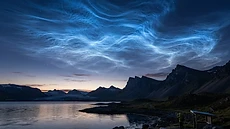
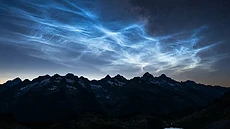
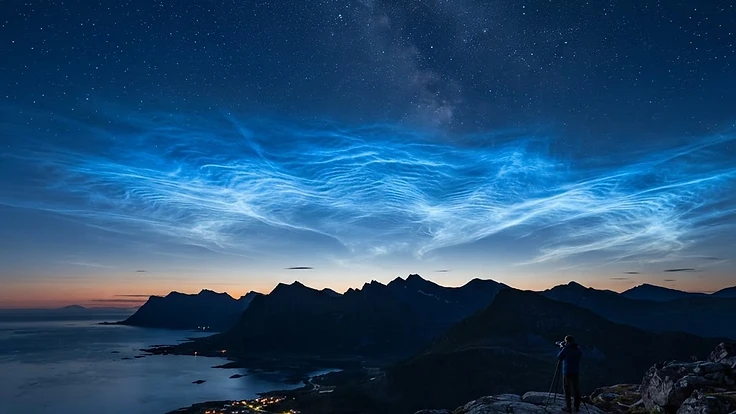
Noctilucent clouds, or night shining clouds, represent one of the most ethereal displays in our atmosphere. While typical clouds drift in the lower troposphere, these rare formations sit at the edge of space, nearly 80 kilometres above the Earth. They appear as wispy, electric blue streaks against a dark sky long after the sun has set below the horizon.
Most observers confuse them with standard twilight phenomena, but their structural origin is distinct. Understanding why they occur requires looking beyond our immediate weather to the cold, thin reaches of the mesosphere. These clouds are visual markers of a complex environment that links our planet to the solar influence documented in our glossary.
The Science Behind It
These clouds form in the mesosphere, the coldest layer of our atmosphere. For these ice crystals to manifest, the region must reach temperatures below negative 120 degrees Celsius. This occurs primarily during the summer months when the mesosphere experiences high altitude cooling, an interesting thermal quirk of atmospheric dynamics.
Water vapour must be present at these extreme heights to freeze onto meteoric dust particles. As meteors burn up during entry, they leave behind tiny fragments that serve as nuclei for ice formation. Because the sun remains below the horizon for ground observers, its light reflects off these high altitude crystals, creating a vivid glow while the rest of the sky is submerged in shadow.
Real-World Implications
While they are primarily a visual spectacle, noctilucent clouds serve as sensitive indicators of atmospheric change. Scientists monitor their increasing frequency and brightness to study long term trends in the upper atmosphere. Because they form in such a delicate, thin environment, they are highly responsive to human induced changes and natural cycles alike.
They offer a unique window into the transport of water vapour and trace gases across atmospheric boundaries. Researchers often compare this data with how [how solar wind shapes Earth's magnetosphere](/blog/how-solar-wind-shapes-earths-magnetosphere) to gain a clearer picture of energy balance. Understanding these clouds helps us model the interaction between the mesosphere and the lower atmosphere where we live and operate our technology.
What You Can Do
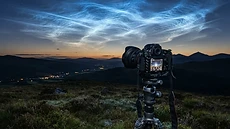
Spotting these clouds requires patience and a clear view of the northern or southern horizon during twilight hours. You do not need expensive equipment, though a steady camera can capture their intricate, rippling structures beautifully. If you want to expand your horizons, you can join [guided aurora tours](https://vi.me/HuXHi) through places like Iceland, Norway, Canada, or Alaska to see the full range of high altitude luminous phenomena.
To ensure you do not miss a celestial event, you can use a local aurora forecast to track geomagnetic activity that might accompany high altitude sky phenomena. You can also view solar imagery from the SDO to understand the current solar conditions that influence our upper atmosphere. If you manage a weather or astronomy blog, consider using our embeddable widgets to share these conditions with your own audience in real time.
Key Takeaways
Noctilucent clouds are a beautiful reminder of the activity occurring at the boundary of our world. They rely on specific conditions of temperature, water vapour, and dust to create their characteristic glow. By observing them, we gain insight into the health and physics of the thin layer that shields us from space.
These clouds remain one of the few ways the general public can witness the complex movements of the upper atmosphere. They serve as a bridge between curiosity and science, encouraging us to look upward. Whether you are tracking them for research or personal enjoyment, these clouds offer a window into the silent, cold beauty of the mesosphere.
Twilight field note
Noctilucent clouds are a fleeting twilight phenomenon, so readers may want to watch for them during the right summer conditions and record their delicate structures. For those interested in documenting unusual sky displays, explore a compact capture setup as one accessible route from observation to image.
Ad · Affiliate link. Flarient may earn a commission if you purchase through this link, at no additional cost to you.
People Also Ask
Can you see noctilucent clouds during the day?+
No, noctilucent clouds are generally not visible during the day because they are too thin and faint to stand out against the bright blue sky. They are only illuminated by the sun when it is below the observer's horizon, allowing the clouds to reflect sunlight against a dark background.
Are noctilucent clouds related to the aurora borealis?+
Noctilucent clouds and the aurora borealis are different phenomena. Auroras are caused by charged particles from the sun interacting with Earth's magnetic field, whereas noctilucent clouds are composed of ice crystals formed in the mesosphere. They can sometimes appear in the same sky, but they have unrelated physical origins.
At what altitude do noctilucent clouds form?+
Noctilucent clouds form in the mesosphere at an altitude of approximately 80 kilometres above the Earth's surface. This height is significantly higher than typical weather clouds, which rarely exceed 15 kilometres, placing these clouds at the very edge of where our atmosphere meets the vacuum of space.
Continue Reading
Forecast These Questions
View all →Express your probability on these active forecast questions.