Optimising HF Frequencies for Aurora Propagation
Discover which high-frequency bands excel during geomagnetic events and learn how to track ionospheric changes for better radio propagation.
Optimising HF Frequencies for Aurora Propagation
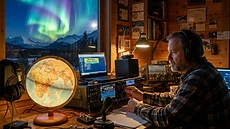
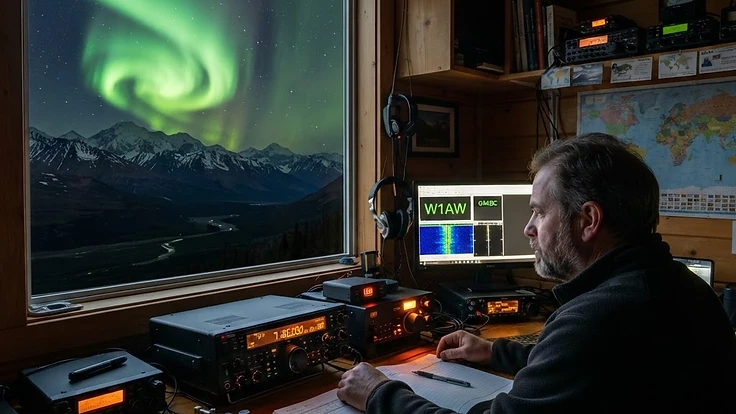
Radio operators often seek to exploit the unique conditions created by high-latitude geomagnetic disturbances. When a geomagnetic storm intensifies, the ionosphere undergoes radical structural changes, creating opportunities for long-distance communication that would otherwise be impossible. Understanding which frequencies perform best during these events requires a grasp of how ionised particles interact with the upper atmosphere.
HF Radio Conditions
Powered by Flarient — embed this on your site →
The Science Behind It
During periods of high solar activity, charged particles from the sun stream into the Earth's magnetic field, channelling towards the poles. This influx of energy creates the aurora, which is the visible manifestation of intense ionisation in the E and F layers of the ionosphere. This ionisation provides a reflective surface that can skip radio waves far beyond the normal line of sight.
Lower frequencies typically suffer from increased absorption during these events because the ionised layers become opaque. Operators often find that frequencies in the 10 metre to 20 metre bands offer the most reliable paths when the ionosphere is sufficiently disturbed to support signal refraction. Signals hitting the auroral curtain often experience a phenomenon known as flutter fading, which gives audio a distinct robotic quality.
Real-World Implications
Geomagnetic disturbances do more than shift radio propagation paths. They introduce significant noise and signal degradation for terrestrial systems that rely on stable ionospheric layers. When the G-scale climbs into the higher categories, the resulting currents can induce surges in power grids and interfere with satellite navigation systems.
For radio amateurs, these events are both a challenge and a reward. Precise frequency selection allows for communication paths that bypass traditional skywave limitations. Learning to read the signals in the storm leaderboard helps operators distinguish between favourable conditions and a total blackout.
Researching sunspots and their role in shaping space weather is an excellent way to understand these cycles in detail.
What You Can Do
To master auroral propagation, you must monitor real-time data to anticipate when the conditions are ripe for long-range contacts. Tools like the local aurora forecast help you identify if the auroral oval is positioned to enhance your specific signal path. Many enthusiasts choose to participate in guided aurora tours across Iceland, Norway, Canada, and Alaska, which offer unique opportunities to witness the source of this interference firsthand while experiencing the beauty of the high-latitude sky.
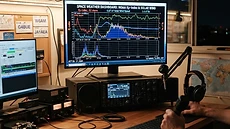
You can also enhance your own station by using embeddable widgets to track solar activity directly on your equipment console. Staying updated with the NOAA SWPC data provides the essential context needed to make informed decisions about which band to prioritise.
Preparation is the difference between missing an opening and making a rare contact.
Key Takeaways
Successful radio communication during geomagnetic events relies on adaptability. While lower bands often fail due to absorption, higher frequencies provide a window into the auroral zone when the ionosphere is correctly charged. Always keep a close eye on the Kp index to gauge the timing of these ionospheric shifts.
By staying informed and utilising the right tracking tools, you turn a period of atmospheric volatility into a productive session for long-distance signalling. Exploring our glossary can also help you brush up on the terminology needed to interpret complex space weather reports. Remember that knowledge of solar behaviour is the best tool in any operator's kit.
People Also Ask
Why do radio signals fade during a geomagnetic storm?+
Signals fade because the intense ionisation in the upper atmosphere causes rapid fluctuations in the refractive index of the ionosphere. This variation creates multipath interference and signal absorption, which listeners hear as a distinct, rapid flutter or distorted audio quality often called auroral flutter.
What is the best time of year for auroral radio propagation?+
The best time often coincides with the equinoxes in March and September. During these periods, the Earth's magnetic field orientation is most favourable for coupling with the solar wind, leading to more frequent and intense geomagnetic storms that enhance radio propagation at high latitudes.
Can I use HF radio to listen to the aurora?+
Yes, you can hear the effects of the aurora on the HF bands. When an auroral event occurs, the ionosphere becomes highly reflective and turbulent. Tuning into these frequencies during a storm will reveal an characteristic, metallic sounding distortion on signals as they bounce off the moving auroral structures.
Continue Reading