Space Debris Poses a Growing Challenge to Orbital Safety
Human activity in low Earth orbit has left behind a growing cloud of fast-moving scrap. Understanding the risks of space debris is essential for protecting the technology we rely on every day.
Space Debris Poses a Growing Challenge to Orbital Safety
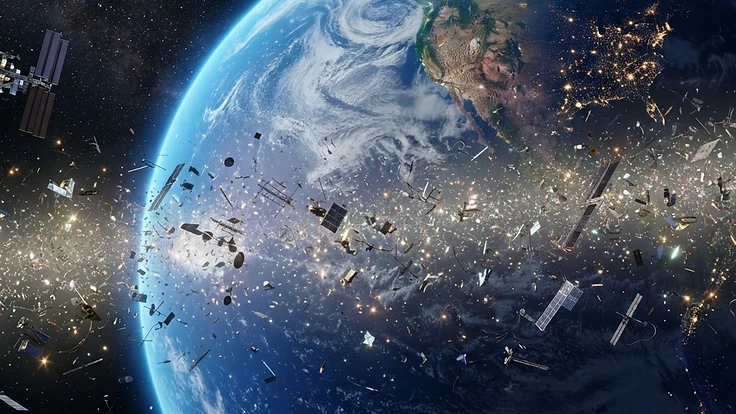
Space debris consists of defunct human-made objects in orbit around the Earth. These objects range from massive spent rocket stages to tiny paint flecks that have chipped away over years of exposure. While space seems empty, the regions around our planet are increasingly crowded with this discarded hardware.
This accumulation of material creates a long-term hazard for active spacecraft and satellites. As we rely more heavily on space-based infrastructure, managing the orbital environment becomes a critical necessity. We must understand the nature of this problem to ensure the future viability of space exploration and communication.
The Science Behind It
Objects in low Earth orbit travel at immense velocities, often exceeding 7 kilometres per second. At these speeds, even a collision with a bolt or a small fragment of metal can cause catastrophic damage to an operational satellite. You can find more detail on these mechanics in our deep dive on the incredible velocity of orbital debris.
When a collision occurs, it often generates a massive number of smaller fragments. Each new piece of debris then becomes a potential projectile, creating a cycle known as the Kessler Syndrome. This cascading effect threatens to make certain orbital altitudes unusable for future missions.
Because objects in space are not subject to the friction of the atmosphere, they remain in orbit for decades or even centuries. Low Earth orbit, where the International Space Station travels at roughly 408 km, is particularly susceptible to this buildup. You can learn more about how space debris frequently re-enters the Earth atmosphere to understand the natural decay process.
Real-World Implications
Modern life depends on satellites for global positioning, weather monitoring, and high-speed communication. The presence of orbital debris forces operators to perform constant manoeuvres to avoid potential impacts. This burns precious fuel and shortens the operational lifespan of critical missions.
If the density of debris continues to rise, the risk to human spaceflight will also grow. We have seen how complex the environment is when looking at the diverse network of satellites operating in near-Earth space. Protecting this environment is essential for the future of global connectivity.
Beyond immediate collision risks, we must also consider the broader impacts on space situational awareness. Monitoring these objects requires robust ground-based tracking systems and international cooperation. A major collision event could disrupt services that millions of people use every single day.
What You Can Do
Staying informed is the first step toward understanding the challenges facing our orbital environment. You can consult the glossary to familiarise yourself with the terminology used by space agencies like ESA and NASA when discussing orbital safety.
Understanding these terms helps clarify how organisations track objects.
Flarient offers tools that allow you to track the current state of our orbital environment. You can utilise our live dashboard to see how different space events, from solar activity to general orbital traffic, are monitored in real time. For those interested in sharing this data, our embeddable widgets provide a simple way to integrate these insights onto your own site or platform.
Key Takeaways
Space debris is a permanent consequence of decades of human space activity. While the orbital environment remains functional, the accumulation of high-speed fragments requires vigilant monitoring and international collaboration to prevent future collisions. This is a solvable challenge, provided we continue to advance our tracking technology and responsible space operations.
By staying informed about the activity in our skies, we contribute to a more sustainable future for space exploration. Keeping a pulse on our orbital surroundings ensures that we continue to benefit from the satellites we have launched into the stars. We must treat the space environment as a finite and valuable resource for the generations to come.
People Also Ask
How much space debris is currently in orbit?+
There are tens of thousands of tracked objects larger than 10 centimetres, along with millions of smaller fragments. Because of the vastness of space, tracking every single piece is difficult, but monitoring the larger objects remains the primary focus for safety agencies worldwide.
Can space debris fall back to Earth?+
Yes, space debris frequently re-enters the Earth atmosphere. Most of these objects burn up due to the intense friction and heat encountered during descent. Very few pieces reach the surface, and they are generally monitored by space agencies to ensure ground safety.
What is the Kessler Syndrome?+
The Kessler Syndrome is a theoretical scenario where the density of objects in low Earth orbit is so high that collisions between objects cause a cascade. Each collision creates more debris, which then increases the probability of further impacts, potentially rendering certain orbital shells unusable.
Continue Reading
Forecast These Questions
View all →Express your probability on these active forecast questions.