The Scientific Framework for Identifying Extraterrestrial Life
Evidence of alien life will likely emerge from subtle atmospheric signatures rather than contact, requiring a rigorous application of chemistry and physics to interpret the data.
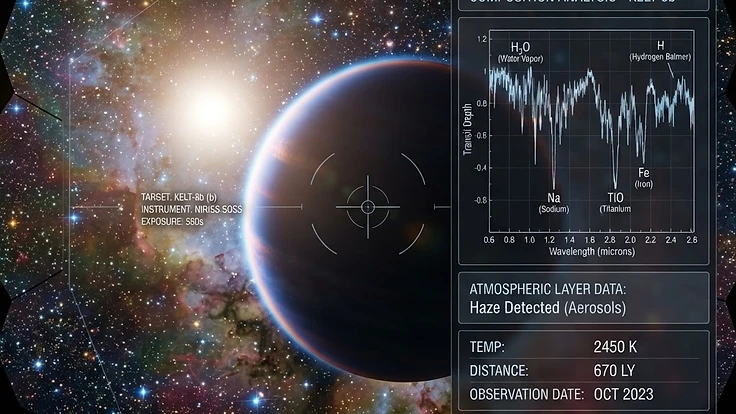
Evidence of Extraterrestrial Life Relies on Atmospheric Chemistry
The search for life beyond Earth remains one of the most compelling challenges in modern science. Rather than anticipating direct communication, researchers focus on identifying biosignatures, which are chemical imbalances in an atmosphere that cannot be explained by non biological processes.
This approach mirrors the The Science of Searching for Extraterrestrial Intelligence framework, where we analyse distant worlds for patterns that suggest biological activity. We look for specific combinations of gases that act in concert to maintain a planetary environment far from chemical equilibrium.
The Science Behind It
Life fundamentally alters its environment by cycling carbon, oxygen, and nitrogen. On Earth, the presence of atmospheric oxygen alongside methane provides a clear indicator of biological metabolism, as these two gases react and disappear quickly without constant replenishment.
Detecting such signatures requires precise spectroscopy to analyse the light passing through a planet's atmosphere. Researchers use tools like solar imagery techniques to isolate faint signals from the glare of host stars, applying principles from the glossary to ensure data accuracy.
Real-World Implications
Confirming life elsewhere would fundamentally shift our understanding of our place in the universe. It would force a reassessment of evolutionary biology and suggest that the conditions for life are common, potentially transforming how we approach space programs and long term exploration goals.
Technological advancements in infrared and ultraviolet detection remain critical to this search. These tools help us build a storm leaderboard of habitable zones, categorising planets by their likelihood of supporting complex chemistry while keeping track of orbital stability.
What You Can Do
You can track the data that informs our search for habitable environments by observing how stars influence their planets. Monitoring the geomagnetic storm activity of our own star provides insight into how space weather impacts atmospheric retention on other worlds.
Tools like Flarient allow you to monitor these variables easily. You can check the [local aurora forecast](/#local) to see how particles interact with our own magnetic field, or use embeddable widgets to track data trends that scientists use to model planetary resilience across the galaxy.
Want the aurora without the homework? Guided aurora tours in Finland, Norway and New Zealand's Stewart Island put a local expert between you and the forecast.
Key Takeaways
Identifying life requires moving beyond the search for intelligent signals toward a deeper understanding of chemical markers. By focusing on planetary atmospheres, we build a robust method for detecting biological influence across vast distances.
This ongoing effort relies on the same rigorous data analysis used to track local space weather. Whether observing the aurora or deep space signals, the primary task remains the careful interpretation of complex, subtle environmental data.
People Also Ask
What is a biosignature in astrobiology?+
A biosignature is any substance, structure, or phenomenon that provides scientific evidence of past or present life. In astronomy, these are typically specific chemical compounds in a planet's atmosphere, such as the simultaneous presence of methane and oxygen, which suggest active biological processes rather than volcanic or chemical equilibrium.
Why is the search for life focused on the habitable zone?+
The habitable zone, often called the Goldilocks zone, is the orbital range around a star where temperatures allow liquid water to exist on a planet's surface. Liquid water is considered a universal solvent and a prerequisite for life as we understand it, making it the primary target for atmospheric study.
Could life exist without oxygen?+
Yes, life on Earth existed for billions of years in an anaerobic state. Scientists search for a variety of markers, including methane, phosphine, and other non-standard atmospheric ratios, ensuring that the search for extraterrestrial life is not overly biased toward Earth-like conditions.
Continue Reading
Forecast These Questions
View all →Express your probability on these active forecast questions.