
The Velocity of Coronal Mass Ejections Through Space
Coronal mass ejections are massive solar eruptions that can travel at speeds of up to 3,000 kilometres per second. Understanding their movement is essential for predicting impacts on our technology.
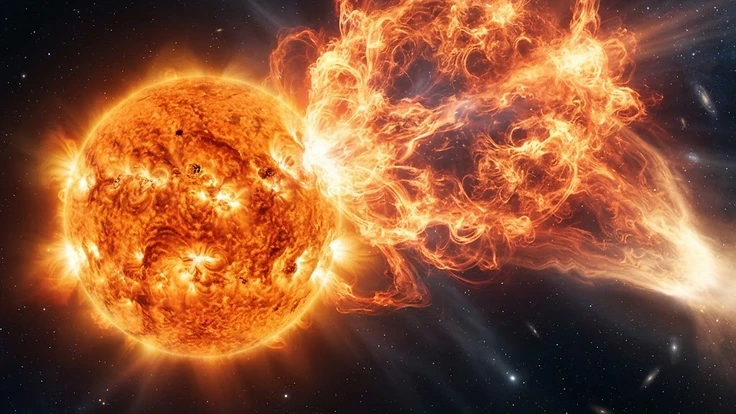
Coronal Mass Ejections Travel at Diverse Speeds Through Space
Solar activity shapes the environment of our entire solar system. Among the most potent phenomena are coronal mass ejections, which involve the expulsion of billions of tonnes of plasma and magnetic fields from the sun into interplanetary space.
These eruptions represent a fundamental driver of space weather. Tracking their velocity is essential for scientists who model the potential interaction between solar plasma and our planetary magnetosphere.
The Science Behind It
The speed of a coronal mass ejection varies significantly depending on the initial conditions of the eruption. While typical solar wind moves at a relatively steady pace between 400 and 700 kilometres per second, these explosive ejections can reach far greater velocities.
In extreme cases, a coronal mass ejection can travel as fast as 3,000 kilometres per second. Most events, however, fall into a lower range, often starting fast and decelerating as they move through the interplanetary medium.
Physics dictates that these clouds of plasma expand as they travel. This expansion is governed by the magnetic pressure within the eruption and the surrounding ambient solar wind, a process that researchers analyse using advanced numerical modelling.
Because light travels at approximately 300,000 kilometres per second, the electromagnetic radiation from a solar flare arrives minutes before the physical plasma cloud. This timing difference allows for early warning systems to operate.
Real-World Implications
The impact of these events on Earth is categorised by the G-scale, which maps the intensity of the resulting geomagnetic disturbance. High-speed ejections can cause significant disruptions to satellite operations and power grids.
When a fast-moving cloud of charged particles slams into the Earth, it creates a geomagnetic storm. This activity leads to the aurora, which can be seen at lower latitudes depending on the magnitude of the disturbance.
Beyond visual beauty, these storms induce electrical currents in long-distance pipelines and high-voltage transmission lines. Understanding the arrival time of such events is a primary defence for critical infrastructure providers.
You can learn more about the mechanics of these events by studying the [The Mechanics of Solar Flare Formation](https://flarient.com/blog/the-mechanics-of-solar-flare-formation-gvug).
What You Can Do
Staying informed about solar activity requires access to reliable data. You can monitor the arrival of these events using Flarient's [local aurora forecast](/#local) to see if you are in a position to witness geomagnetic activity.
For those planning travel to high-latitude destinations like Iceland, Norway, Canada, or Sweden, taking advantage of professional guided aurora tours ensures you have the best chance to see the lights under expert guidance. These tours combine scientific insight with local knowledge to track cloud cover and geomagnetic conditions.
If you run a website or a technical community, you might consider using embeddable widgets to share real-time solar data with your audience. Having quick access to the latest imagery via solar imagery libraries also helps in contextualising current solar activity.
Key Takeaways
Coronal mass ejections remain one of the most dynamic forces in our solar system. While they can travel at thousands of kilometres per second, their impact is mediated by the complex magnetic interactions between the solar wind and Earth.
Regularly reviewing past events helps us better understand the cyclical nature of these storms as we navigate Solar Cycle 25. By staying prepared and informed, we can mitigate the risks these solar eruptions pose to our technology-dependent society.
People Also Ask
What happens when a CME hits Earth?+
When a coronal mass ejection reaches Earth, it interacts with the magnetosphere, causing geomagnetic storms. These storms can disrupt high-frequency radio communications, satellite electronics, and navigation systems. They also intensify auroral displays near the poles and can induce dangerous currents in power grids and long-distance pipelines.
How long does it take for a CME to reach Earth?+
The travel time for a coronal mass ejection varies based on its initial speed and how much it decelerates. Extremely fast events can arrive in less than 24 hours, while slower ones may take three to four days to cover the 150 million kilometres from the sun to Earth.
Are CMEs the same as solar flares?+
No, they are distinct. A solar flare is a sudden flash of increased brightness and intense electromagnetic radiation. A coronal mass ejection is a massive physical eruption of solar plasma and magnetic fields. While they often occur together, they are independent events with different physical characteristics and travel speeds.
Continue Reading
Forecast These Questions
View all →Express your probability on these active forecast questions.
Related Articles

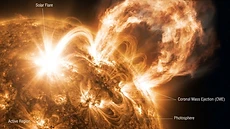
Distinguishing Between Solar Flares and Coronal Mass Ejections
2026-10-18 · 5 min read

How Scientists Predict CME Arrival Times at Earth
2026-10-07 · 5 min read

Scientists Predict CME Arrival Times Using Advanced Modelling
2026-10-03 · 5 min read