Scientists Predict CME Arrival Times Using Advanced Modelling
Predicting the arrival of Coronal Mass Ejections requires precise space weather modelling. Learn how scientists track these solar events and why timing matters for Earth.
Scientists Predict CME Arrival Times Using Advanced Modelling
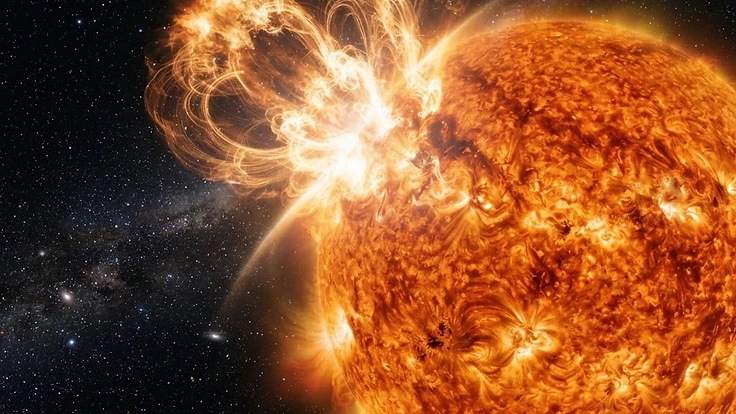
When a massive eruption occurs on the Sun, it sends billions of tonnes of plasma hurtling through space. These Coronal Mass Ejections, or CMEs, can travel at speeds reaching 3,000 kilometres per second. Predicting their arrival time at Earth is essential for protecting the technology that powers modern life.
Scientists rely on a global network of space observatories to monitor solar activity. By analysing data from missions such as the Solar and Heliospheric Observatory, experts can track the expansion of these clouds across the solar system. This process requires a sophisticated blend of observational data and physical modelling to ensure accuracy.
The Science Behind It
The prediction process begins the moment an eruption is detected. Satellites equipped with coronagraphs block the bright light of the Sun, allowing researchers to see the faint solar corona and the ejected plasma. This early solar imagery is the first step in determining the size and velocity of the blast.
Scientists then feed this information into numerical models. These simulations account for the background solar wind, which typically moves at 400 to 700 kilometres per second. The interaction between the dense, fast CME and the background solar wind determines how the structure changes during its journey.
Modelling the complex magnetic fields within the ejecta remains a significant challenge. If the magnetic orientation of the CME opposes Earth's magnetic field, the resulting impact can trigger a powerful geomagnetic storm. These interactions are fundamental to understanding the solar cycle and its impact on space weather.
Real-World Implications
When a CME hits our magnetic field, it creates a geomagnetic storm. These events are measured using the G-scale, which categorises impacts from G1 to G5. A significant storm can induce currents in long-distance power lines, potentially disrupting electrical grids across entire continents.
Satellite operations are also vulnerable to these sudden energy shifts. Spacecraft at higher altitudes may experience increased atmospheric drag, forcing operators to adjust orbits to avoid collisions. This is similar to the precision required when tracking the International Space Station in real time.
Communication systems, particularly high-frequency radio and satellite-based navigation, suffer from ionospheric interference during these storms. If the disturbance is severe enough, it can degrade the signals that aircraft and shipping rely upon. Maintaining robust data in our glossary helps infrastructure managers prepare for these risks.
What You Can Do
Staying informed about solar activity does not require a degree in astrophysics. You can monitor current conditions using a [local aurora forecast](/#local) to see if you are in a prime position for sightings. If you are planning an adventure, keep in mind that guided aurora tours in countries like Iceland, Norway, and Canada can help you find clear skies during peak activity.
If you run a website or blog, consider using embeddable widgets to keep your audience updated on real-time solar events. These tools provide instant visual updates on the state of the solar wind. Staying prepared means understanding that space weather is a constant, dynamic force.
Key Takeaways
CME prediction is a vital scientific endeavour that safeguards our technological foundation. While our models continue to improve, the sheer unpredictability of the Sun ensures that space weather will always present a challenge. We have come a long way since the Carrington Event of 1859, but the stakes remain high.
By leveraging international collaboration and advanced computing, we move closer to perfect arrival forecasts. Understanding these cycles helps us appreciate our place in a volatile solar system. Keep learning about the forces that shape our environment by exploring our blog for further deep dives.
People Also Ask
What is the difference between a solar flare and a CME?+
A solar flare is an intense burst of radiation caused by magnetic field reconnection on the Sun. A Coronal Mass Ejection, or CME, is a massive release of plasma and magnetic field material into space. While they often occur together, they are distinct phenomena with different impacts.
How long does it take for a CME to reach Earth?+
Travel times for a CME vary depending on their speed and interaction with the solar wind. Fast-moving CMEs can reach Earth in as little as 15 to 18 hours, while slower ones might take several days. On average, most Earth-directed CMEs arrive within two to three days of the initial eruption.
Can CMEs destroy the internet?+
While a minor CME is unlikely to cause widespread damage, an extreme geomagnetic storm could potentially disrupt undersea cables and satellite systems that form the backbone of the internet. This could lead to long-term outages and significant economic disruption, though modern grids are increasingly designed with some level of defence.
Continue Reading
Forecast These Questions
View all →Express your probability on these active forecast questions.