Tracking the International Space Station in Real Time
Discover how to locate the International Space Station as it streaks across the night sky, and learn the science behind its continuous orbit around Earth.
Monitoring the International Space Station Above Us
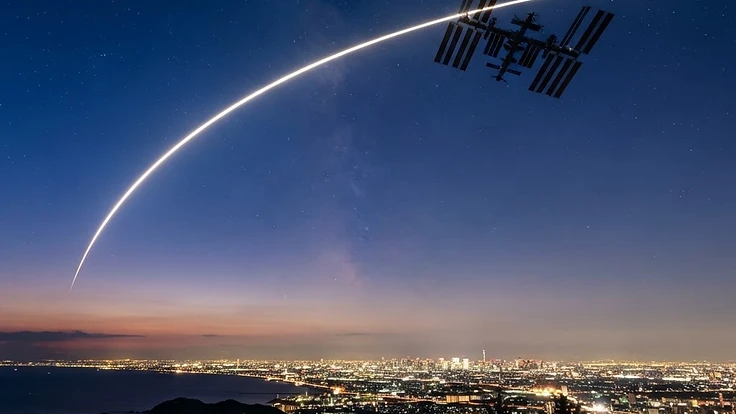
The International Space Station is a brilliant point of light often visible to the naked eye as it cruises across the heavens. Orbiting Earth at an altitude of roughly 408 kilometres, this massive laboratory serves as a beacon of human ingenuity and international cooperation. Observing it requires little more than knowing where and when to look, yet the experience connects us directly to the reality of life in low Earth orbit.
Tracking the station transforms our perception of the sky from a static backdrop into a dynamic arena of human activity. Whether you are a casual observer or a dedicated enthusiast, understanding how to follow this marvel helps ground your perspective in the actual mechanics of space flight. The station moves at approximately 7.66 kilometres per second, completing an orbit roughly every 90 minutes.
This high velocity is essential to maintain its position above our planet, as explained in our guide on the mechanics of sustained orbital motion.
The Science Behind Its Constant Motion
To understand how we track the station, one must first grasp the physics of its trajectory. The station remains in constant freefall, balanced by the velocity required to maintain a stable path that follows the curve of the Earth. It does not simply float, rather, it travels at such a high speed that as it falls toward the planet, the planet curves away beneath it.
This balance is maintained through precise orbital mechanics. Because the station orbits at a significant velocity, it experiences periodic atmospheric drag that gradually lowers its altitude over time. Mission controllers perform regular reboost manoeuvres to compensate for this drag, ensuring the laboratory remains at its target height.
You can explore how these complex manoeuvres are managed in our article about navigating cislunar space requiring complex precision.
Tracking data relies on these orbital parameters, which are published as two-line element sets. These sets allow computers to calculate the exact position of the station at any given second. While the station is quite large, its visibility depends entirely on it being illuminated by the sun while the observer on the ground remains in darkness.
This is why sightings typically occur near dawn or dusk.
Real World Implications of Orbital Activity
The presence of the International Space Station highlights the importance of space weather monitoring for orbital safety. Just as we monitor the [K-index and geomagnetic storm strength](/ #kp) to protect satellites, tracking the station involves observing the space environment for potential hazards. Solar activity, such as coronal mass ejections, can expand the upper atmosphere and increase drag on orbiting objects.
Understanding the space environment is vital for maintaining reliable infrastructure. Space weather phenomena can disrupt communications and power grids, as discussed in solar flares regularly impacting Earth's environment. While the station has robust shielding, crews monitor radiation levels closely during periods of heightened solar activity.
This proactive approach mirrors how we monitor other threats, such as when scientists assess a [near-Earth asteroid](/ #asteroids) for potential close approaches.
Practical Steps for Successful Sightings
Finding the station starts with selecting a location with a clear, unobstructed view of the horizon. You do not need expensive equipment to see the station, as it often appears brighter than even the brightest stars in the night sky. Many digital platforms now offer live tracking that accounts for your specific coordinates, making it simple to plan your next observation.
If you want to integrate these updates into your own website or dashboard, you can utilise various embeddable widgets that display real time orbital data. These tools often pull information directly from sources like NASA, providing accurate predictions for passes over your house.
Many enthusiasts also enjoy using tools that monitor the [local aurora forecast](/ #local) simultaneously, as high latitude observers might catch a glimpse of the station during a display of the [aurora](/ #aurora).
For those who prefer experience over apps, guided aurora tours in Tromsø, Abisko and the Kola Peninsula combine local dark-sky knowledge with on-the-night forecasting.
Key Takeaways for Every Observer
Tracking the International Space Station is an accessible way to engage with orbital science. By observing the station, you are witnessing the result of thousands of calculations and the dedicated work of scientists across the globe. It serves as a reminder that we live in an interconnected era where humanity maintains a permanent, occupied presence in space.
Always ensure you verify your viewing window with current data to account for orbit adjustments. As you continue your interest in the skies, consider checking our glossary for further definitions of orbital terms or exploring our archive for historical flight context. The sky is a vast laboratory, and the station is merely the most prominent of many objects travelling above our heads.
People Also Ask
Why is the ISS only visible at certain times?+
The ISS is only visible when the station is in sunlight but the observer on the ground is in darkness. Because the station orbits the Earth so quickly, these windows of opportunity are brief and specific to your geographic location, typically occurring near dawn or dusk.
How fast does the International Space Station travel?+
The International Space Station travels at an average speed of approximately 27,600 kilometres per hour, or about 7.66 kilometres per second. At this velocity, the station completes a full orbit around the Earth roughly every 90 minutes, covering the circumference of the planet in less than two hours.
Can I see the ISS without a telescope?+
Yes, the ISS is easily visible to the naked eye. It appears as a bright, steady white point of light that moves across the sky much faster than an aeroplane. Unlike stars, it does not twinkle, and its motion is smooth and continuous until it disappears into the Earth's shadow.
Continue Reading
Forecast These Questions
View all →Express your probability on these active forecast questions.