
The Mechanics of Orbital Motion
Satellites remain in orbit by balancing speed and gravity. Discover the physics that keeps our technology operational in the vacuum of space.
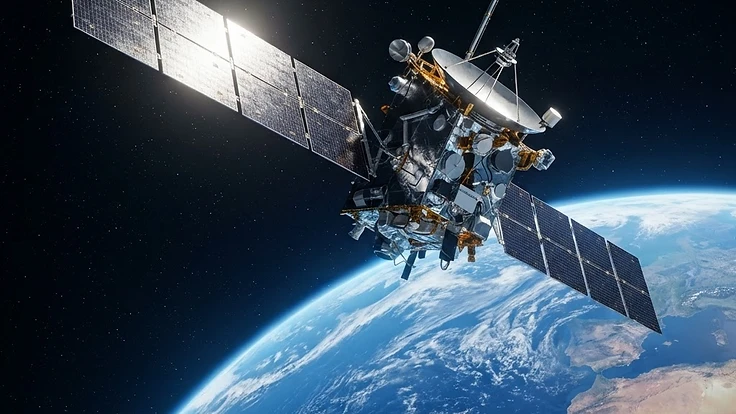
Satellites Maintain Orbit Through Perpetual Free Fall
High above the atmosphere, thousands of satellites circle the Earth. They remain in position not because they are anchored, but because they are caught in a permanent state of falling around the planet.
This dance of motion allows our modern world to function. Understanding the balance between velocity and gravity reveals why these machines do not simply drift away into the void or crash back to the surface.
The Science Behind It
Gravity acts as a constant tether pulling a satellite toward the centre of the Earth. If a satellite were stationary, it would fall straight down like a stone, crossing the Kármán line and eventually burning up in the atmosphere.
To counteract this, engineers accelerate satellites to immense speeds. When a satellite travels fast enough, the curvature of its path matches the curvature of the Earth itself.
Isaac Newton first conceptualised this effect through a thought experiment involving a cannonball fired from a mountain top. If fired at the right velocity, the projectile would miss the horizon as it fell, effectively circling the globe.
Modern craft like the International Space Station, orbiting at approximately 408 km, must maintain a velocity of roughly 28,000 km/h to stay aloft. At this speed, the satellite is constantly falling, yet it never reaches the ground because the planet curves away beneath it.
Real-World Implications
While this orbital motion seems stable, it faces constant disruption. Solar weather can heat the upper atmosphere, causing it to expand and increase drag on low Earth orbit satellites.
This drag slows craft down, causing them to lose altitude over time. Engineers must periodically perform manoeuvres to maintain their stations, as explored in articles like Engineers Harden Spacecraft Against the Harsh Realities of Solar Weather.
Beyond drag, we must also consider space debris, which turns high speed travel into a significant safety hazard. A tiny fragment hitting a satellite at orbital velocity can cause catastrophic damage due to the kinetic energy involved.
Tracking these objects is essential for the longevity of our orbital infrastructure. You can follow how experts handle these risks by tracking satellites in real time.
What You Can Do
Space is a dynamic environment that requires monitoring to ensure our technologies remain safe. You can stay informed by checking the current state of the space environment on the Flarient live dashboard.
If you are interested in the broader context of space hazards, you might also look into the history of orbital events in our archive. Keeping an eye on how our infrastructure behaves during solar events helps demystify the complex interactions between the Sun and our orbiting hardware.
Educating yourself on the terminology used in orbital mechanics is another helpful step. Visit our glossary to learn the precise meanings behind terms like perigee, apogee, and orbital inclination.
Key Takeaways
Satellites stay in orbit by achieving a precise balance between gravity and forward velocity. This state of constant free fall is a feat of engineering that powers everything from communication networks to weather monitoring.
While the physics remains elegant, the environment is harsh and subject to constant change. By staying informed about solar impacts and orbital hazards, we can better appreciate the invisible infrastructure that connects our world.
People Also Ask
Do satellites ever run out of fuel?+
Yes, satellites carry limited fuel for station-keeping and altitude adjustments. Once they exhaust their propellant, they can no longer maintain their precise orbit, leading them to eventually decay and re-enter the atmosphere. Some modern missions are now testing robotic refuelling or de-orbiting technologies to extend their operational lifespan.
What is the Kármán line?+
The Kármán line is an internationally recognised boundary at 100 kilometres above sea level. It is widely considered the threshold between Earth's atmosphere and outer space. Below this line, aviation is possible, but above it, flight becomes impossible without the speed required to achieve orbit.
Why do satellites need to be protected from space weather?+
Space weather, including solar flares and geomagnetic storms, can cause surface charging and radiation damage to sensitive electronics. High-energy particles can interfere with communication signals, degrade solar panels, and cause orbital drag by heating the upper atmosphere, which can shorten the operational life of a satellite.
Continue Reading
Forecast These Questions
View all →Express your probability on these active forecast questions.
Related Articles

Satellite Operators Use Advanced Strategies to Mitigate Space Weather Risks
2026-11-10 · 5 min read

Understanding the Mechanics of Sun-Synchronous Orbits
2026-10-16 · 5 min read

Tracking the International Space Station in Real Time
2026-10-02 · 5 min read