Space Debris Poses a Growing Threat to Modern Orbital Infrastructure
Human activity in orbit has created a cloud of high-speed junk that threatens satellites and future space travel. Understanding the risks is essential as we rely more on orbital technology.
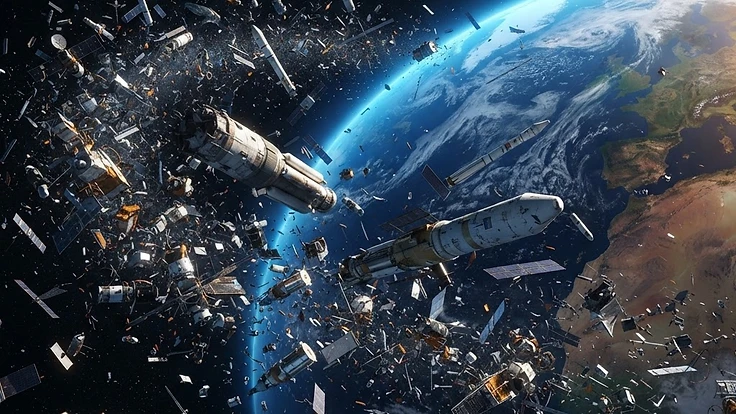
Space Debris Poses a Growing Threat to Modern Orbital Infrastructure
Earth is surrounded by an invisible, swirling junkyard. Decades of satellite launches, rocket stages, and orbital collisions have left behind thousands of fragments that continue to orbit our planet at extreme velocities.
This material is known as space debris or orbital junk. While most of it is tiny, its sheer speed makes it a significant hazard to the satellites that power our modern world. Understanding this environment is the first step toward preserving our access to space.
The Science Behind It
Space debris consists of anything man-made in orbit that is no longer functional. This includes derelict spacecraft, discarded rocket stages, and even flecks of paint shed during routine operations.
Objects in low Earth orbit travel at speeds of roughly 7 kilometres per second. At these velocities, even a tiny fragment of metal carries the kinetic energy of a bullet.
When these objects strike other satellites, they shatter into even smaller pieces. This phenomenon, often discussed in studies regarding the mechanics and consequences of orbital satellite collisions, creates a cascade effect. Each collision produces more debris, which increases the likelihood of further impacts.
This cycle is known as the Kessler Syndrome. It represents a tipping point where the density of objects in orbit becomes self-sustaining through collisions alone, eventually making certain orbital paths unusable.
Real-World Implications
Our daily lives depend heavily on an invisible network of satellites orbiting above the Kármán line. From GPS navigation and telecommunications to weather forecasting, this infrastructure is fragile.
Every time a satellite is damaged or destroyed by debris, we lose essential services. Financial markets rely on timing signals from orbit, and many emergency services depend on satellite communications for remote regions.
Beyond current operations, debris restricts our future ability to explore the stars. Just as we use tools for tracking satellites in real time, we must be aware of the congestion levels in our primary orbital shells.
Large-scale debris fields make it difficult to launch new missions safely. The threat is not just to equipment, but to the long-term feasibility of maintaining a human presence in space.
What You Can Do
While the problem of space debris is largely managed by space agencies and global organisations, individual awareness plays a role. It is important to understand the environment of near-Earth space.
You can stay informed by monitoring the state of our orbital environment through reliable [accessing reliable real-time space weather data](/blog/accessing-reliable-real-time-space-weather-data). Understanding how solar activity impacts satellite drag is part of being an informed observer of space affairs.
If you represent an organisation or run a website, consider using our embeddable widgets to display current orbital or space weather conditions to your audience. Education is the best way to foster a culture of responsible space stewardship for future generations.
We encourage those interested in the broader context of our place in the universe to browse our glossary for clear definitions of key terms. Keeping abreast of the state of our space infrastructure helps everyone appreciate the complexity of the domain above us.
Key Takeaways
Space debris is a permanent consequence of our rapid expansion into orbital space. The high speeds involved turn even small fragments into dangerous projectiles that threaten the functionality of our satellite networks.
While space agencies work on mitigation and cleanup technologies, the focus remains on preventing new debris from forming. By understanding the risks, we can advocate for better policies and practices in space exploration.
Technological progress in orbit must be matched by responsible management of the environment we create. Protecting the orbital space around Earth ensures that we can continue to rely on the technology that defines modern civilisation.
People Also Ask
How do we track space debris?+
Space debris is tracked using ground-based radar and optical telescopes. Agencies like NASA and the Department of Defence maintain catalogs of objects larger than 10 centimetres to calculate potential collision risks. Smaller debris is harder to detect, making preventative measures and shield design crucial for spacecraft safety.
Can we clean up space debris?+
Yes, various technologies are being developed for debris removal, including robotic arms, nets, and harpoons. These active debris removal missions aim to capture large, derelict satellites and de-orbit them. The challenge lies in the high cost of such missions and the technical difficulty of grabbing tumbling objects.
Is space debris dangerous to Earth?+
Very little space debris poses a threat to the surface of Earth. Most fragments burn up upon re-entry due to the intense heat caused by friction with the atmosphere. Only very large objects or heavy components have a small chance of reaching the ground, and their impact zones are closely monitored.
Continue Reading
Forecast These Questions
View all →Express your probability on these active forecast questions.