The Mechanics and Consequences of Orbital Satellite Collisions
When satellites collide in orbit, the resulting debris poses a growing challenge to space operations. Understanding the physics of these events is essential for modern space situational awareness.
The Mechanics and Consequences of Orbital Satellite Collisions
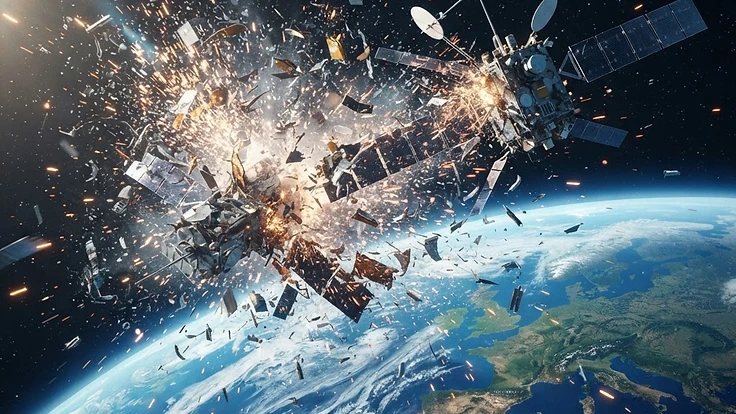
Space is vast, but the regions we rely on for global communications and navigation are increasingly crowded. When two man-made objects collide at orbital velocities, the result is not a simple fender bender. It is a high-energy event that transforms functional hardware into thousands of pieces of lethal shrapnel.
Most satellites operate in Low Earth Orbit, which is the same region that houses the International Space Station at an altitude of approximately 408 km. Because these objects travel at speeds of several kilometres per second, even a tiny piece of debris carries immense kinetic energy. A collision effectively ends the mission of both assets while creating a persistent hazard for everything else currently in orbit.
The Science Behind It
The fundamental physics of a satellite collision are governed by momentum and velocity. Because objects in orbit are travelling at thousands of kilometres per hour, the relative velocity during a head-on impact can be staggering. This energy turns metallic structures into clouds of debris, ranging from microscopic flecks of paint to massive chunks of twisted metal.
These fragments continue to travel at orbital speeds, meaning each piece becomes a new potential projectile. This process is often described as the Kessler Syndrome, where the density of objects in low orbit becomes high enough that collisions between objects cause a cascade. One crash generates debris that strikes other satellites, creating even more debris, which eventually renders specific orbital shells unusable for generations.
Space agencies like NASA and other international partners spend significant resources tracking these objects to prevent such scenarios.
By using ground-based radar and optical telescopes, they maintain a catalogue of tracked debris.
However, smaller fragments often go undetected, making the environment increasingly hazardous for all missions, including those tracking space weather impacts on satellite operations.
Real-World Implications
The most direct consequence of a satellite collision is the immediate loss of service for the satellite operators and their customers. Beyond the economic cost of replacing billions of dollars in hardware, we risk losing vital capabilities like global positioning, weather monitoring, and secure military communications. When space infrastructure fails, the disruption cascades through terrestrial systems that rely on precise timing and data signals.
Collisions also force operators to perform expensive evasive manoeuvres. Satellites must expend precious fuel to change their trajectory to avoid known debris, which shortens their operational lifespan. Frequent manoeuvres become a new normal, turning space traffic management into a delicate dance of constant monitoring and adjustment.
We must also consider the safety of human spaceflight. For astronauts living on the ISS, the presence of orbital debris is a daily concern. While small particles are mitigated by shielding, a larger collision event would force the crew to seek shelter or even evacuate if their spacecraft becomes compromised.
What You Can Do
Staying informed about the environment in space is the best way to understand the risks we face. You can monitor the state of space traffic and potential orbital hazards by observing the latest data on mission status and debris tracking. Our glossary provides essential definitions for those wanting to dig deeper into the terminology used by space professionals to describe these events.
For those interested in how space environments evolve, looking into how satellites monitor the ever changing space weather is a great starting point. Understanding the broader context of the space environment helps contextualise why we must be so careful with our assets. You can also explore embeddable widgets to keep track of critical updates directly on your own platform or website.
Key Takeaways
Satellite collisions are high-energy events that generate dangerous debris clouds, threatening the future of space exploration. The physics of orbital mechanics dictate that once a collision cascade begins, it is incredibly difficult to stop or reverse. By investing in better tracking, sustainable design, and international coordination, we can protect the orbital environment for future generations.
Space is a shared resource that requires a global commitment to safety and responsibility. As we continue to launch new satellites and expand our reach, we must ensure our practices reflect the fragility of the vacuum we operate in. Constant vigilance remains our best defence against the unintentional creation of new hazards in the night sky.
People Also Ask
What is the Kessler Syndrome?+
The Kessler Syndrome is a theoretical scenario where the density of objects in low Earth orbit is high enough that collisions between them cause a cascade. Each impact creates a cloud of debris, which in turn increases the probability of further collisions, potentially rendering orbits unusable for many years.
How do satellites avoid colliding with debris?+
Satellite operators use highly accurate tracking data from global space surveillance networks. When a potential conjunction or close approach is detected, the satellite operator fires small thrusters to perform an evasive manoeuvre, changing the satellite's velocity and altitude to ensure it passes safely away from the debris.
Does space debris fall back to Earth?+
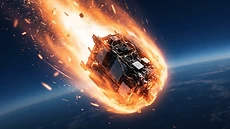
Yes, debris in lower orbits experiences atmospheric drag, which slows the objects down and causes them to descend. Most small pieces of debris burn up completely upon re-entry into the atmosphere, while larger, more robust components might survive and reach the surface, though they typically land in remote ocean areas.
Continue Reading
Forecast These Questions
View all →Express your probability on these active forecast questions.