Astrophysicists Unveil the Invisible Mechanics of Black Holes
Black holes remain some of the most mysterious objects in space. Astronomers use indirect observation and gravitational modelling to map these invisible giants.
Studying the Unseen Giants of the Universe
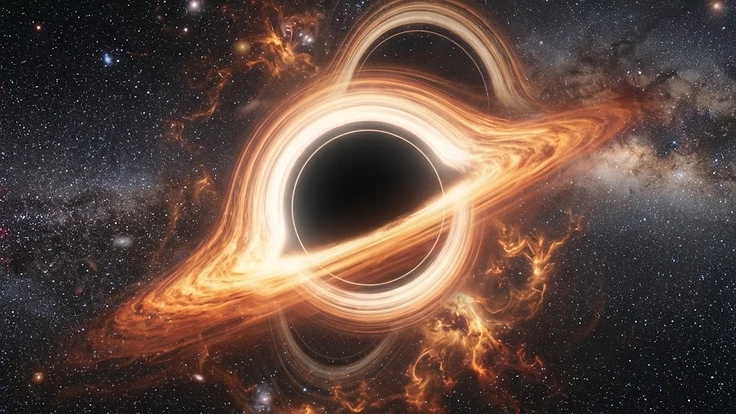
Black holes are regions of space where gravity is so intense that nothing, not even light, can escape. Because they do not emit their own light, astrophysicists cannot look at them through a standard optical telescope. Instead, they study these phenomena by analysing how gravity influences the objects surrounding them.
Understanding how these massive structures behave is vital for modern science. It allows researchers to test the limits of general relativity and our understanding of the universe. By mapping these invisible gravitational wells, we gain insight into the formation of galaxies and the life cycles of stars.
The Physics of Gravitational Detection
Astrophysicists identify black holes by observing the erratic behaviour of nearby stars and gas clouds. If a star appears to orbit an empty point in space, or if gas is seen accelerating to extreme velocities, it suggests a massive, compact object is present. This process is similar to how we measure space weather by tracking how the solar wind affects Earth magnetosphere.
Scientists also look for X ray emissions from accretion disks. As matter is pulled toward the event horizon, it heats up to millions of degrees, releasing intense energy. Using advanced sensors, researchers can create detailed images of the shadows cast by these disks.
This method has provided some of the most compelling evidence for the existence of supermassive black holes at the centre of galaxies.
Real World Implications of Spacetime Research
While black holes exist millions of light years away, the methods used to study them have direct benefits on Earth. The complex data modelling and imaging algorithms developed for black hole observation are now used in medical imaging and signal processing. These techniques help us analyse massive datasets efficiently, much like how one might use an archive of historical data to predict space activity.
Furthermore, studying extreme gravity helps refine the technology used for global satellite communications and precise navigation. When we understand how mass bends spacetime, we can better account for time dilation errors in GPS systems. This research serves as a foundation for understanding the forces that govern both the micro and macro scales of our reality.
Tools for Observing Cosmic Phenomena
If you want to track cosmic activity yourself, you do not need a professional telescope. Many enthusiasts use a digital glossary to learn the terminology of space science before diving into deeper data. Using real time monitoring tools, you can stay informed about current space conditions, which often provide a glimpse into the broader physics of our solar system.
For those who wish to share this data, setting up embeddable widgets on your own website can help others track space events easily. You can observe the patterns of solar output and gravitational interactions through public solar imagery archives. These resources bring the complexity of astrophysics to your screen, turning abstract data into an engaging and educational experience.
Not confident reading the forecast yourself? Guided Northern Lights tours across Lapland, the Yukon and the Scottish Highlands come with a local who knows the dark-sky spots and the signs of a substorm brewing.
Key Takeaways for the Curious Mind
Studying black holes is a masterclass in detective work, relying on light, gravity, and mathematics rather than direct sight. By observing how they shape their environment, we learn about the fundamental laws of nature that govern everything from stars to planetary systems. This scientific endeavour proves that we do not need to touch an object to understand its power.
As our technology improves, our ability to map the unseen reaches of the universe will only grow more precise. Whether you are tracking a distant black hole or simply checking the K-index to see if you can view the aurora tonight, you are participating in the modern practice of sky observation. We live in an age where the mysteries of the cosmos are increasingly within our reach.
People Also Ask
Can we see a black hole with a regular telescope?+
No, black holes cannot be seen directly with optical telescopes because they emit no light. Astronomers must rely on indirect methods, such as observing the orbital motion of nearby stars or the X-ray emissions from gas spiralling into the event horizon, to locate and study them.
What is an event horizon?+
The event horizon is the theoretical boundary around a black hole beyond which the gravitational pull becomes so strong that nothing, including light, can escape. Once matter or light crosses this threshold, it is permanently captured by the black hole and can no longer influence the outside universe.
How do we know black holes actually exist?+
We know they exist through years of indirect evidence, including orbital dynamics of stars near the galactic centre and the detection of gravitational waves. The first direct image of a black hole's shadow, captured by the Event Horizon Telescope, provided visual confirmation of the intense gravity predicted by general relativity.
Continue Reading
Forecast These Questions
View all →Express your probability on these active forecast questions.