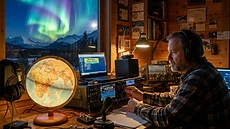
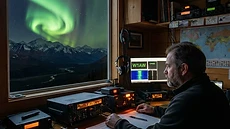
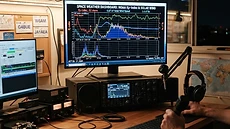
Auditory Detection of Aurora on HF Radio
Discover how the shifting energy of the auroral oval creates audible signatures on high frequency radio bands. Learn to tune in and listen to the lights.
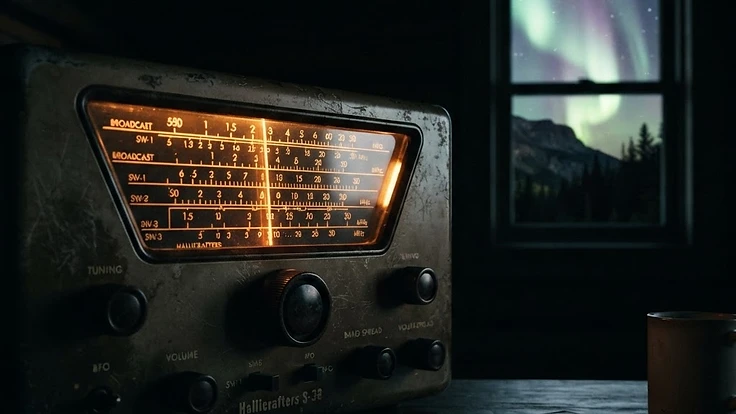
Auroral Sounds on the High Frequency Band
Most people view the aurora as a visual phenomenon, a silent dance of light across the night sky. Yet, for those equipped with a simple high frequency receiver, the sky produces a distinct and haunting auditory signature.
This sonic connection bridges the gap between Earth and the sun, turning electromagnetic interference into sound. By tuning your radio, you gain access to a different dimension of solar activity that remains hidden from the naked eye.
The Science Behind It
When charged particles from the sun strike the atmosphere, they create the aurora. This process occurs within the ionosphere, a layer of the atmosphere vital for radio wave propagation.
HF Radio Conditions
Powered by Flarient — embed this on your site →
As geomagnetic activity increases, these interactions disturb the ionosphere. The resulting turbulence manifests as radio frequency noise, which changes in pitch and intensity based on the strength of the Kp index.
Radio operators often hear this as a distinct roar or hiss. The effect is particularly pronounced during periods of high solar activity, such as those monitored while Understanding the Mechanics of Coronal Mass Ejections.
The ionosphere acts like a giant antenna, reflecting signals back to Earth. When this medium is charged by solar wind, the reflection properties shift, causing the signal to warble or fade.
Real-World Implications
This interaction is not merely a curiosity for hobbyists, as it directly impacts global communications. High frequency radio remains a critical link for aviation and maritime navigation in remote regions.
During intense geomagnetic storms, signal degradation can cause significant disruption to these essential services. You can track these historic disturbances by viewing the storm leaderboard to see how past events impacted our infrastructure.
Understanding these auditory cues helps professionals prepare for service outages. It also provides a practical lesson in how Solar Flares and Their Impact on Earth ripple through our technological landscape.
What You Can Do
To listen for yourself, tune an HF receiver to quiet, unoccupied frequencies in the 3 to 30 MHz range. You may hear atmospheric static that shifts into a rhythmic, pulsing sound during active displays.
If you prefer to see the data alongside your radio experiments, you can utilise [Essential Tools for Real-Time Space Weather Monitoring](/blog/essential-tools-for-real-time-space-weather-monitoring) to correlate your audio findings with live solar activity. For those seeking the visual counterpart to their radio findings, guided aurora tours operate in countries like Iceland, Norway, Canada, and Finland, offering a direct view of the sky.
You can even use embeddable widgets on your own website to share these live conditions with others. Keeping an eye on a local aurora forecast helps ensure you know exactly when to start your radio listening session.
Key Takeaways
The auroral oval is a dynamic engine that creates both visual beauty and radio-frequency noise. By listening to the static on your HF radio, you become a direct observer of the solar wind interacting with our planet.
This practice connects modern technology with ancient celestial rhythms. Whether you are a scientist or an enthusiast, the radio provides a unique window into the invisible forces that shape our space environment.
People Also Ask
What does an aurora sound like on a radio?+
On an HF radio, auroral activity typically sounds like a shifting, rhythmic hiss or a low-frequency roar. This is caused by the modulation of radio waves as they travel through the ionosphere, which becomes turbulent and uneven during geomagnetic disturbances.
Does the Kp index affect radio reception?+
Yes, a higher Kp index indicates increased geomagnetic activity. This often leads to increased atmospheric noise, signal fading, or complete blackouts on high-frequency bands, as the charged particles disrupt the ionospheric layers used for long-distance radio communication.
Which radio frequency is best for hearing aurora?+
The most effective frequencies for detecting auroral noise are in the High Frequency (HF) range, specifically between 3 MHz and 30 MHz. Operators usually search for empty or quiet channels where the background atmospheric hiss is stable enough to detect subtle changes.
Continue Reading