Corporate Space Weather Forecasting Services for Modern Industry
Space weather directly impacts global infrastructure. Learn which organizations and resources provide the data necessary to navigate the sun's influence on Earth's technology.
Space Weather Forecasting is Essential for Global Infrastructure
The sun remains a dynamic force that shapes the operational landscape for satellites, power grids, and aviation. While many view solar activity as a distant phenomenon, its influence on our technological systems is both constant and measurable. Industries ranging from telecommunications to energy distribution now rely on precise space weather monitoring to protect their assets from geomagnetic disruptions.
Live Solar Flare Monitor
Powered by Flarient — embed this on your site →
Businesses require specialized forecasting to mitigate risks before solar events translate into operational downtime. Understanding the solar environment allows organisations to make informed decisions about satellite manoeuvres and power grid load balancing. This field has evolved from a niche scientific endeavour into a critical component of modern risk management strategies for global enterprises.
The Science Behind Solar Dynamics
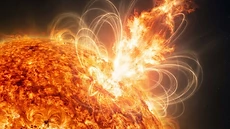
Solar activity follows an approximate 11 year cycle, marked by fluctuating levels of sunspots and eruptive events. During the peak of a cycle, the sun releases bursts of energy known as solar flares, which reach Earth at the speed of light. These events are often accompanied by coronal mass ejections, which consist of clouds of charged particles travelling through the interplanetary medium.
When these particles collide with Earth's magnetic field, they trigger geomagnetic storms, often quantified by the Kp index. These indices allow scientists to categorise the severity of disturbances that can compress our magnetosphere. The intensity of these storms is further analysed using the Dst index to measure geomagnetic storm magnitude in nanoteslas, where higher negative values indicate more intense magnetic field deviations.
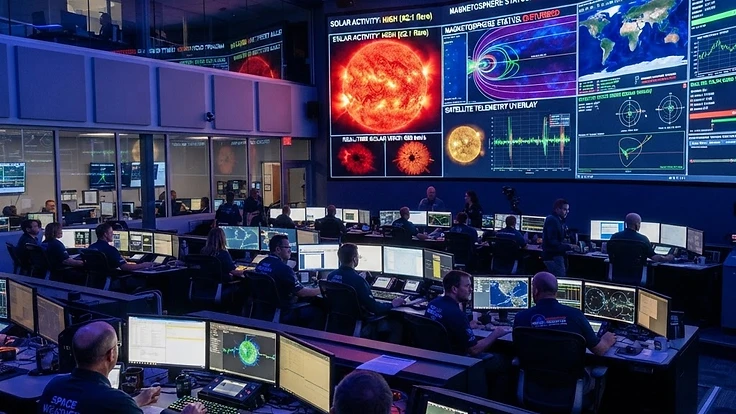
Monitoring these events requires a suite of space-based observatories that provide real-time data on plasma speed and magnetic orientation. The NASA and NOAA SWPC provide the foundational data that powers most commercial forecasting services.
By processing this telemetry, firms can build predictive models to anticipate impacts on radio communications and high-altitude flight paths.
Real-World Implications for Businesses
Geomagnetic disturbances have a tangible impact on the network of satellites orbiting our planet. Solar radiation can cause drag on satellites in low Earth orbit, altering their trajectories and shortening their operational lifespan.
Companies managing satellite constellations must receive accurate forecasts to adjust flight paths and prevent costly collisions.
Terrestrial infrastructure also faces significant vulnerabilities. Power grids are susceptible to geomagnetically induced currents during strong solar storms, which can lead to transformer failures and widespread blackouts. Furthermore, companies that rely on high-frequency radio or GPS navigation find their accuracy compromised when ionospheric conditions shift.
Experts often refer to a glossary of terms to standardise communication between researchers and industrial operators. By understanding the specific thresholds that trigger service outages, businesses can implement defensive protocols. These protocols range from temporary equipment shutdown to the rerouting of flights away from high-latitude regions where solar impact is more severe.
Preparedness and Data Access
Modern businesses do not need to build their own satellite networks to stay informed. A variety of platforms now aggregate raw scientific data into accessible, actionable insights for non-specialists. You can track current activity through professional dashboards that visualise solar imagery and particle density in real time.
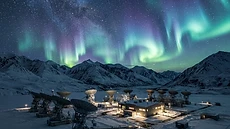
For teams working in logistics or telecommunications, embeddable widgets offer a way to bring live space weather data directly into internal monitoring platforms. If you are specifically monitoring the aurora for research or tourism, you might consider booking guided aurora tours in locations like Iceland, Norway, or Alaska to gain firsthand experience in observing these atmospheric displays.
Staying aware of these trends prevents reactionary decision-making when the sun enters a more active phase.
Maintaining a routine of checking the storm leaderboard for historical context is also valuable for long-term planning. Understanding past events helps organisations model their own risk profiles against potential future storms of similar magnitude to the Carrington Event.
Key Takeaways
Space weather forecasting has transitioned from a purely academic field to a necessity for industrial resilience. By leveraging data from major space agencies and professional monitoring tools, businesses can effectively shield their critical infrastructure from solar variability. The Kp index remains the primary metric for most users to understand current geomagnetic conditions and their potential for disruption.
Preparation is the best defence against the unpredictable nature of our star. Companies that prioritise space weather literacy in their risk management policies will remain at a distinct advantage as we continue to rely more heavily on space-based technology. Ongoing monitoring ensures that even during periods of intense solar activity, global services remain operational and secure.
People Also Ask
How do solar flares affect businesses?+
Solar flares can disrupt high-frequency radio communications, impact satellite navigation accuracy, and increase orbital drag on satellites. For power grid operators, intense geomagnetic storms caused by these flares can induce electrical currents that may damage infrastructure and cause widespread service outages.
What is the Kp index used for?+
The Kp index is a global geomagnetic activity index that ranges from 0 to 9. It measures disturbances in Earth's magnetic field, helping professionals predict the likelihood of aurora displays and potential technical disruptions caused by solar activity.
Where can businesses get reliable space weather data?+
Reliable data is primarily sourced from national and international space agencies like NASA, NOAA, and ESA. Many businesses also use private sector forecasting services that aggregate this raw data into user-friendly dashboards and alerts tailored to specific operational needs.
Continue Reading
Forecast These Questions
View all →Express your probability on these active forecast questions.