The Network of Satellites Orbiting Our Planet
Thousands of satellites currently orbit the Earth, sustaining our global communications, navigation, and environmental monitoring. Understanding this complex orbital infrastructure is essential as we rely increasingly on space-based technology.
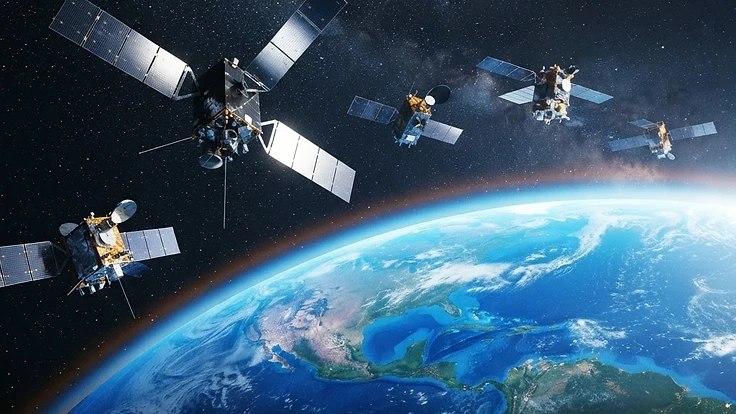
The Network of Satellites Orbiting Our Planet
Near-Earth space has become an increasingly crowded domain. From the low-altitude reaches of the International Space Station at 408 kilometres to the distant stretches of geostationary orbits, thousands of human-made objects circle our world. This infrastructure acts as the invisible nervous system for modern civilisation.
Near-Earth Asteroid Watch
Powered by Flarient — embed this on your site →
Most satellites occupy specific orbital zones tailored to their primary functions. Low Earth Orbit houses everything from Earth observation sensors to large communications constellations, while higher orbits facilitate global television broadcasts and essential weather monitoring systems. Every satellite serves a purpose, maintaining the connectivity we often take for granted.
The Science Behind It
Satellites remain in orbit due to a delicate balance between forward velocity and the downward pull of gravity. At their operational altitude, they travel fast enough to essentially fall around the curve of the Earth rather than toward it. This requires speeds of approximately 28,000 kilometres per hour in low orbits to maintain stability.
Orbital mechanics are dictated by altitude and the mission requirements of the craft. Objects in Low Earth Orbit complete a single pass around the planet in roughly 90 minutes, allowing for rapid mapping or high-resolution imagery. Conversely, geostationary satellites sit at much higher altitudes, matching the rotation speed of the Earth to remain fixed over a single geographic point.
These systems are constantly monitored for their interaction with the space environment. Solar activity can create a geomagnetic storm, causing the atmosphere to expand and creating drag on craft in lower orbits. This increases the risk of orbital decay, requiring operators to perform regular station-keeping manoeuvres to avoid re-entry.
Real-World Implications
Our daily lives depend on the continuous function of these orbital assets. GPS navigation, which relies on a precise constellation of satellites, dictates everything from financial transaction timestamps to maritime shipping lanes. Disruptions to these signals can have widespread consequences for global logistics.
Communications satellites bridge the digital divide, providing internet and telephony to remote locations where fibre optics are unavailable. Beyond consumer convenience, these assets provide essential early warning data for extreme weather events. Scientists use this solar imagery to track environmental changes and protect critical terrestrial infrastructure.
Reliance on this technology means that space weather is no longer a niche scientific concern. You can read more about how these impacts are mitigated in our guide on monitoring solar storms to protect satellite infrastructure. Keeping these systems operational ensures that global commerce and public safety are maintained during solar cycles.
What You Can Do
Understanding the space environment is the first step toward appreciating the fragility of our orbital assets. You do not need an aerospace engineering degree to track these systems or understand their behaviour. Resources like our glossary can help you decode the technical jargon often used in space operations.
If you run a website or a technical dashboard, you might consider using embeddable widgets to display real-time space data to your audience. These tools allow you to pull live feeds of orbital telemetry or environmental conditions directly onto your own platforms. It keeps your visitors informed without the need for complex data pipelines.
For those interested in the broader context of our place in the universe, exploring the Earth magnetosphere and the invisible shield protecting life offers a deeper look at the natural forces interacting with our technology. Staying informed about current conditions ensures you are prepared for how solar activity might affect your local environment.
Key Takeaways
Space is not a void but a bustling environment populated by essential human technology. From high-speed internet to precision weather tracking, our modern society relies on the satellites constantly passing overhead. These assets are subject to the same physical laws that govern the movement of planets and the near-Earth asteroid population.
As we continue to launch new constellations, the management of these orbits becomes increasingly important for long-term sustainability. Understanding the relationship between solar behaviour and satellite performance remains a vital skill for anyone tracking modern technology. By keeping an eye on the storm leaderboard, you can see how significant space weather events have influenced historical operations.
Staying educated on these systems ensures we can continue to benefit from the advantages that space exploration provides.
People Also Ask
How many satellites are currently in space?+
As of recent counts, there are thousands of active satellites orbiting Earth. This number grows rapidly due to the deployment of large communications constellations, alongside thousands of pieces of space debris which are also tracked by global space surveillance networks to prevent collisions.
What happens if a satellite gets hit by a solar flare?+
A solar flare can release intense X-rays and extreme ultraviolet radiation. While the flare itself is light, it often accompanies coronal mass ejections that cause geomagnetic storms. These storms can induce electrical currents in satellite electronics, potentially causing anomalies, signal interference, or permanent hardware damage.
How long do satellites stay in orbit?+
Orbital lifespan varies significantly based on altitude. Satellites in low Earth orbit may only last a few years before atmospheric drag causes them to re-enter. Higher satellites, such as those in geostationary orbit, can remain operational for 15 to 20 years before fuel depletion ends their mission.
Continue Reading
Forecast These Questions
View all →Express your probability on these active forecast questions.