Hohmann Transfer Orbits Explained
A Hohmann transfer orbit is the most efficient way for spacecraft to travel between two circular orbits using minimal fuel by leveraging elliptical mechanics.
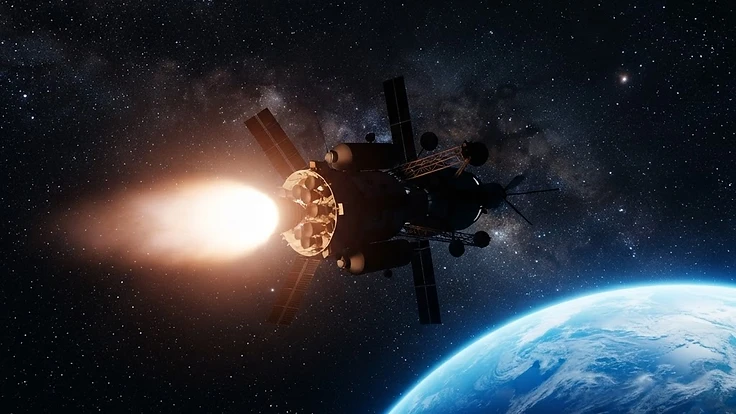
The Hohmann Transfer Orbit Defined
Space exploration relies on efficiency, as carrying fuel adds significant mass and cost to any mission. A Hohmann transfer orbit is a classic orbital manoeuvre that allows a spacecraft to move from one circular orbit to another using the least amount of energy possible.
Named after the German scientist Walter Hohmann who described it in 1925, this method remains the gold standard for orbital transfers today. By using two engine burns, a craft can transition between orbits effectively, making it a cornerstone of modern astronautics.
The Science Behind It
The fundamental principle relies on an elliptical orbit that touches both the starting orbit and the target orbit. To start the transfer, the spacecraft performs a burn to increase its velocity, which shifts its trajectory from a circle into an ellipse.
As the craft reaches the furthest point of this ellipse, it performs a second burn to circularise its path. The timing of these burns is critical because it relies on precise celestial mechanics to ensure the target destination is in the right place at the right time.
Because this method consumes the least amount of propellant, it is the primary choice for missions travelling to other planets or moving between stable satellite altitudes. While it is not the fastest way to reach a destination, the fuel savings are essential for long duration missions.
Real-World Implications
Understanding these mechanics is vital when we look at how satellites are placed in orbit or how deep space probes navigate our solar system. If we miscalculate the fuel budget for such a transfer, a mission could become stranded in space with no way to adjust its position.
This precision is a key part of how space agencies navigate the complexities of cislunar space. It also highlights why monitoring the space environment is important, as solar activity can create drag or damage hardware that relies on such exact orbital manoeuvres.
Reliability is everything in orbit, and even minor deviations in performance can lead to significant changes in a mission lifecycle. Just as solar flares can impact Earth and its technology, orbital mechanics dictate the success of every satellite currently circling our planet.
What You Can Do
If you want to track how modern spacecraft operate, you can use a glossary to learn more about the terminology used by flight dynamics teams. Keeping an eye on the archive of past mission data provides excellent context for how these transfers have been executed historically.
Space enthusiasts should also explore the space-programs section to see upcoming missions that will utilise these transfer methods. Understanding the environment is half the battle, especially since solar conditions can influence the communication signals used to command these complex orbital moves.
Key Takeaways
The Hohmann transfer orbit is a testament to the power of mathematics in solving the challenges of space travel. It proves that with precise timing and clever physics, humanity can explore the stars without needing infinite fuel supplies.
As we continue to push further into the solar system, mastering these foundational techniques remains as relevant as ever. Whether dealing with near-Earth missions or deep space exploration, the economy of movement remains the guiding principle for all successful spaceflight.
People Also Ask
Is a Hohmann transfer the fastest way to travel in space?+
No, it is not the fastest method, but it is the most fuel-efficient. While faster trajectories exist, they require significantly more propellant, which makes them expensive and impractical for most long-duration space missions that need to conserve mass and weight.
Why is the Hohmann transfer so popular in space missions?+
It is popular because it requires the minimum amount of delta-v, or velocity change, to transition between two circular orbits. By using two precise engine burns at opposite ends of an elliptical path, mission controllers can conserve fuel, allowing for heavier payloads or longer mission durations.
Can Hohmann transfers be used for interplanetary travel?+
Yes, they are commonly used to send probes from Earth orbit to other planets like Mars. By timing the launch window so the spacecraft and the target planet arrive at the same spot in space simultaneously, engineers can reach other worlds with high efficiency.
Continue Reading
Forecast These Questions
View all →Express your probability on these active forecast questions.