Sunspots and Solar Flares: The Physics of Magnetic Storms
Sunspots act as the engine for solar flares, driven by intense magnetic fields that can disrupt our technology. Learn how these dark solar features create the space weather that shapes our environment.
Sunspots as the Engine of Solar Activity
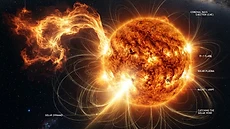
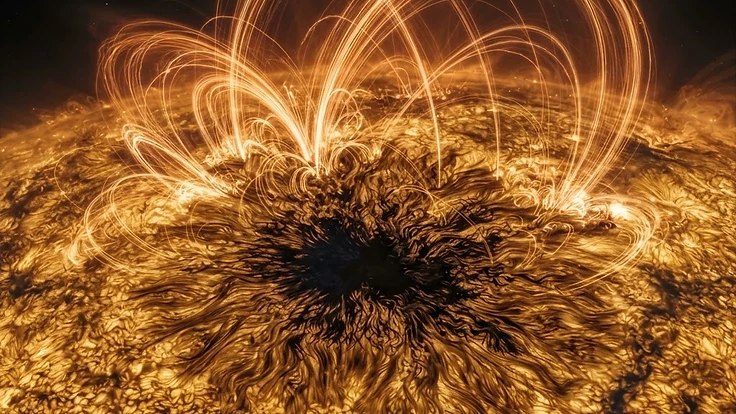
Solar flares are intense bursts of radiation originating from the Sun, yet they do not occur at random. They are intimately linked to sunspots, those dark patches on the solar surface that appear cooler than their surroundings.
Live Space Weather Dashboard
Powered by Flarient — embed this on your site →
These spots are regions where intense magnetic field lines penetrate the Sun's visible layer. As the Sun rotates, these field lines become twisted and tangled, storing massive amounts of energy that eventually snap and reconnect to release a solar flare.
The Science Behind It
The solar cycle, which lasts about 11 years, dictates the frequency of these events. During solar maximum, sunspots become plentiful, providing the magnetic fuel necessary for flares to occur.
Flares are categorised by their X-ray intensity into A, B, C, M, and X classes. Each letter represents a ten-fold increase in energy, with X-class flares being the most powerful.
When magnetic energy is released through a process known as magnetic reconnection, the Sun ejects high energy particles and radiation. This phenomenon is often documented through solar imagery provided by space agencies like NASA.
While the light from a flare arrives in roughly eight minutes, travelling at 300,000 kilometres per second, other solar material like a coronal mass ejection travels much slower. These particles can reach speeds of 3,000 kilometres per second, impacting Earth after a delay of one to three days.
Real-World Implications
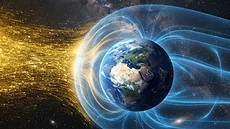
When these solar eruptions reach Earth, they interact with our magnetic field to produce a geomagnetic storm. These storms are measured by the Dst index or the G-scale, which ranges from G1 to G5.
Strong geomagnetic storms can induce currents in power grids and interfere with radio communications. You can learn more about how this impacts modern infrastructure in our article on Solar Flares and Their Impact on Power Grids.
Satellites orbiting in the thermosphere are particularly vulnerable to increased drag during these periods. This interference is also a primary driver for the aurora, as particles funnel into the poles and light up the upper atmosphere.
For those curious about the history of such events, the archive provides records of past geomagnetic disturbances. Understanding these patterns is essential for anyone operating in space or relying on satellite-dependent navigation systems.
What You Can Do
Staying informed is the best defence against space weather disruption. For those planning to chase the lights, many travellers seek out guided aurora tours in countries like Iceland, Norway, Canada, and Alaska, where the display is most vivid.
If you maintain a website or dashboard, you can use embeddable widgets to display current space weather data for your audience. Monitoring the current solar climate helps you anticipate potential disruptions to high-frequency radio and satellite services.
It is helpful to check current conditions regularly to understand how solar activity fluctuates day by day. Building this habit allows you to distinguish between minor solar wind events and major flares.
Key Takeaways
Sunspots are the fundamental drivers of solar flares, acting as concentrated magnetic anchors on the solar surface. As the Sun progresses through its cycle, monitoring these active regions becomes critical for predicting space weather.
By keeping track of solar activity, we can better protect our global infrastructure and appreciate the complex physics occurring millions of kilometres away. Understanding these mechanisms bridges the gap between solar science and our daily lives on Earth.
Whether you are a researcher or an enthusiast, the glossary offers quick definitions of these technical terms. Keeping a close watch on the Sun ensures that you are never caught off guard by the next big storm.
A closer look at the Sun
The magnetic activity described here has visible counterparts in the changing patterns of sunspots. For readers curious about observing those features for themselves, explore one way to capture the sky, using appropriate solar viewing precautions.
Ad · Affiliate link. Flarient may earn a commission if you purchase through this link, at no additional cost to you.
People Also Ask
How long does a solar flare take to reach Earth?+
The electromagnetic radiation from a solar flare travels at the speed of light and reaches Earth in approximately eight minutes. However, the associated plasma and solar particles from a coronal mass ejection take much longer, typically arriving between one and three days after the initial eruption.
Are all sunspots dangerous?+
No, not all sunspots produce major flares. The potential for a flare depends on the complexity of the magnetic field within the sunspot region. Scientists use specific classification systems to monitor these magnetic arrangements to determine which spots have the highest probability of producing significant solar activity.
What is the difference between a solar flare and a coronal mass ejection?+
A solar flare is a sudden, intense burst of radiation from the Sun's atmosphere, whereas a coronal mass ejection is a massive cloud of solar plasma and magnetic field lines. While they often occur together, they are distinct physical phenomena with different impacts on Earth's magnetosphere.
Continue Reading
Forecast These Questions
View all →Express your probability on these active forecast questions.