Solar Flares and Their Impact on Power Grids
Solar flares are powerful bursts of radiation that interact with Earth's magnetic field. While they rarely cause blackouts, understanding the risks is essential for modern grid management.
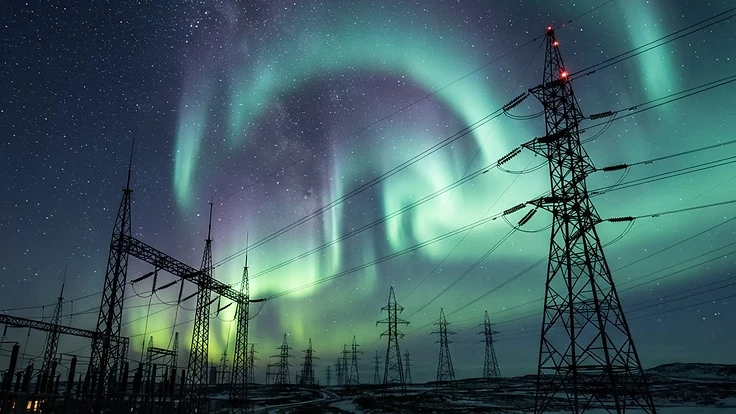
Solar Flares Pose Potential Risks to Global Power Infrastructure
Solar activity represents one of the most significant natural challenges to our interconnected modern world. While we often think of space as a distant vacuum, the Sun constantly bombards Earth with energy and particles that directly influence our infrastructure. Understanding how these solar events interact with our power systems is not merely a scientific curiosity but a necessity for long term resilience.
Live Solar Flare Monitor
Powered by Flarient — embed this on your site →
Technological progress has made us more sensitive to solar weather than ever before. As we grow our reliance on electrical grids, understanding the mechanics of these events becomes vital for engineers and the public alike. Exploring these phenomena helps us better manage our technological footprint on this planet.
The Science Behind It
The Sun operates on an eleven year cycle that dictates the frequency of its activity. Solar Cycle 25 began in December 2019, marking a period of increasing intensity in flares and coronal mass ejections. Flares are classified by their strength, with the X class representing the most powerful events.
When a large eruption occurs, high energy radiation reaches Earth at the speed of light. However, the associated plasma cloud, or coronal mass ejection, travels much slower. These clouds move between 400 and 3,000 kilometres per second, meaning they can take several days to reach us.
Once a mass ejection hits our magnetosphere, it can trigger a geomagnetic storm. You can consult our glossary for more precise definitions of these solar terms. The intensity of such a storm is measured using the G-scale, which ranges from G1 to G5.
Real-World Implications
Geomagnetic storms induce electrical currents in long, grounded structures like power lines and pipelines. These extra currents can overwhelm sensitive equipment, such as transformers, potentially leading to widespread outages. Most modern systems are designed to handle minor variations, but extreme events can pose a serious threat.
Communication networks also face interference during high energy events. You might read about how solar flares impact Earth and its technology to understand these risks in greater detail. Navigation systems and satellite operations often require temporary adjustments to maintain accuracy during solar disturbances.
Such interference is often temporary and manageable with proper shielding and operational protocols. Still, studying past events helps us model future risks more effectively. It is a balancing act between maintaining high efficiency and ensuring the safety of our infrastructure.
What You Can Do
Staying informed is the best defence against the uncertainty of space weather. You can track solar conditions in real time to understand whether current activity poses a threat to local grids. There are many ways to learn about solar physics, including monitoring solar activity through real-time tracking apps.
If you live in higher latitudes, you might also have the chance to see an aurora caused by these geomagnetic interactions. Many travellers now seek out guided aurora tours across countries like Norway, Sweden, Finland, Iceland, Canada, and Alaska.
These tours provide an expert look at the skies while safely enjoying the celestial display.
For those managing their own data or research projects, adding tools to your platform can provide valuable context for your visitors. Utilising embeddable widgets allows you to display live solar data directly on your own website. This helps build awareness and keeps your community updated on changing conditions.
Key Takeaways
Solar flares and the resulting geomagnetic storms are natural, cyclical events that interact with Earth on a regular basis. While our modern grid is vulnerable to induced currents, infrastructure remains resilient against most typical solar activity levels. Constant monitoring and rigorous engineering standards serve as our primary protection against rare, high intensity events.
By staying educated on solar cycles and utilising available data, we can better appreciate the complex relationship between the Sun and our technology. Awareness is our most powerful tool for ensuring that we remain prepared for whatever the solar cycle brings next. Keep tracking the activity to stay ahead of the weather in space.
People Also Ask
How often do severe solar flares occur?+
Significant solar activity follows an approximately eleven-year cycle. While small flares occur frequently, extreme events capable of impacting global infrastructure are rare. The frequency of these major storms depends on the peak intensity of the specific solar cycle currently in progress.
Can solar flares destroy electronics?+
Most consumer electronics are too small to be affected by the induced currents caused by geomagnetic storms. The risk is primarily directed at large-scale, long-distance infrastructure like power grids, undersea cables, and satellite arrays that can experience surges from the shifting magnetic field.
How does the Kp index work?+
The Kp index is a global geomagnetic activity index ranging from 0 to 9. It reflects the intensity of disturbances in Earth's magnetic field. A higher Kp value indicates stronger geomagnetic activity, which correlates with more intense auroral displays and a greater potential for technological interference.
Continue Reading
Forecast These Questions
View all →Express your probability on these active forecast questions.