Mastering the Science of HF Radio Propagation
Understanding high-frequency radio propagation requires navigating solar weather and ionospheric shifts. Learn how to track conditions to keep your communications clear and reliable.
Predicting HF Radio Propagation Conditions
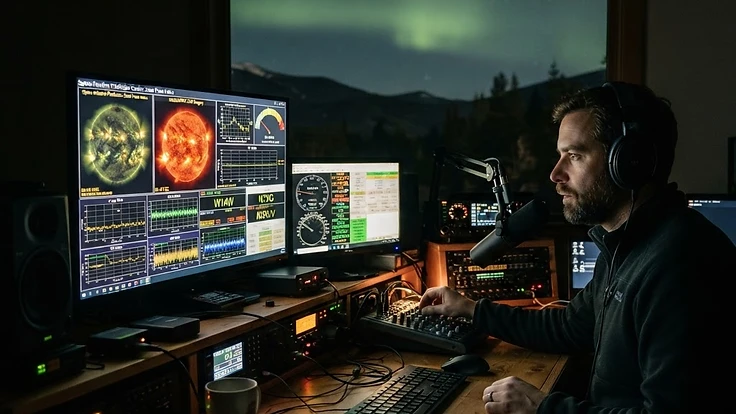
High frequency, or HF, radio communication relies on the ionosphere to reflect signals across vast distances. When the Sun is active, this layer of the atmosphere shifts, causing fluctuations that can either enhance or completely block your signal path. Understanding these changes turns radio operation from a game of chance into a reliable craft.
HF Radio Conditions
Powered by Flarient — embed this on your site →
The Science Behind It
The ionosphere is a region of the upper atmosphere ionised by solar radiation. Its density changes based on the solar cycle, which typically lasts about 11 years, dictating the maximum usable frequency for global communication. Solar flares can cause sudden ionospheric disturbances, while particles from the sun arrive as solar wind, impacting the geomagnetic field.
These impacts are often categorised by the Kp index, which measures geomagnetic activity. When solar activity spikes, the ionosphere becomes volatile, often leading to signal absorption or fading. Researchers use satellite data, such as solar imagery from the SDO, to observe the source of these disturbances.
Understanding the glossary of these terms is essential for any operator looking to improve their propagation knowledge.
Real-World Implications
Radio operators, emergency services, and aviation experts must monitor these conditions to avoid communication blackouts. During a strong geomagnetic storm, HF frequencies can experience significant attenuation, effectively muting long-range contact. This makes real-time awareness a matter of operational safety rather than mere convenience.
These conditions affect far more than hobbyist radios. They influence power grid stability and orbital satellite trajectories. As discussed in Solar Flares and Coronal Mass Ejections Are Distinct Solar Phenomena, the nature of these solar events dictates how long an interruption might last.
Tracking the storm leaderboard provides context for how extreme these events can become when the sun hits peak cycle output.
What You Can Do
To predict conditions, look for trends in the solar flux index and the current geomagnetic state. Monitoring a live feed of solar activity allows you to anticipate fades before they disrupt your contact. If you run a club website or professional portal, you can use embeddable widgets to display current propagation data to your users.
Those interested in the visual result of these ionospheric interactions can also check [local aurora forecast](/#local) data, as intense geomagnetic activity often creates visible light shows at high latitudes. For those planning an expedition, booking guided aurora tours across Iceland, Norway, Canada, or Alaska offers the best way to experience these events safely.
Always cross-reference multiple sources to form a complete picture of the current radio environment.
Key Takeaways
Predicting HF propagation is about observing the Sun to understand the Earth's ionosphere. You must pay attention to the solar cycle and geomagnetic indices to ensure your signals reach their destination. By staying informed, you gain the ability to choose the best operating bands for your specific needs.
Keep a log of your successes and failures to better understand how your equipment reacts to different solar conditions. You can even review our archive to see how past events influenced long-range communication. Mastery comes from combining real-time data with historical patterns, ensuring you stay on air regardless of what the sun throws at the planet.
People Also Ask
What is the Kp index?+
The Kp index is a global geomagnetic activity index that measures the fluctuations in the horizontal component of the Earth's magnetic field. It ranges from 0 to 9, where 0 indicates quiet conditions and 9 indicates an extreme geomagnetic storm, providing a quick reference for ionospheric stability.
How do solar flares affect radio signals?+
Solar flares emit intense X-ray and ultraviolet radiation that ionises the lower levels of the atmosphere. This increased ionisation causes radio waves to be absorbed rather than reflected, leading to sudden ionospheric disturbances that can black out high-frequency radio communications for several minutes or hours.
Why does the solar cycle matter for HF radio?+
The 11-year solar cycle dictates the amount of solar radiation reaching Earth. Higher activity during the solar maximum produces a more ionised upper atmosphere, allowing for better reflection of higher frequency radio waves, which increases the range and reliability of long-distance communication compared to the solar minimum.
Continue Reading