Predicting the Visibility of the Aurora Borealis
Understanding the conditions required for northern lights visibility helps observers plan for successful nights under the stars.
Predicting the Visibility of the Aurora Borealis
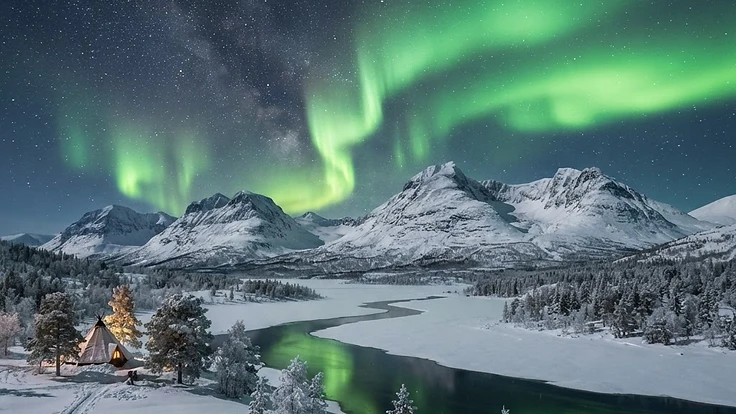
The night sky offers few spectacles as profound as the aurora borealis. Dancing lights across the high latitudes represent a direct interaction between our sun and the Earth magnetic field. While many perceive these lights as random, they follow predictable physical laws that dictate when and where they appear.
Live Aurora Forecast
Powered by Flarient — embed this on your site →
Understanding these mechanisms turns a hunt for the lights from a guessing game into a calculated pursuit. By learning the interplay of solar activity and terrestrial geography, anyone can improve their chances of witnessing this natural light show.
The Science Behind It
The sun constantly emits a stream of charged particles known as the solar wind. When this wind reaches Earth, it encounters our protective magnetosphere, which funnels particles toward the polar regions.
These particles collide with oxygen and nitrogen atoms in the upper atmosphere, causing them to emit light. This process creates the familiar aurora patterns that observers seek in the night sky.
The strength of this display often correlates with geomagnetic activity, which experts measure using the K-index. A higher index indicates a more intense disturbance in the magnetic field, which expands the area where these lights are visible.
Solar activity follows an approximately 11 year cycle, influencing how frequently intense storms occur. During the peak of this cycle, flares and coronal mass ejections happen more often, pushing the boundaries of the auroral oval toward lower latitudes.
Real-World Implications
Geomagnetic storms do more than just produce beautiful displays for skywatchers. High intensity events can induce electrical currents in long power lines, potentially straining electrical grids.
Satellite operators must also remain vigilant, as increased drag from atmospheric heating can alter orbital trajectories. Scientists often discuss the impacts on modern infrastructure, such as how [solar flare impacts on global satellite navigation systems]( /blog/solar-flare-impacts-on-global-satellite-navigation-systems) can cause momentary positioning errors.
Radio communication, particularly at high frequencies, faces disruptions during strong geomagnetic events. This phenomenon is a subject of ongoing research, much like [what causes HF radio blackouts during solar flares?]( /blog/what-causes-hf-radio-blackouts-during-solar-flares) which provides deeper insight into solar-terrestrial physics.
What You Can Do
Preparation involves monitoring real-time data provided by space weather agencies like the NOAA SWPC.
You should also consult a local aurora forecast to see if conditions near your coordinates align with active geomagnetic levels.
For those planning travel, booking guided aurora tours in countries like Iceland, Norway, Canada, or Finland can offer expert insight and local navigation through remote landscapes. These professionals know the best vantage points to escape light pollution and find clear skies.
If you maintain a blog or website, consider using embeddable widgets to share live geomagnetic updates with your own audience. This keeps your community informed without needing constant manual updates from your end.
Key Takeaways
The aurora borealis serves as a visual reminder of our place within a dynamic solar system. By tracking the sun and understanding geomagnetic indices, you move beyond mere luck in your observations.
Whether you are a casual photographer or a dedicated space weather enthusiast, the key lies in persistence and data. Keep your eyes on the horizon, but keep your data sources current to capture the moment when the sky finally ignites.
People Also Ask
Does the moon affect aurora visibility?+
Yes, a bright moon can wash out faint auroras, making them harder to see. For the best experience, try to plan your observation for the days surrounding a new moon when the sky is at its darkest and light pollution from the moon is minimal.
Why are auroras mostly green?+
Auroras appear green because oxygen atoms at lower altitudes, roughly 100 to 200 kilometres up, emit light at that specific wavelength when hit by solar particles. Red auroras occur higher up, while blue or purple hues appear when particles hit nitrogen atoms.
Can you see the aurora in the city?+
Light pollution from city streets and buildings makes it very difficult to spot the aurora. You need a dark sky, far from urban centres, to see the more subtle displays. Always travel to a rural location with an unobstructed view of the northern horizon.
Continue Reading