Understanding the Physics and Beauty of the Aurora
The aurora is more than a celestial light show. It is a visible manifestation of Earth's interaction with solar weather, serving as a pulse for our planet's magnetic environment.
Understanding the Physics and Beauty of the Aurora
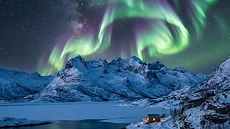
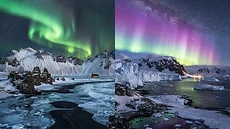
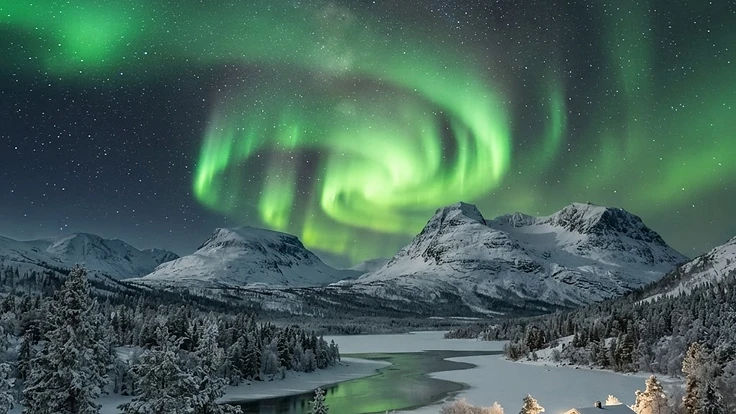
The aurora is a luminous display that captures the human imagination. Across the northern and southern polar regions, shifting curtains of green, violet, and red light illuminate the night sky.
Live Aurora Forecast
Powered by Flarient — embed this on your site →
These displays are not merely aesthetic wonders. They act as visual reminders that Earth exists within the active, often turbulent atmosphere of our Sun. Understanding these lights requires looking beyond the horizon to the complex magnetic interplay between our planet and the solar wind.
The Science Behind It
The process begins nearly 150 million kilometres away at the surface of the Sun. Solar activity ejects charged particles into space, forming a constant stream known as the solar wind.
When this wind travels toward Earth, our planet's magnetic field acts as a protective shield. Most of these high energy particles are diverted around us, but some find their way into the polar regions where the field lines converge.
These particles crash into oxygen and nitrogen atoms in our upper atmosphere. The collision excites these atoms, causing them to emit light as they return to their ground state.
Oxygen typically produces green or red hues, while nitrogen can result in blue or purple tones. The resulting aurora effectively maps the structural integrity of our magnetosphere in real time.
Real-World Implications
While the aurora is harmless to observers on the ground, the conditions that create it can have profound impacts on modern technology. Intense solar activity often coincides with geomagnetic storms measured by the Kp index.
During these events, shifts in the ionosphere can degrade radio communications and impact satellite operations. High levels of radiation can also pose risks to electronics on spacecraft orbiting the planet.
Monitoring these events is vital for protecting infrastructure like power grids. Readers interested in the broader context of how these storms behave can explore how solar flares impact power grids for a deeper look at grid resilience.
What You Can Do
Staying informed about space weather allows you to predict when the night sky might come alive. Many enthusiasts turn to digital tools to track solar wind speeds and planetary K-indices before planning a trip.
If you are serious about catching a display, consider booking guided aurora tours in iconic regions such as Iceland, Norway, Canada, or Finland to maximise your chances of success. Professional guides understand the local microclimates and use tracking data to place you under the clearest skies.
For those who prefer to track the activity from home, our free live dashboard helps you monitor the local aurora forecast for your specific coordinates. Having this information at your fingertips ensures you never miss a significant display occurring in your region.
Key Takeaways
The aurora serves as a bridge between the quiet of our night sky and the chaotic energy of our host star. It is a dynamic system that changes constantly, offering a glimpse into the forces that shape our solar system.
By observing the auroral oval, we gain a better understanding of how Earth manages its relationship with the Sun. Whether you view these lights from a research station or a remote cabin, they remind us of our place in the cosmos.
Keep track of ongoing solar activity to understand the patterns that drive these lights. Frequent checks of your local space weather conditions will turn a simple stargazing session into a scientific observation.
People Also Ask
Does the aurora only happen at night?+
Auroral displays occur constantly, even during the day. However, the light is usually too faint to be seen against the brightness of the sunlit sky. Darkness is a requirement for human eyes to perceive the colours, as the display is not bright enough to overcome daylight glare.
Can auroras be seen from the equator?+
It is extremely rare to see an aurora near the equator. A geomagnetic storm would need to be exceptionally intense, reaching a G5 level on the G-scale, to push the auroral oval far enough south toward the tropics. Such events are historically documented but occur very infrequently.
What is the difference between aurora borealis and australis?+
The physical mechanism is identical for both. The aurora borealis occurs in the Northern Hemisphere, centred around the North Pole, while the aurora australis occurs in the Southern Hemisphere, centred around the South Pole. They are mirror images triggered by the same solar particles hitting the magnetic poles.
Continue Reading