When Aurora Happens: The Science of the Northern Lights
Understanding the conditions required for the aurora borealis, from solar wind interactions to the geomagnetic field.
Predicting the Occurrence of Auroral Activity
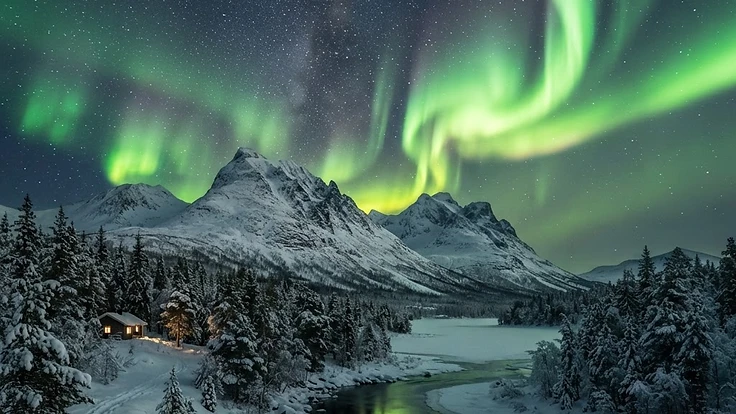
The aurora is one of the most mesmerising natural phenomena on our planet. It appears as a dance of light in the high latitude skies, shifting between vibrant greens and deep purples.
While these displays seem ethereal, they are the result of predictable physical processes. Understanding when these lights appear requires looking toward the Sun and the state of our own magnetosphere.
The Science Behind It
The process begins with the solar wind, a constant stream of charged particles flowing from the Sun. When a solar flare or a coronal mass ejection releases a massive burst of plasma, these particles travel through space at speeds ranging from 400 to 700 kilometres per second.
When this material reaches Earth, it interacts with our geomagnetic field. Scientists measure this interaction using the G-scale, which categorises the intensity of geomagnetic storms from G1 to G5.
If the solar material is strong enough, it funnels toward the magnetic poles. Here, it collides with oxygen and nitrogen atoms in the upper atmosphere, causing them to emit light.
This creates the aurora, which typically settles into an oval shape around the polar regions. The intensity of these light shows is often quantified by researchers using the Dst index, which reveals the level of magnetic disturbance in the ionosphere.
Real-World Implications
Solar activity is not merely a light show, as it can have significant impacts on modern infrastructure. Strong geomagnetic storms can induce electrical currents in long-distance power grids, potentially causing voltage instability.
Satellite operators must also remain vigilant during periods of high activity. The increased atmospheric drag caused by heating can alter the orbital altitude of objects, including the ISS which maintains a steady orbit at roughly 408 kilometres.
Communication systems and GPS signals are also susceptible to disruption during peak solar events. This makes the ability to monitor solar storms essential for protecting our global technology networks.
What You Can Do
Staying informed about space weather is the best way to catch a display. You can monitor the current local aurora forecast to see if visibility conditions are favourable for your specific geographic area.
Many enthusiasts rely on essential consumer devices to stay updated on real-time solar activity. If you prefer a guided experience, you can book guided aurora tours in countries like Iceland, Norway, Canada, or Sweden to maximise your chances under expert supervision.
If you run a website, you might consider using embeddable widgets to provide your own audience with live space weather updates. Having immediate access to data allows you to plan your observations around the actual arrival of solar particles rather than guesswork.
Key Takeaways
The aurora is a testament to the dynamic relationship between our planet and the Sun. It occurs when solar energetic particles collide with our atmosphere, a process that varies according to the 11-year solar cycle.
While we cannot stop the solar wind, we can certainly track it. By staying aware of current space weather data, you turn the random chance of seeing the lights into an educated pursuit.
For those interested in the deeper mechanics, reading about the physics and formation of the aurora borealis provides a perfect foundation for further study. The lights are a reminder that Earth is an active participant in a much larger solar system environment.
People Also Ask
Can you see the aurora during the day?+
Auroral activity occurs regardless of the time of day, but the light is too faint to be seen against the brightness of the Sun. You need a dark, clear night sky to witness the phenomenon, as the human eye cannot distinguish the colours during daylight hours.
How long do aurora displays last?+
Auroral displays can last anywhere from a few minutes to several hours. During intense geomagnetic storms, the oval may expand, allowing the lights to persist for the entire night. Their duration depends on the density and speed of the solar wind interacting with Earth's magnetic field at the time.
What colour are the northern lights?+
The most common colour is green, caused by oxygen atoms interacting with particles at lower altitudes. Rarer reds occur at higher altitudes, while purples and blues can appear when solar particles interact with nitrogen. The specific hue depends on the altitude of the collision and the type of gas involved.
Continue Reading
Forecast These Questions
View all →Express your probability on these active forecast questions.