The Distinction Between Aurora Borealis and Aurora Australis
While the Northern and Southern Lights share a common solar origin, they are unique atmospheric spectacles. Learn how geomagnetic activity shapes these displays across both hemispheres.
The Atmospheric Symmetry of Polar Lights
The night sky occasionally erupts in dancing ribbons of green, violet, and red. This phenomenon, known as an aurora, occurs when solar particles collide with our atmosphere. While people often associate these lights exclusively with the north, they are a global event happening in both polar regions.
Live Aurora Forecast
Powered by Flarient — embed this on your site →
Understanding why they appear differently in each hemisphere provides a window into the complex interaction between our planet and the sun.
The Science Behind It
The sun constantly releases a stream of charged particles known as the solar wind. When this wind reaches Earth, our magnetic field channels the energy toward the poles, where the Earth magnetosphere and the invisible shield protecting life direct these particles into the upper atmosphere. The resulting collisions with oxygen and nitrogen atoms release the characteristic light we observe from the ground.
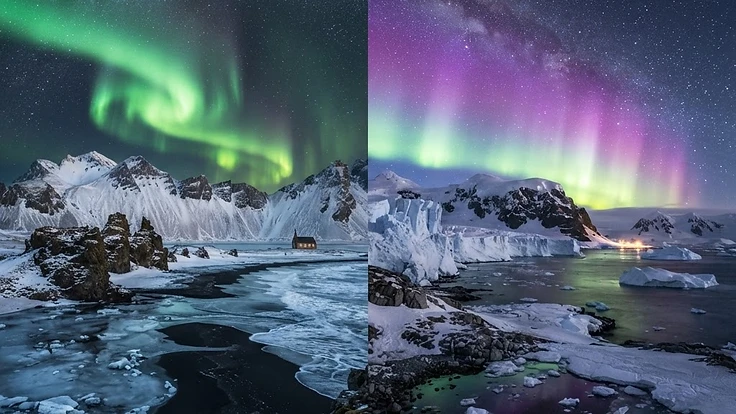
The aurora borealis occurs in the Northern Hemisphere, typically encircling the Arctic Circle. Its counterpart, the aurora australis, happens in the Southern Hemisphere near the Antarctic. Both displays follow the same physical principles, yet their visibility differs due to the distribution of landmasses.
While the northern lights are frequently spotted over inhabited regions like Scandinavia and Canada, the southern lights are largely confined to Antarctica and the southern oceans.
Real-World Implications
Geomagnetic activity that triggers these auroras can also interfere with modern technology. High-intensity storms, often measured by the Kp index, have the potential to disrupt satellite communications and electrical grids. When solar activity is high, ionospheric changes can significantly impact GPS accuracy, a critical factor for global navigation and aviation industries.
Beyond technical disruptions, these events offer vital data for space weather research. Scientists monitor these storms using solar imagery to better predict when a massive solar event might reach our orbit. Keeping track of such trends is essential, as even minor fluctuations in the geomagnetic storm environment can have cascading effects on the power infrastructure that sustains our modern lives.
What You Can Do
To catch these displays, you need to monitor space weather patterns and find a location with minimal light pollution. You can easily track current conditions and local aurora forecast data on your phone before planning a trip. If you want to experience these lights firsthand, there are many excellent Northern Lights tours available across regions like Iceland, Norway, Canada, and Finland that provide expert guidance.
If you are interested in sharing this data, you might consider using embeddable widgets on your own website to display live space weather feeds. Staying prepared requires checking official data regularly, such as the latest updates from the NOAA SWPC, to ensure you do not miss a significant display.
Being informed turns a random search for lights into a successful night of observation.
Key Takeaways
The aurora borealis and aurora australis are two sides of the same celestial coin, both driven by the sun and regulated by our planet's magnetic field. While their origins are identical, their geographical footprint and visibility vary greatly due to Earth's unique geography. Understanding these differences allows us to better appreciate the delicate balance of our space environment.
Whether you are an enthusiast tracking the next storm or a researcher studying solar cycles, these lights remain one of nature's most profound displays. By keeping a close eye on space weather, we can continue to marvel at these events while protecting the technologies that connect us.
People Also Ask
Can you see the aurora borealis and australis at the same time?+
Yes, it is physically possible. Because both auroras are triggered by the same solar wind events interacting with the magnetosphere, they often occur simultaneously. However, because one is in the high north and the other in the deep south, you cannot see both from the same location on Earth.
Why are auroras usually green?+
The colour of an aurora depends on the type of gas atoms being excited and their altitude. Green light is produced by oxygen molecules at lower altitudes, typically around 100 to 150 kilometres, which are the most common collisions we see during moderate geomagnetic activity.
Does the solar cycle affect how often we see auroras?+
Yes, the solar cycle, which lasts about 11 years, directly impacts auroral frequency. During the solar maximum, there are more frequent sunspots and solar flares, leading to more intense solar wind and higher chances of seeing brilliant auroras across a wider range of latitudes.
Continue Reading
Forecast These Questions
View all →Express your probability on these active forecast questions.