The Science and Wonder of the Aurora Borealis
The aurora borealis is a celestial light display caused by solar particles colliding with Earth's atmosphere. Explore the physics behind this phenomenon and how to track it.
The Aurora Borealis Is a Solar-Terrestrial Connection
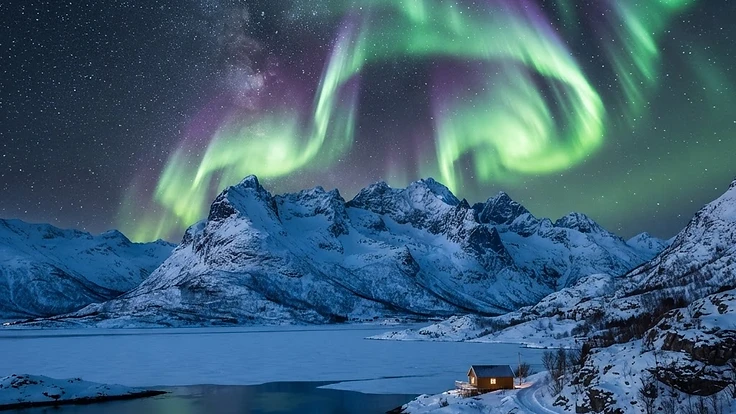
The aurora borealis, commonly known as the northern lights, is a natural light display in Earth's sky. It primarily appears in high latitude regions around the Arctic.
Live Aurora Forecast
Powered by Flarient — embed this on your site →
This phenomenon is not merely a pretty sight. It serves as a visual indicator of the complex relationship between the Sun and our home planet.
The Science Behind It
The sun constantly emits a stream of charged particles known as the solar wind. This wind travels at speeds ranging from 400 to 700 kilometres per second.
When these particles reach Earth, our planet's magnetic field acts as a shield. The field deflects most of the solar wind around the globe.
Some particles become trapped in the magnetosphere, however. They are funnelled towards the polar regions along magnetic field lines.
These charged particles eventually collide with atoms of oxygen and nitrogen in the upper atmosphere. The collisions excite the atoms and cause them to release energy in the form of light.
This light manifests as the shimmering curtains or bands of colour we observe from the ground. Oxygen atoms produce green and red hues, while nitrogen causes blue or purplish tints.
Real-World Implications
While the lights offer a spectacle, they originate from space weather events that impact our modern infrastructure. Strong geomagnetic storms can induce electrical currents in long-distance power grids.
These currents may damage transformers and lead to significant power outages. Scientists use the G-scale to classify the intensity of these storms, ranging from G1 to G5.
Satellite communications and navigation systems also face risks during intense events. High levels of atmospheric radiation can disrupt how solar flares disrupt GPS accuracy and satellite navigation across the globe.
Operators often must adjust flight paths or satellite orientation to mitigate these effects. Understanding the [K-index](/ #kp) helps us predict these disturbances and maintain the stability of our technological networks.
What You Can Do
Tracking the activity of the [aurora](/ #aurora) requires a mix of patience and data. You can consult the [local aurora forecast](/ #local) to determine if conditions are favourable for visibility in your specific area.
Many enthusiasts travel to places like Iceland, Norway, Canada, Finland, Sweden, or Alaska to experience this beauty in person. You might consider booking guided aurora tours to gain expert insight and better positioning during your expedition.
If you represent a media outlet or a community centre, you can even embeddable widgets on your own website to show live space weather data to your audience. This helps everyone stay informed about the current state of our solar neighbourhood.
Key Takeaways
The aurora is a testament to the dynamic nature of our Sun. It acts as a reminder that Earth is an integral part of the solar system, constantly interacting with solar energy.
Understanding these mechanisms is crucial as we become more dependent on satellite-based technology. By observing the skies and tracking solar activity, we appreciate the beauty of our planet while preparing for the challenges posed by space weather.
Referencing the glossary for key terms ensures you stay up to date with the latest space science developments. Whether you are a casual observer or a dedicated watcher, the aurora remains one of nature's greatest shows.
People Also Ask
What causes the different colours in the aurora?+
The colours depend on the specific gas atoms and the altitude at which the collisions occur. Oxygen atoms at lower altitudes typically emit green light, while high-altitude oxygen produces red. Nitrogen atoms are responsible for the rarer blue and purple displays seen during intense geomagnetic storms.
Is the aurora borealis dangerous?+
The light display itself is harmless to humans on the ground. However, the space weather that creates the aurora can interfere with satellites, radio communications, and power grids. Major geomagnetic storms may disrupt GPS accuracy and place significant stress on electrical infrastructure across high-latitude regions.
Can you see the aurora from anywhere on Earth?+
The aurora is typically restricted to the auroral ovals near the Earth's magnetic poles. During periods of high solar activity, or a G5-rated geomagnetic storm, these ovals can expand significantly, allowing the lights to be visible at much lower latitudes than usual, though this is relatively rare.
Continue Reading
Forecast These Questions
View all →Express your probability on these active forecast questions.