Essential Consumer Devices for Tracking Space Weather Conditions
Discover how everyday technology and accessible data allow individuals to monitor solar activity, geomagnetic storms, and the potential impact of space weather on our world.
Essential Consumer Devices for Tracking Space Weather Conditions
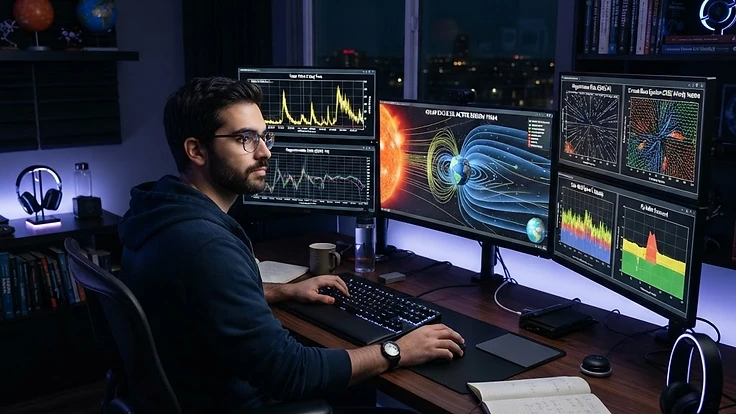
Space weather is no longer the exclusive domain of scientists at NASA or the NOAA SWPC.
As our reliance on satellite technology and high frequency radio increases, tracking solar activity has become a relevant hobby for enthusiasts and professionals alike.
Live Solar Flare Monitor
Powered by Flarient — embed this on your site →
Understanding the space environment helps us predict when atmospheric conditions might disrupt navigation or trigger spectacular displays in the night sky. Accessing this information requires little more than a smartphone or a standard home computer linked to global monitoring networks.
The Science Behind It
The Sun operates on an approximate 11 year cycle, a rhythm that dictates the intensity of solar radiation and the frequency of geomagnetic events. Solar Cycle 25, which began in December 2019, continues to provide opportunities to witness significant space weather phenomena.
Solar activity is measured through electromagnetic emissions and particle ejection. While light travels at 300,000 kilometres per second, solar wind typically moves at 400 to 700 kilometres per second, though massive coronal mass ejections can reach 3,000 kilometres per second.
These particles interact with the planetary magnetic field, resulting in geomagnetic storms ranked by the G-scale from G1 to G5. Scientists often use the Dst index to quantify the intensity of these events, as detailed in our guide to [understanding the Dst index and geomagnetic storm intensity](/blog/understanding-the-dst-index-and-geomagnetic-storm-intensity).
Real-World Implications
Space weather impacts daily infrastructure in subtle but significant ways. A strong geomagnetic storm can induce currents in power grids or shift the ionosphere, which affects maximum usable frequency for radio operators.
Beyond communications, these events dictate the behaviour of the auroral oval. When the magnetosphere is disturbed, the lights may become visible at lower latitudes than usual, creating a unique opportunity for observers to track the local aurora forecast.
Tracking these events is vital for anyone relying on precision timing or satellite-based navigation. Even for those not directly involved in aerospace, the knowledge of solar conditions provides context for everything from potential radio blackouts to the health of our orbital infrastructure as discussed in monitoring solar storms to protect satellite infrastructure.
What You Can Do
Modern technology has democratised space weather monitoring. You can use your smartphone to access live feeds of solar imagery from the Solar Dynamics Observatory, providing a real-time look at sunspots and active regions.
For those interested in experiencing the results of these solar interactions, guided aurora tours in countries like Iceland, Canada, and Sweden offer the best chance to view the results of high-energy solar particles firsthand. These services are often timed perfectly with solar activity peaks to ensure optimal viewing.
If you prefer to track data from your own workspace, you can utilise embeddable widgets to display current solar data on your personal website or dashboard. Keeping an eye on the storm leaderboard allows you to compare current activity against historical benchmarks documented in the archive.
Key Takeaways
Space weather is a dynamic force that shapes our technological landscape and provides breathtaking visual phenomena. By utilising accessible consumer devices and data tools, you can stay informed about the volatile environment beyond the Kármán line.
Whether you are an amateur radio operator, a photographer seeking the next light show, or someone interested in the long-term patterns of solar cycles, the resources available today are more robust than ever. Continuous learning remains the best tool for understanding our position in the solar system.
Be sure to consult the glossary for definitions on complex solar terminology. Staying connected to real-time data ensures you never miss a significant event in our ever-changing solar neighbourhood.
People Also Ask
What is the Kp index in space weather?+
The Kp index is a global geomagnetic activity index that measures disturbances in Earth's magnetic field on a scale of 0 to 9. Higher numbers indicate more intense geomagnetic storms, which are often associated with increased auroral activity and potential interference with satellite and radio communications.
How do solar flares affect electronic devices?+
Solar flares release intense X-rays and extreme ultraviolet radiation. While these do not pass through the atmosphere to affect handheld electronics directly, they can disrupt the ionosphere, leading to high-frequency radio blackouts and errors in GPS and satellite communication systems that rely on signal transmission through the atmosphere.
Can I see the aurora at home without special equipment?+
Yes, if the geomagnetic storm is strong enough and your location is within the visible auroral zone. You do not need special equipment to see the lights, though a good camera with manual settings helps capture them. Tracking local forecasts can tell you when the auroral oval has shifted south.
Continue Reading
Forecast These Questions
View all →Express your probability on these active forecast questions.