Satellite Reentry and the Physics of Orbital Decay
Satellite reentry marks the final stage of an object's life in space. Understanding how we predict these dramatic descents is essential for modern space safety and atmospheric science.
Satellite Reentry and the Physics of Orbital Decay
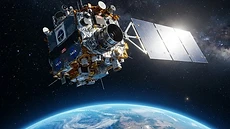
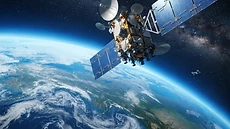
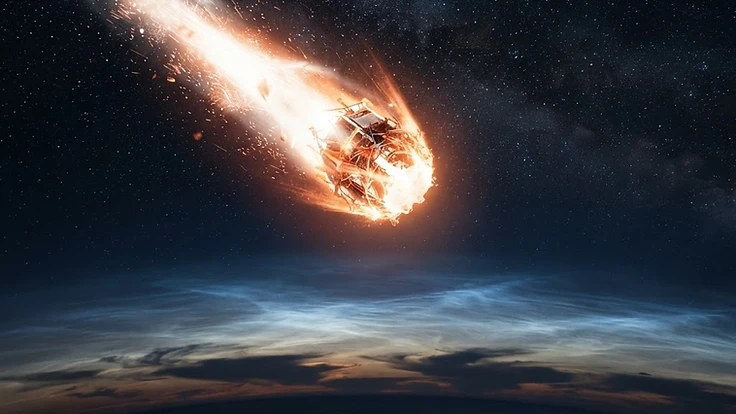
Satellite reentry is the natural or controlled conclusion to a spacecraft's mission, occurring when an object loses enough velocity to drop below stable orbit. As it falls toward Earth, it encounters the thickening layers of the atmosphere, transforming kinetic energy into intense heat. While many satellites are designed to burn up completely during this process, larger structures may survive, making the precise prediction of impact times and locations a vital task for space agencies worldwide. This process balances the reality of our increasing presence in low Earth orbit against the safety of the population below.
The Science Behind It
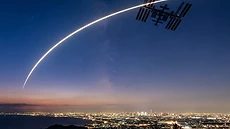
Orbital decay begins when atmospheric drag acts upon a satellite. Even at altitudes like those of the ISS at 408 km, trace amounts of gas particles exert a tiny but constant force that slows the craft over time. This force is highly sensitive to solar activity; when the sun is more active, the upper atmosphere expands like an accordion, increasing drag and pulling satellites down faster. You can look at our glossary to understand how these atmospheric variations relate to broader orbital dynamics.
Predicting the exact moment of reentry involves complex modelling of the spacecraft's shape, orientation, and the density of the atmosphere. Solar flux and geomagnetic conditions—often measured by the Kp index—directly influence how quickly the atmosphere swells. Because atmospheric density is notoriously difficult to calculate with perfect precision, these predictions remain probabilistic until the final hours of the descent. The goal is to determine the narrow window when the craft will cross the Kármán line at 100 km, the internationally recognised boundary of space.
Real-World Implications
Managed reentry allows operators to guide defunct satellites into uninhabited regions, typically over the South Pacific. When this is not possible, the unpredictable nature of natural decay requires global coordination. Understanding these risks is as important as monitoring other orbital dangers, such as a near-Earth asteroid passing through our cosmic neighbourhood, which we discuss in detail in our article on [Earth's Orbital Neighbourhood: Analysing Potential Asteroid Threats](/blog/earths-orbital-neighbourhood-analysing-potential-asteroid-threats).
Reliable predictions are essential for aerospace safety, aviation routing, and the protection of space-based infrastructure. A satellite losing altitude can cross paths with active missions, increasing the risk of collisions. By using advanced tracking data, agencies ensure that reentry zones are clear of shipping lanes and air traffic. This field of study highlights the growing need for better debris management as we continue to launch more hardware into the heavens.
What You Can Do
Staying informed about the space environment is a great way to better understand the forces at play above us. You do not need a degree in astrophysics to track these trends; many public tools provide real-time updates on satellite tracking and space weather. If you manage a website or a space-focused community, you can use our embeddable widgets to share these live data streams directly with your audience.
Keeping an eye on current solar conditions is another practical step, as these influence the drag environment that drives orbital decay. Whether you are interested in satellite telemetry or simply tracking the aurora caused by high-energy particles hitting our magnetosphere, access to raw, real-time data makes the complex science of space weather accessible to everyone. Engaging with these tools helps demystify the mechanics of our orbital environment.
For travellers who want expertise over guesswork, guided Northern Lights excursions in Sweden, Scotland and Alaska pair you with photographers who read the aurora oval in real time.
Key Takeaways
Satellite reentry is an inevitable part of the life cycle of every craft we send into orbit. It is a process governed by the invisible friction of the atmosphere, which ebbs and flows according to solar behaviour and the craft's own physical profile. By refining our predictive models, we ensure that as our activities in space expand, our safety measures keep pace.
Understanding these mechanisms provides a deeper appreciation for the delicate balance required to maintain a sustainable orbital environment. From the early days of spaceflight to the modern era, the ability to track these objects remains a triumph of physics and engineering. We continue to improve our observation methods to ensure the skies remain both a site of discovery and a safe space for global progress.
Continue Reading
Forecast These Questions
View all →Express your probability on these active forecast questions.