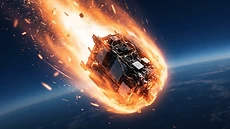
The Current Legal Framework Governing Space Debris
Outer space is becoming increasingly crowded, yet international law struggles to keep pace with the growing volume of orbital debris that threatens our technological infrastructure.
The Current Legal Framework Governing Space Debris
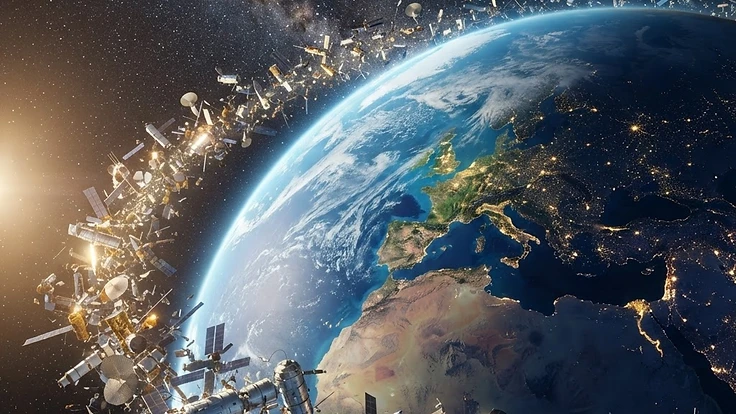
Humanity has transformed Earth orbit into a bustling industrial zone. Thousands of active satellites maintain our global communications, weather monitoring, and navigation systems, but these assets share their path with an ever growing cloud of discarded rocket stages and defunct hardware.
This collection of orbital junk presents a significant risk to future exploration. While the sky appears infinite, the reality of orbital mechanics dictates that collisions can occur at extreme velocities, creating even more fragments in a cascading effect known as the Kessler Syndrome.
The Science Behind It
Objects in low Earth orbit move at speeds exceeding 27,000 kilometres per hour to maintain their altitude. At these velocities, even a fleck of paint or a stray bolt acts like a bullet, possessing enough kinetic energy to compromise an expensive satellite or damage the ISS at 408 kilometres above the surface.
Most current debris orbits follow predictable paths, but external factors complicate long-term stability. Solar activity often heats the upper atmosphere, causing it to expand and increase drag on objects in orbit. This natural cleaning mechanism helps de-orbit lower debris, but it does little for hardware stationed at higher altitudes.
Beyond human-made debris, the space environment remains dynamic due to natural hazards. Monitoring the frequency of a near-Earth asteroid or tracking a geomagnetic storm, which you can explore on our storm leaderboard, is crucial for operators. These high energy events can shift satellite orbits, making it harder to predict the trajectory of existing debris clouds.
Real-World Implications
Our modern lifestyle relies on the integrity of the orbital environment. A single collision involving a major piece of debris could disable a critical communications network, leading to widespread disruptions in navigation and global financial systems. This fragility highlights why understanding space weather is as vital as tracking physical junk.
When a strong solar event occurs, categorised by a high Kp index, satellite operators must often manoeuvre their hardware to protect sensitive electronics. Increased debris risk forces operators to choose between keeping their station in a safe orbit or sacrificing fuel to dodge potential impacts. This delicate balancing act is a constant cost of doing business in the vacuum of space.
As defined in our glossary, space debris is not just an inconvenience for engineers. It is a fundamental challenge to the sustainability of the space sector. Without clear international mandates, the responsibility for mitigation remains largely voluntary, leaving the burden on the private companies that own the assets.
What You Can Do
Staying informed about the environment surrounding Earth is the best way to understand these risks. You can monitor live data streams via embeddable widgets that track real-time space conditions. This helps clarify how physical debris and solar radiation influence the health of our satellites.
If you have a keen interest in the upper atmosphere, you might also find value in reading our guide on The High Altitude Reality of Noctilucent Clouds. These clouds provide visual proof of the complex layers of our atmosphere that interact with solar wind. Knowledge of these conditions is essential for any amateur astronomer or space enthusiast.
Preparedness involves active monitoring rather than passive observation. By using reliable tools to check for upcoming atmospheric disturbances, you gain a better appreciation of the challenges faced by space agencies. Ensuring you have access to accurate, up-to-date information is the first step toward responsible space stewardship.
Key Takeaways
The lack of comprehensive, enforceable international laws regarding space debris remains a significant policy gap. While treaties from the 1960s provide basic principles of liability, they fail to address the technical realities of active debris removal or mandatory de-orbiting timelines.
Addressing this issue requires a global consensus that moves beyond voluntary guidelines. As we continue to launch more hardware, the pressure to organise a cohesive regulatory framework will only increase. Protecting the orbital environment is not merely a legal concern, it is a prerequisite for our future as a space-faring species.
People Also Ask
What is the Kessler Syndrome?+
The Kessler Syndrome is a theoretical scenario where the density of objects in low Earth orbit becomes high enough that collisions between objects cause a cascading effect. Each collision generates more debris, increasing the likelihood of further impacts and potentially rendering certain orbital bands unusable for future space activity.
Are there international treaties for space debris?+
There are no specific treaties dedicated solely to cleaning up space debris. The 1967 Outer Space Treaty provides a foundation for liability and national responsibility, but it does not mandate specific debris mitigation practices, leaving regulation largely to individual national policies and voluntary international guidelines created by organisations like the IADC.
How do satellites avoid space debris?+
Satellite operators use radar tracking data from ground stations to predict potential close approaches. When a collision risk is identified, they perform avoidance manoeuvres using onboard propulsion to alter the satellite's altitude or velocity. This requires significant fuel and precise calculation to ensure the new orbit remains effective for the mission.
Continue Reading
Forecast These Questions
View all →Express your probability on these active forecast questions.