The Nature and Composition of Intergalactic Space
Intergalactic space is not a true void but a complex environment of low-density gas and dark matter. Understanding this vast expanse provides crucial insight into the structure of our universe.
The Vast Expanse Between Galaxies
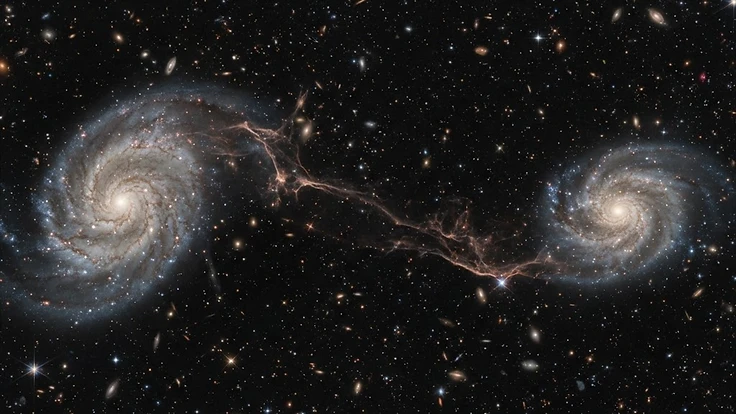
Intergalactic space serves as the primary bridge between galaxies, spanning millions of light-years across the cosmos. It represents the largest structural component of the universe, yet it is profoundly empty when compared to the dense environments found within planetary systems.
While we often think of space as a vacuum, it contains a tenuous web of matter that connects galactic structures. This region is not truly empty but is filled with the warm-hot intergalactic medium and elusive dark matter that shapes the cosmic skeleton.
The Science Behind Cosmic Voids
The density of matter in intergalactic space is exceptionally low, often amounting to less than one atom per cubic metre. This environment consists primarily of ionised hydrogen and helium gas left over from the early universe.
Gravity remains the dominant force in these vast regions, slowly pulling matter toward the centres of galactic filaments. While most of the baryonic matter in the universe resides in stars and galaxies, a significant portion is theorised to linger within these diffuse intergalactic clouds.
Scientists use sensitive instruments to detect this matter by analysing the light from distant quasars as it passes through the medium. This process, often detailed in our glossary, helps astronomers map the distribution of matter across billions of light-years of distance.
Real World Implications of Cosmic Distances
Although intergalactic space seems removed from our daily lives, it dictates the evolution and eventual fate of the entire universe. The expansion rate of this space influences how galaxies drift apart over billions of years, which impacts the long term trajectory of cosmic structures.
Understanding these scales is essential for space research, especially when monitoring objects such as a near-Earth asteroid that travels through our local environment. While our immediate focus is often on local space weather, such as the geomagnetic storm activity driven by solar cycles, the backdrop of intergalactic space provides the ultimate context for these events.
Researchers keep a close eye on solar imagery from satellites to understand how local dynamics compare to the stillness of deep space. These observations help refine our models of how energy propagates through the cosmic medium.
What You Can Do To Explore Space
To better understand how our local environment relates to the wider universe, you can engage with live data tools. Monitoring the current state of space weather allows you to see the immediate influence of the Sun before the energy dissipates into the void.
Flarient provides a live dashboard where you can track solar conditions and magnetospheric responses in real time. This helps demystify the complex interactions that occur within our own solar system.
For those interested in the history of such events, the archive offers a look at past solar activity. Using these resources, you can learn to interpret the data behind space weather, providing a practical entry point into the study of the broader cosmos.
Key Takeaways of Cosmic Structure
Intergalactic space is a defining feature of our universe, acting as the low-density medium that links all large-scale structures. It remains a focal point for modern astrophysics as researchers attempt to locate missing matter.
By observing the interactions between our Sun and the interplanetary environment, we gain the tools to study these larger concepts. The universe is far more connected than its vast, empty distances would suggest at first glance.
People Also Ask
Is intergalactic space a perfect vacuum?+
No, it is not a perfect vacuum. While the density is extremely low, it contains a very thin plasma of hydrogen and helium, along with dark matter and cosmic rays. It is far less dense than the best vacuums we can create in laboratories on Earth, but it is not completely empty.
Why is intergalactic space so cold?+
Intergalactic space is cold because there is very little matter to absorb or radiate heat. Temperatures often hover just a few degrees above absolute zero. Because the particles are so far apart, they cannot effectively transfer thermal energy, resulting in an environment that is extremely close to thermal equilibrium with the cosmic microwave background.
How does dark matter affect intergalactic space?+
Dark matter acts as the gravitational scaffolding of the universe. It is concentrated in filaments that connect galaxy clusters, drawing baryonic gas into these regions. Without dark matter, the structure of intergalactic space would be significantly different, as it provides the gravitational pull necessary to organise the distribution of galaxies.
Continue Reading
Forecast These Questions
View all →Express your probability on these active forecast questions.