The Physics and Wonder of the Aurora Borealis
The aurora borealis is a natural light display triggered by solar particles colliding with Earth's atmosphere. Understanding this phenomenon reveals the invisible connection between our planet and the sun.
The Aurora Borealis Is a Manifestation of Solar Wind
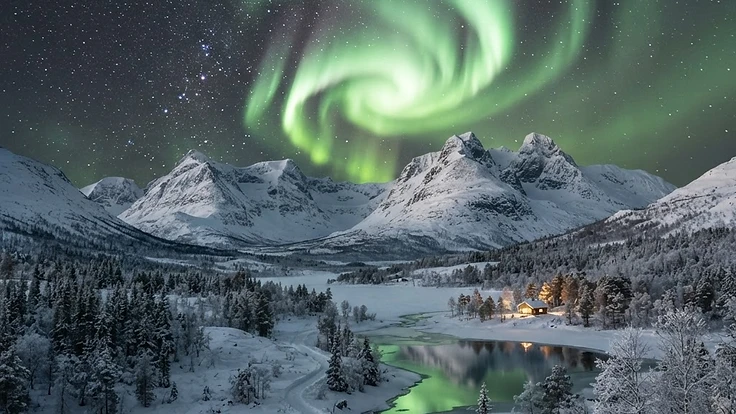
The aurora borealis, often known as the northern lights, represents one of nature's most spectacular displays. These shifting curtains of colour dance across the high-latitude night sky, serving as a visual reminder of our planet's complex relationship with the sun. While they appear ethereal, the science driving them is rooted in constant, measurable interactions between solar emissions and Earth's magnetic field.
Live Aurora Forecast
Powered by Flarient — embed this on your site →
Scientists classify these displays by their intensity, often referring to the aurora as the visible edge of a geomagnetic storm. When the sun is active, it releases charged particles that travel across space to strike our magnetosphere. Understanding these events is crucial for anyone interested in space weather, as they bridge the gap between abstract astrophysical data and the tangible beauty we see from the ground.
The Science Behind It
The process begins at the solar surface. As solar flares erupt, they launch plasma into space at immense speeds, often reaching thousands of kilometres per second. When this solar wind reaches Earth, our magnetosphere acts as a shield, funneling charged particles towards the magnetic poles.
Once these particles reach the upper atmosphere, they collide with atoms of oxygen and nitrogen. This impact excites the atoms, causing them to emit light as they return to their ground state. Green light typically signifies oxygen excited at an altitude of about 100 to 200 kilometres, while deep red hues appear when oxygen is impacted at higher altitudes.
Observers can track the intensity of these events using the Kp index, a global measure of magnetic activity. A higher value on the scale indicates a more intense disturbance, which often pushes the auroral oval further toward the equator. NASA researchers monitor these interactions constantly to ensure our technological infrastructure remains protected from severe solar weather.
Real-World Implications
While the lights themselves are harmless, the geomagnetic conditions required to produce a vibrant display can impact modern life. Powerful storms may disrupt electrical grids and lead to errors in satellite navigation systems. By reading Space Weather Disrupts High-Frequency Radio Communications, one can see how these invisible currents interfere with long-range radio signals used by aviation and maritime industries.
Infrastructure providers rely on the NOAA SWPC to monitor incoming coronal mass ejections.
These agencies track the arrival of solar plasma to mitigate potential damage to power transformers and orbital satellites.
Even at a glossary level, it is clear that our reliance on space-based technology makes tracking solar activity a necessity for modern society.
What You Can Do
Monitoring the sky requires a combination of patience and the right data. If you are planning to witness the lights, you should consult a local aurora forecast to determine if conditions favour visibility in your region. Many enthusiasts also utilise guided aurora tours in countries like Iceland, Norway, Canada, Finland, Sweden, and Alaska to improve their chances of finding clear skies and optimal viewing angles.
Preparation involves more than just checking the weather. It means understanding the difference between a minor fluctuation and a genuine solar storm. By exploring Predicting the Arrival of the Aurora, you can learn to interpret the technical indices that indicate when a display is likely to become visible.
Key Takeaways
The northern lights serve as a bridge between terrestrial life and the volatile activity of the sun. They transform complex magnetic energy into visible art, revealing the protective nature of our planet's magnetic field. While they offer a moment of quiet reflection for those watching from the ground, they also demand our respect for the immense power of our solar system.
Whether you are an amateur astronomer or simply a curious observer, learning the mechanics of the aurora provides a deeper appreciation for the night sky. Keep an eye on the solar cycle, stay informed, and enjoy the show whenever the magnetosphere decides to put on a display.
People Also Ask
Why are auroras different colours?+
Auroras display different colours based on the altitude and the type of gas atoms involved in the collision. Oxygen atoms at lower altitudes produce the common green glow, while oxygen at higher altitudes creates red light. Nitrogen molecules can produce shades of blue or deep purple during intense solar activity.
Can you hear the aurora borealis?+
While auroras are primarily visual, some observers report hearing faint crackling or hissing noises during intense displays. Scientists believe this is caused by electrostatic discharges near the ground in extremely cold, quiet conditions, rather than sound traveling directly from the auroral light display high in the atmosphere.
Is the aurora visible from the space station?+
Yes, astronauts aboard the ISS can see the aurora from above, often looking down at the light curtains as they circle the Earth. Because the station orbits at approximately 408 kilometres, the crew often sees the lights from a unique perspective that highlights the structure of the upper atmosphere.
Continue Reading