The Physics of the Northern Lights
Discover the cosmic dance between the Sun and Earth that creates the aurora borealis, and learn why our planet's magnetic field is the ultimate shield against solar wind.
The Mechanics of the Auroral Display
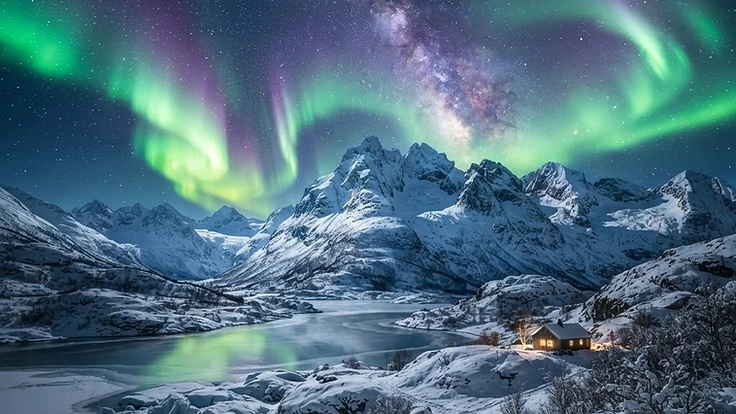
The aurora borealis represents one of nature’s most spectacular visual phenomena. While it appears as a serene, dancing curtain of green and violet light, the reality is a violent collision between solar particles and our planet’s upper atmosphere. This atmospheric light show is the visible signature of our magnetic field interacting with the solar wind. Understanding how this light is generated requires us to look beyond the horizon and into the charged space environment surrounding our globe.
Live Aurora Forecast
Powered by Flarient — embed this on your site →
The Science Behind It
The Sun constantly sheds a stream of charged particles known as the solar wind, which typically travels at speeds between 400 and 700 kilometres per second. When these particles encounter Earth, our magnetosphere acts as a protective shield, deflecting the majority of the onslaught. However, during periods of heightened solar activity, particles can funnel toward the poles along magnetic field lines. This is where we see the aurora phenomenon begin.
As these electrons and protons collide with atoms of oxygen and nitrogen in the thermosphere, they transfer energy, exciting these atoms to higher states. When the atoms return to their ground state, they release that energy as visible light. Oxygen emits green and occasionally red light, while nitrogen tends to produce blue and purple hues. The intensity of this process is often classified by the Kp index, a global measurement of geomagnetic activity that helps researchers quantify the strength of the solar interaction.
Real-World Implications
Geomagnetic disturbances are not just aesthetic events; they represent tangible stressors on our modern infrastructure. Significant solar storms can induce electric currents in long-distance power lines, potentially destabilising regional grids. Satellite operators also pay close attention to space weather, as the increased atmospheric drag during a storm can shift the orbit of craft like the ISS, which resides roughly 408 kilometres above us. Monitoring this activity is essential for protecting the systems that define our digital age.
We categorise these impacts using the G-scale, which ranges from G1 for minor events to G5 for extreme geomagnetic storms. To see how these events compare in intensity, one can consult the storm leaderboard to view the strongest storms on record. Much like we track space-based threats through [Earth's Orbital Neighbourhood: Analysing Potential Asteroid Threats](/blog/earths-orbital-neighbourhood-analysing-potential-asteroid-threats), scientists maintain a constant watch on the Sun to mitigate the risk of large-scale infrastructure failure.
What You Can Do
Predicting the next display of lights requires access to real-time data. Rather than relying on guesswork, amateur enthusiasts often turn to professional local aurora forecast tools to determine the likelihood of visibility based on current solar indices and cloud cover. If you are planning a photography trip to capture these elusive bands of light, you should refine your technique using guides like Mastering Camera Settings for Capturing the Aurora.
For those who want to display this live data on their own websites or dashboards, developers often utilise embeddable widgets that pull directly from trusted sources like the NOAA SWPC. By integrating these tools, you transform a general understanding of space weather into actionable, site-specific intelligence. Keeping an eye on these parameters ensures that when the next storm arrives, you are prepared to observe rather than scramble.
For a hands-off experience, Northern Lights tours in Iceland, Finnish Lapland and Scotland's Cairngorms pair you with guides who live under the oval and know every clear-sky hideout.
Key Takeaways
The auroral oval is a permanent feature of our planet’s interaction with the solar wind, though its visibility fluctuates with the 11-year solar cycle. While we are currently in Solar Cycle 25, which began in December 2019, the mechanisms driving these lights remain a constant subject of study. By learning the glossary of terms used by space weather physicists, you can better interpret the data behind these events. Though the science is complex, the fundamental takeaway is simple: we live on a dynamic planet, shielded by a magnetic field that turns lethal radiation into a breathtaking display of light.
Continue Reading