Asteroid Mining Is a Future Economic Reality
Asteroid mining is moving from science fiction to a tangible industrial prospect. By capturing resources from space, we could secure essential materials for human expansion beyond Earth.
Asteroid Mining Is a Future Economic Reality
Humanity stands at the threshold of a new industrial frontier. Asteroid mining represents the potential to harvest precious metals and water from space rocks that drift through our solar system.
Near-Earth Asteroid Watch
Powered by Flarient — embed this on your site →
While once confined to the pages of speculative fiction, the economic reality of resource extraction is now being analysed by engineers and private space firms. This shift promises to reshape how we support long-term space exploration and global demand for rare materials.
The Science Behind It
Asteroids are essentially the leftover building blocks of the solar system, containing everything from iron and nickel to water ice. Many a near-Earth asteroid contains high concentrations of platinum group metals that are increasingly difficult to source on our home planet.
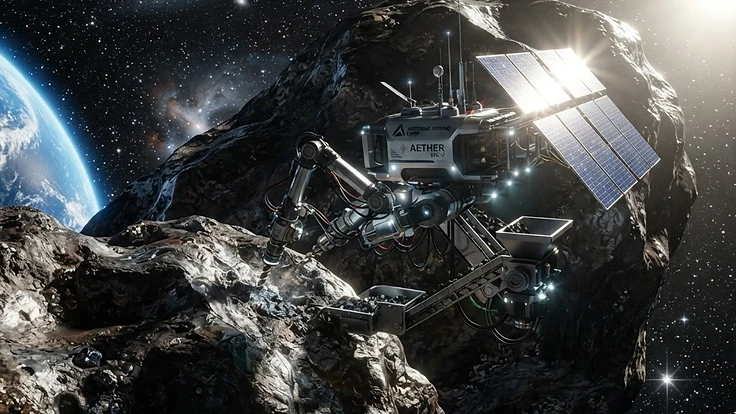
Extracting these resources requires precise orbital mechanics. Engineers must identify an ideal candidate, match its velocity, and anchor a spacecraft to the surface to begin the processing phase.
Water extraction is particularly vital for deep space missions. By splitting water into hydrogen and oxygen, we can create rocket fuel directly in space, drastically reducing the cost and complexity of travelling from Earth's deep gravity well.
Real-World Implications
Securing resources in space could alleviate the environmental burden of terrestrial mining. Large-scale industrial activities currently consume vast quantities of energy and water, which could be mitigated by shifting such operations off-world.
Furthermore, the formation and evolution of asteroids provides a natural laboratory for studying planetary origins. The findings from these missions will clarify the history of our solar system while providing a steady supply of raw materials for infrastructure projects in orbit.
As we increase our presence in space, we must also monitor the environment around us. Just as we track solar weather to protect satellites, as described in How Satellites Maintain Communication During Geomagnetic Storms, we must track orbital debris and asteroids to ensure the safety of our growing space fleet.
What You Can Do
Staying informed about the objects moving through our cosmic neighbourhood is easier than ever. Enthusiasts and professionals can monitor tracking data provided by NASA CNEOS to understand which bodies are making a close approach.
You can also explore the glossary to learn about the specific terminology used by astronomers. Understanding these metrics helps you follow the latest developments in space exploration with greater clarity and depth.
If you want to track space conditions, Flarient offers powerful tools to keep you updated. You might find it helpful to integrate our data directly into your own site using our embeddable widgets to provide live updates for your audience.
Key Takeaways
Asteroid mining is not a distant fantasy but a logical progression for a spacefaring civilisation. By tapping into the abundant minerals found on asteroids, we can sustain human activity in space while protecting Earth's own fragile environment.
Technological progress remains the primary hurdle for this industry. As we refine our ability to navigate and harvest these rocky bodies, the economic landscape of the twenty-first century will likely undergo a permanent transformation.
People Also Ask
What metals are found in asteroids?+
Asteroids are rich in minerals and elements including iron, nickel, cobalt, and platinum group metals. Carbonaceous chondrite asteroids, in particular, often contain significant amounts of water ice and volatile organic compounds that are essential for supporting life and fuel production in space.
How do you mine an asteroid?+
Mining involves rendezvousing with an asteroid, anchoring a craft, and using thermal or mechanical methods to break down material. The extracted matter is then processed to separate usable water or metals from the regolith, often using solar energy to power the equipment in the vacuum of space.
Why is water so valuable in space?+
Water is considered the oil of the space age. It can be electrolysed into hydrogen and oxygen to produce rocket fuel. Because launching heavy fuel from Earth is prohibitively expensive, sourcing water directly from asteroids allows for cheaper, more sustainable refuelling of spacecraft in deep space.
Continue Reading
Forecast These Questions
View all →Express your probability on these active forecast questions.
Will a near-Earth object pass within 1 Lunar Distance this quarter?
35%
Community
Will a near-Earth object pass within 1 Lunar Distance this quarter?
35%
Community
Will a newly discovered asteroid larger than 10m pass within 5 LD this month?
35%
Community
Will a near-Earth object pass within 5 Lunar Distances this month?
45%
Community