The Orbital Mechanics Governing Asteroid Motion in Space
Asteroids travel through the solar system governed by the immutable laws of gravity and orbital mechanics. Understanding their pathways is essential for planetary defence and space situational awareness.
The Orbital Mechanics Governing Asteroid Motion in Space
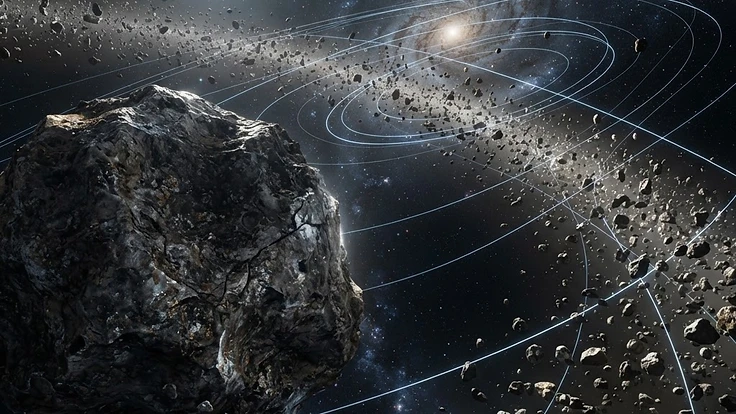
Asteroids are far more than chaotic rocks drifting aimlessly through the void. They follow predictable paths dictated by the massive gravitational pull of the Sun and the larger planets, moving in elliptical orbits that have remained consistent for billions of years. By understanding these trajectories, scientists can map the solar system with incredible precision.
Near-Earth Asteroid Watch
Powered by Flarient — embed this on your site →
The Science Behind It
At the core of asteroid motion lies Keplers laws of planetary motion. Every object orbiting the Sun follows an elliptical path, with the Sun situated at one of the two foci. The closer an object is to the Sun, the faster it must travel to maintain its orbit, a phenomenon that governs the varying velocities of these bodies.
Gravity acts as the primary sculptor of these paths. When an asteroid wanders too close to a gas giant like Jupiter, its orbit is significantly altered, a process known as a gravitational assist. This interaction can either eject the object from the inner solar system or pull it into a new, complex orbital plane.
These objects are categorised based on their proximity to our home world. A near-Earth asteroid represents a significant area of study for NASA CNEOS, as these bodies have orbits that bring them close to our own orbital path.
Tracking their precise position is the foundation of modern planetary defence.
Real-World Implications
Our modern world depends heavily on space-based infrastructure that occupies the same orbital neighbourhood as these ancient relics. While the vacuum of space is vast, the potential for a near-Earth asteroid to cross paths with satellite constellations remains a subject of serious scientific modelling. This is not just a theoretical concern for astronomers.
We also look to the history of these collisions to understand our own vulnerability. The Chicxulub event, which occurred 66 million years ago, serves as a stark reminder of what happens when a 10-kilometre-wide object intersects with Earth. Analysing these past impacts provides context for the importance of ongoing sky surveys.
Beyond planetary safety, there is the emerging industry of space mining. Companies now evaluate the trajectory of metallic asteroids to determine if they can be reached, mined, and utilised for their precious resources. Accurate orbital mechanics are the essential licence for any future operation of this scale.
What You Can Do
Staying informed about the celestial environment does not require a degree in astrophysics. You can familiarise yourself with the current status of the sky by browsing an archive of data to see how objects have moved over the last decade. Observing these patterns helps demystify the mechanics of our solar neighbourhood.
If you represent an organisation or a scientific group, consider integrating real-time data into your own platforms. Using embeddable widgets allows you to share up-to-date tracking information with your audience directly from your website. This transparency helps build a culture of shared scientific curiosity and preparedness.
Key Takeaways
Asteroids move according to strict mathematical principles that allow us to forecast their positions decades in advance. While the sheer number of objects in space can seem overwhelming, the ability to track each one individually keeps our planet secure. This scientific rigour is a triumph of modern astronomy.
As we look toward the future of space exploration, our knowledge of these paths will only grow more refined. By continuing to support observational programmes and keeping a close eye on the heavens, we ensure that the next generation of space travel remains safe and productive. The study of asteroid motion is truly a gateway to understanding the evolution of the solar system.
People Also Ask
Why do asteroids have different orbital speeds?+
Asteroids follow elliptical orbits around the Sun. According to Kepler's second law, an object must travel faster when it is closer to the Sun to maintain its orbital balance. As the asteroid moves to the outer reaches of its orbit, it slows down due to the decreased gravitational pull.
Can the gravity of planets change an asteroid's path?+
Yes, large planets like Jupiter exert significant gravitational influence on smaller objects. If an asteroid passes close to a planet, the planet's gravity can alter the asteroid's velocity and direction, potentially redirecting it into a completely new orbit or ejecting it from the solar system entirely.
How do scientists track the movement of asteroids?+
Scientists use ground-based telescopes and radar to observe an asteroid's position over time. By collecting multiple observations, they can calculate its trajectory and predict where it will be in the future. This data is then refined by international space agencies to ensure long-term orbital accuracy.
Continue Reading
Forecast These Questions
View all →Express your probability on these active forecast questions.