Asteroids and Their Relation to Ionising Radiation
While asteroids are known for physical impact risks, they do not inherently generate ionising radiation like solar events. Discover how space bodies interact with our environment and what risks they actually pose.
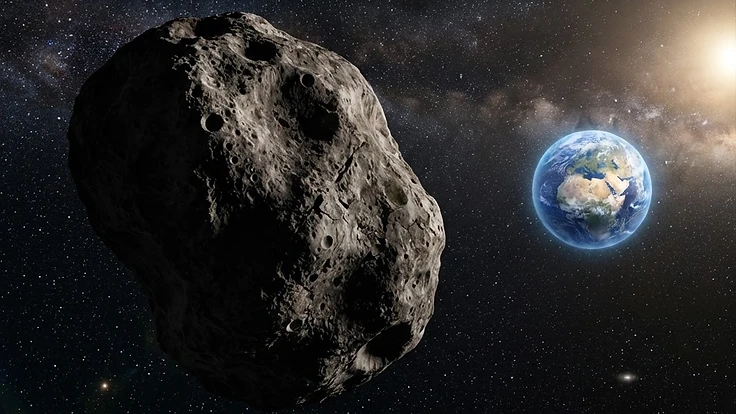
Asteroids Do Not Typically Emit Ionising Radiation
When people consider the hazards of space, the discussion often turns to radiation. Common concerns involve solar flares or cosmic rays, but confusion often arises regarding whether a near-Earth asteroid represents a source of radioactive material. It is important to distinguish between the kinetic energy of a celestial body and the electromagnetic radiation emitted by our sun.
Near-Earth Asteroid Watch
Powered by Flarient — embed this on your site →
Most asteroids, including every documented near-Earth asteroid, are essentially inert rocks. They are composed of minerals, metals, and ices that do not produce harmful ionising radiation in any significant capacity. While they may carry trace amounts of radioactive isotopes from their formation, these pose no threat to the Earth or human health in the way solar activity does.
The Physics of Asteroid Composition
An asteroid is fundamentally a solid object with no internal mechanism for nuclear fusion or significant decay heat. It travels through the vacuum of space, often reflecting sunlight, but it does not function as an emitter of high-energy particles. When we study these objects, we look for physical hazards rather than radiation profiles.
Unlike the sun, which constantly generates immense amounts of energy through hydrogen fusion, asteroids are cold and stable. They do not trigger the Kp index fluctuations that we associate with geomagnetic storms. For a detailed understanding of how space weather differs from physical asteroid risks, one might consult a glossary of astronomical terms.
Real World Implications for Space Safety
If an asteroid were to enter our atmosphere, the danger would be purely kinetic. The impact event involving an object like the Chicxulub asteroid, which was roughly 10 kilometres wide, released enough energy to shift the climate through dust and debris. This is a massive physical event, yet it is distinct from the type of radiation risk posed by a solar particle event.
Our modern infrastructure is far more sensitive to solar weather than to random orbital rocks. We monitor space weather to protect power grids, satellites, and astronauts on the International Space Station, which orbits at roughly 408 kilometres above the surface. Tracking asteroids is a separate field of study focused on planetary defence rather than radiation shielding.
Monitoring Space Hazards
To keep track of the space environment, you should utilise tools that provide real time data on celestial activity. If you want to see if your area is likely to experience any geomagnetic disturbance, you can monitor the local aurora forecast which tracks current solar conditions. This helps differentiate between the quiet movement of rocky bodies and the active weather driven by the sun.
Those interested in the wider scope of space monitoring can view current solar imagery to see the sun in action. For individuals passionate about the sky, taking part in guided aurora tours across places like Iceland, Norway, and Canada offers a unique way to experience the reality of space weather.
Knowledge is the best form of preparedness for any event, whether it involves asteroids or solar particles.
Key Takeaways
Asteroids do not emit the ionising radiation that causes health concerns or geomagnetic storms. Their primary threat remains their physical trajectory and the potential for kinetic impact if they were to cross the path of our planet. The global scientific effort to track asteroids ensures we remain aware of these rocky visitors long before they approach us.
Focus your safety concerns on solar activity for radiation, and leave the asteroid tracking to the professional observatories. By staying informed, you contribute to a better understanding of the space environment. Keeping an eye on the storm leaderboard provides context on how intense our space weather can truly become during the current solar cycle.
People Also Ask
Are asteroids radioactive?+
Most asteroids are not radioactive in a way that poses a threat to humans. They consist of rock, metal, and ice, which do not emit dangerous levels of ionising radiation. While they may contain trace isotopes from the solar nebula, these do not compare to the radiation generated by the sun.
What is the biggest threat from asteroids?+
The primary threat posed by asteroids is kinetic impact. If a large enough object were to hit Earth, the energy released upon atmospheric entry and impact would cause significant geological and environmental destruction. This is purely a physical danger rather than a radiation or biological hazard to the planet.
How do we track near-Earth objects?+
Astronomers use ground-based and space-based telescopes to monitor the movement of near-Earth objects. By calculating their orbits and velocities, they can predict potential close approaches decades in advance. Organisations like NASA and ESA maintain extensive databases to ensure that any potential impact threats are identified and assessed early.
Continue Reading
Forecast These Questions
View all →Express your probability on these active forecast questions.