Asteroids Can Have Moons, Scientists Have Discovered
The idea of asteroids having their own satellites was once science fiction. However, observations have confirmed that these celestial bodies can indeed host moons, a phenomenon that challenges our understanding of small solar system bodies.
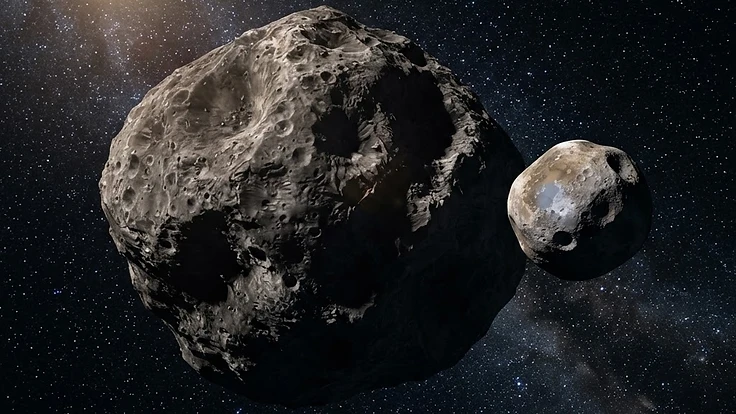
Asteroids Can Have Moons
For decades, the image of an asteroid conjured up visions of solitary rocks drifting through space. The notion that these minor planets might host their own satellites seemed like a fanciful concept, relegated to the realm of science fiction. However, a wealth of observational data and dedicated scientific inquiry has revealed a surprising truth: many asteroids are not alone.
Near-Earth Asteroid Watch
Powered by Flarient — embed this on your site →
They can, and often do, possess their own moons, a discovery that has reshaped our understanding of the complex dynamics within our solar system.
The Science Behind It
The existence of asteroid moons, also known as natural satellites or 'secondaries', is primarily a consequence of gravitational capture or co-formation. When two asteroids pass close enough, the gravitational pull of the larger body can capture the smaller one, forming a binary or even multiple-body system. Alternatively, during the formation of the solar system, some asteroids may have formed from a common cloud of dust and gas, leading to the co-creation of a primary body and its moon.
The discovery of 87 Sylvia's two moons, Romulus and Remus, by astronomer Michael Brown in 2001 was a pivotal moment, proving that even small celestial bodies could possess companions.
Since then, numerous other asteroids have been found to have moons, with some systems even featuring multiple satellites.
Real-World Implications
The discovery of asteroid moons has significant implications for space exploration and planetary science. Understanding these systems helps scientists refine models of solar system formation and evolution. It also presents unique challenges and opportunities for future space missions.
For instance, planning a mission to study an asteroid that has moons requires careful consideration of orbital mechanics and potential gravitational interactions.
Analysing the composition and origin of these moons can provide invaluable clues about the parent asteroid and the conditions present in the early solar system.
The study of binary asteroid systems offers a unique laboratory for testing gravitational theories and understanding the mechanics of orbital motion in complex configurations.
What You Can Do
While direct interaction with asteroid moons is reserved for specialised space missions, staying informed about celestial events and space weather is accessible to everyone. Websites like Flarient offer real-time tracking and data that can enhance your appreciation for the cosmos. Understanding the underlying forces at play in our solar system can also deepen your enjoyment of phenomena like the aurora borealis; for example, did you know that understanding solar activity can actually improve your chances of seeing a spectacular display?
If you're planning a trip to witness the Northern Lights, consider the benefits of [guided aurora tours](https://viime/HuXHi) in locations like Iceland, Norway, or Canada, which often leverage current space weather forecasts to maximise your viewing opportunities.
If reading Kp charts isn't your idea of a holiday, Northern Lights guided tours across Iceland, Canada and Scottish Highlands handle the science so you can simply look up.
Key Takeaways
The confirmation that asteroids can possess moons is a testament to the dynamic and surprising nature of our solar system. These discoveries, driven by advancements in observational technology and theoretical modelling, continue to expand our knowledge of celestial bodies. Studying these asteroid systems provides crucial insights into the processes that shaped our solar system and offers a glimpse into the potential complexities of future space exploration.
As our capabilities grow, so too will our understanding of these fascinating cosmic partnerships.
People Also Ask
What is the largest known asteroid moon?+
The largest known asteroid moon is believed to be Petit Prince, orbiting the asteroid Lutetia. While not a moon in the traditional sense, it is a significant secondary body discovered by the Rosetta spacecraft, highlighting the complex nature of asteroid systems.
How are asteroid moons discovered?+
Asteroid moons are typically discovered using powerful ground-based telescopes or space telescopes like Hubble. Techniques involve observing subtle gravitational perturbations or directly imaging the moon as it orbits its larger parent body.
Are there asteroids with more than one moon?+
Yes, some asteroids have been found to possess multiple moons. A notable example is 87 Sylvia, which has two confirmed moons, Romulus and Remus, making it a triple system and demonstrating the complex gravitational arrangements possible.
What does the presence of asteroid moons tell us about their formation?+
The existence of asteroid moons suggests that they may have formed through co-accretion, where both bodies formed together from the same primordial material, or through gravitational capture, where a smaller body was drawn into orbit by a larger one.
Continue Reading
Forecast These Questions
View all →Express your probability on these active forecast questions.
Will a near-Earth object pass within 1 Lunar Distance this quarter?
35%
Community
Will a near-Earth object pass within 1 Lunar Distance this quarter?
35%
Community
Will a newly discovered asteroid larger than 10m pass within 5 LD this month?
35%
Community
Will a near-Earth object pass within 5 Lunar Distances this month?
45%
Community