The Elusive Possibility of Asteroid Atmospheres
While most asteroids are barren rocks, scientific enquiry explores whether these small celestial bodies can ever hold onto a thin veneer of gas.
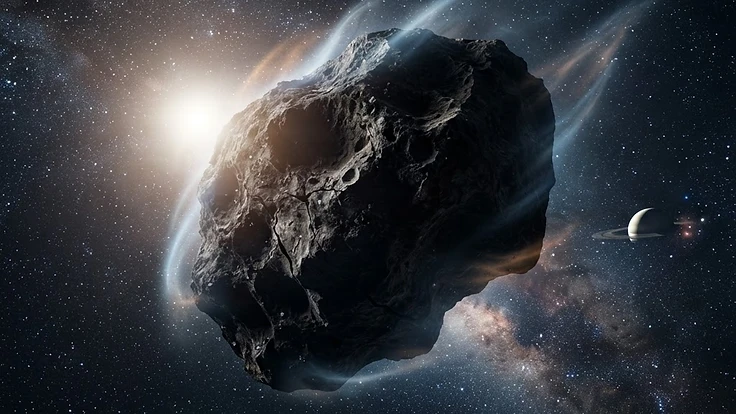
Asteroids Can Sustain Extremely Thin Atmospheres Under Rare Conditions
When we imagine an atmosphere, we typically think of the thick, protective blanket surrounding Earth. In the vacuum of space, however, the definition of an atmosphere shifts from a breathable mixture to any concentration of gas held by a body’s gravity. While most asteroids are airless relics of the early solar system, researchers have identified mechanisms that allow some to briefly cling to trace gases.
Near-Earth Asteroid Watch
Powered by Flarient — embed this on your site →
This fascinating interplay between gravity and solar activity challenges our traditional understanding of what constitutes a world.
The Science Behind It
Gravity is the primary barrier for any celestial body attempting to hold an atmosphere. Small asteroids possess such weak gravitational fields that gas molecules easily escape into space at low speeds. For a body to retain gas, it must be massive enough to prevent molecular leakage, or it must be extremely cold to keep gas molecules sluggish.
Most asteroids fail these criteria entirely.
However, outgassing from volatile materials provides a temporary solution. When an asteroid approaches the sun, heat can liberate trapped ices or minerals, creating a transient shroud of dust and gas. This is a common feature in comets, which are often described as icy cousins to asteroids.
Scientists monitor these events using deep space sensors to analyse how gas pressure interacts with the surface crust.
Real-World Implications
Understanding the presence of gas on a near-Earth asteroid is critical for planetary defence. If an asteroid has even a thin envelope of gas or dust, it can alter the way sunlight reflects off its surface, a phenomenon known as the Yarkovsky effect. This force changes the orbit of the rock over time, which makes predicting a potential impact significantly more complex for organisations like NASA.
Furthermore, these gaseous envelopes provide a laboratory for studying the building blocks of the solar system. By analysing the chemical composition of these trace atmospheres, researchers can infer the history of water and organic molecules in the early solar neighbourhood. This research complements our work in Identifying Near-Earth Asteroid Hazards, ensuring that we stay informed about the objects that cross our path.
What You Can Do
Monitoring the heavens requires the right tools to distinguish between stable planets and passing space rocks. You can use our embeddable widgets to track the latest data from orbiting observatories and stay updated on asteroid movements. By observing how these bodies behave, you can contribute to a broader understanding of the dynamics within our solar neighbourhood.
If you are interested in broader space phenomena, you might find that tracking geomagnetic activity provides a perfect balance to asteroid monitoring. You can use our local aurora forecast to see if the solar wind is currently shaping our own atmosphere in spectacular ways. Whether you are observing a distant rock or the dance of the northern lights, the goal is always to keep your eyes on the sky.
For those who prefer experience over apps, [guided aurora tours](https://vi.me/HuXHi) in Tromsø, Abisko and the Kola Peninsula combine local dark-sky knowledge with on-the-night forecasting.
Key Takeaways
Asteroids rarely possess atmospheres in the way we traditionally understand them. They lack the massive gravitational wells necessary to hold dense gases over geological timescales. Any gas observed is typically ephemeral, driven by thermal activity or volatile release during a solar encounter.
Despite their small size, these objects influence our safety and our scientific knowledge. Continued observation remains the best defence against surprises in the dark. By keeping track of these celestial wanderers, we refine our ability to predict their paths and protect our home planet.
People Also Ask
Why do asteroids lack thick atmospheres?+
Asteroids lack the significant gravitational pull required to retain gas molecules. Because their mass is relatively low, the escape velocity is quite small, meaning any gases released from their surface or trapped within their structure quickly drift away into the vacuum of space.
What is the difference between an asteroid and a comet?+
Asteroids are primarily rocky or metallic bodies, while comets contain large amounts of frozen gases and ices. As comets approach the sun, their ice sublimates to create a visible atmosphere called a coma. Asteroids generally remain inert unless they contain specific volatile minerals.
How do scientists detect gas around an asteroid?+
Scientists use spectroscopy and high-resolution imaging to detect chemical signatures. By measuring how light reflects off an object, researchers can identify the presence of specific gases or dust clouds that might indicate outgassing or active volcanic processes occurring on the surface.
Continue Reading
Forecast These Questions
View all →Express your probability on these active forecast questions.
Will a near-Earth object pass within 1 Lunar Distance this quarter?
35%
Community
Will a near-Earth object pass within 1 Lunar Distance this quarter?
35%
Community
Will a newly discovered asteroid larger than 10m pass within 5 LD this month?
35%
Community
Will a near-Earth object pass within 5 Lunar Distances this month?
45%
Community