Astrophysicists Detect Black Holes Through Indirect Observation
Black holes do not emit light, so scientists use creative methods to map these invisible giants. By studying their effects on surrounding matter, we can uncover the mysteries of the most extreme objects in the universe.
Astrophysicists Detect Black Holes Through Indirect Observation
Black holes represent some of the most mysterious phenomena in the cosmos. Because their gravitational pull is so immense that even light cannot escape, they remain invisible to traditional optical telescopes. Astrophysicists must therefore act like celestial detectives, piecing together evidence from the environment surrounding these voids to confirm their existence and measure their properties.
Understanding how we identify these objects is central to modern astronomy. By observing the behaviour of nearby stars and gas clouds, scientists can infer the presence of a supermassive object hidden from view. This process of indirect observation has fundamentally changed our perception of the deep sky.
The Science Behind It
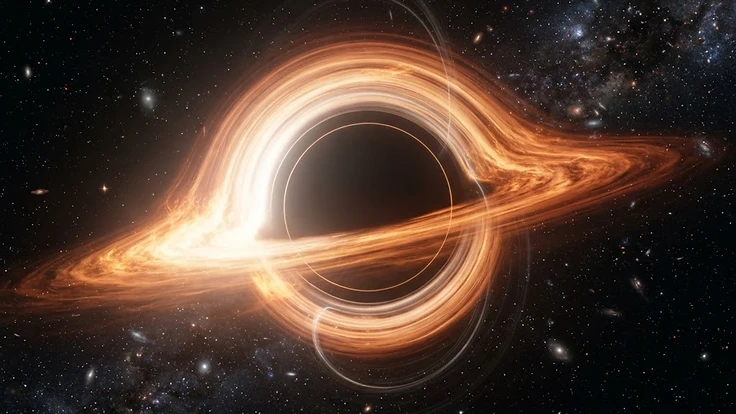
Most black holes are studied by observing their impact on the surrounding environment. When a black hole orbits a companion star, it pulls gas from the star into an accretion disk. This matter orbits at immense speeds and reaches temperatures of millions of degrees, causing it to emit powerful X-rays that telescopes like the Chandra X-ray Observatory can detect.
Another method involves monitoring the orbital motion of stars at the centre of galaxies. If a star appears to orbit a dark, empty point at high velocity, it suggests the presence of a concentrated mass. Scientists often use the glossary to define these specific gravitational interactions, which helps in standardising research across the global scientific community.
Real-World Implications
While black holes appear distant, the physics governing them mirrors the extreme forces we study in our own solar system. Just as researchers model the accretion of gas onto a black hole, they also monitor the solar wind, which travels between 400 and 700 kilometres per second, as it interacts with our magnetosphere. Understanding these high-energy environments helps us prepare for space weather events that could affect satellite infrastructure.
Studying black holes also pushes the boundaries of General Relativity. By observing these objects, scientists refine their understanding of spacetime, which ultimately informs the technology required for precise GPS and global communications. Knowledge of these extreme gravitational wells provides a laboratory for testing the laws of physics under conditions we could never replicate on Earth.
What You Can Do
If you have an interest in the mechanics of the universe, you can track current solar activity using Flarient's real-time tools. Monitoring the Kp index or checking our local aurora forecast provides a direct way to see how space weather affects our atmosphere. You can also explore our archive to see how past high-energy events have shaped our current data models.
For those who prefer a more immersive experience, there are many opportunities to view the night sky. Joining guided aurora tours in locations like Iceland, Norway, Canada, Finland, Sweden, or Alaska allows you to witness the visual effects of solar activity firsthand. These experiences ground the complex science of black holes and solar physics in a beautiful, tangible reality.
If planning around Kp and cloud cover feels like work, guided aurora tours in Norway, Finland and Iceland remove the guesswork — a guide watches the data while you stay warm until it's time to move.
Key Takeaways
Astrophysicists have developed sophisticated ways to detect black holes through the light emitted by surrounding matter and the orbital patterns of nearby stars. These methods rely on the same fundamental principles of gravity and electromagnetism that we use to monitor our own sun.
By keeping up to date with space weather and celestial dynamics, you gain a better appreciation for the forces that shape our universe. Science is not just an academic pursuit, but a way to better understand the environment of our planet within the broader cosmic landscape.
People Also Ask
Can we see a black hole directly?+
No, black holes do not emit or reflect light, making them invisible to traditional optical telescopes. Instead, scientists rely on observing the behaviour of nearby stars, gas clouds, and the intense X-rays produced by matter heating up in an accretion disk before it falls past the event horizon.
What happens if a star gets too close to a black hole?+
If a star strays too close, it undergoes a process called tidal disruption. The extreme gravitational forces from the black hole stretch the star, pulling it apart into a stream of gas. This matter then spirals into the black hole, releasing a massive burst of energy and light.
How do we know the mass of a black hole?+
Astrophysicists calculate the mass of a black hole by observing how it affects its surroundings. By tracking the orbital speed and distance of stars or gas clouds circling the black hole, scientists use gravitational laws to determine the central mass required to keep those objects in their specific orbits.
Continue Reading
Forecast These Questions
View all →Express your probability on these active forecast questions.