Corporate Space Weather Services Provide Essential Infrastructure Protection
Modern businesses rely on satellite technology that is vulnerable to solar storms. Discover the companies and tools providing the monitoring services required to protect critical assets.
Corporate Space Weather Services Provide Essential Infrastructure Protection
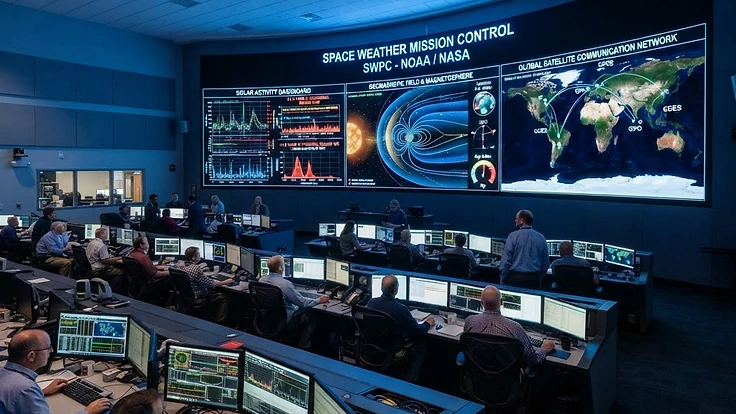
Space weather has shifted from a niche scientific interest to a critical business concern. As reliance on satellite communications, GPS navigation, and high-altitude power grids grows, the demand for precise space weather forecasting services has risen. Companies and government agencies now require real time data to mitigate risks from solar activity.
Live Solar Flare Monitor
Powered by Flarient — embed this on your site →
While organizations like the NOAA SWPC provide essential foundational data, private sector firms offer tailored solutions for specific industries. These services translate raw scientific measurements into actionable insights, helping operators manage assets during periods of heightened solar activity.
The Science Behind It
The sun operates on roughly 11 year cycles, with Solar Cycle 25 beginning in December 2019. During these periods, the sun releases energy through flares and coronal mass ejections. These eruptions send charged particles hurtling through space, sometimes travelling at speeds up to 3,000 km/s.
When these particles reach Earth, they interact with our magnetic field to produce a geomagnetic storm. Scientists measure the severity of these events using the G-scale which ranges from G1 to G5. These storms can disrupt the ionosphere and affect the accuracy of signal propagation.
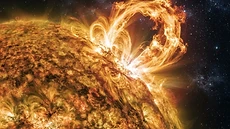
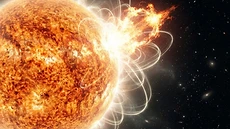
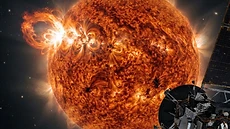
Solar flares are categorised by intensity from A to X, where each class is ten times more powerful than the last. You can explore solar imagery to see how these eruptions look as they leave the sun. Understanding these phenomena is vital for anyone managing hardware in orbit or sensitive terrestrial infrastructure.
Real-World Implications
Space weather directly influences global communications and power stability. High levels of geomagnetic activity can induce currents in long distance pipelines and power lines, potentially leading to widespread outages. These risks are documented in our storm leaderboard for historical context.
Satellite operators face persistent challenges regarding orbital drag and signal interference. Solar particle events often cause communication blackouts for aircraft flying polar routes or those relying on precise timing signals. For those interested in the underlying mechanics, reading about solar flares and the reliability of GPS navigation provides deeper technical insight.
What You Can Do
Staying informed is the first step toward effective risk management. You do not need to be a heliophysicist to monitor solar activity, as many accessible tools provide clear status updates. Beginners should start by checking a glossary to familiarise themselves with key terminology.
If you want to track the current state of the space environment, you can use a free live dashboard to monitor activity in real time. Businesses often integrate embeddable widgets into their own internal portals to ensure their operations teams have immediate visibility. Those looking to chase the lights can find [guided aurora tours](https://vi.me/HuXHi) across Iceland, Norway, Canada, and Alaska, offering a safe way to witness the visual effects of these storms firsthand.
Key Takeaways
Space weather forecasting is a vital component of modern risk management for any tech dependent organisation. By understanding the solar cycle and utilizing professional monitoring tools, businesses can protect their assets from the impacts of solar flares and geomagnetic storms. Reliability depends on foresight and preparation.
Whether you are monitoring satellite health or ensuring grid stability, the ability to anticipate solar events is a competitive advantage. Continual learning through resources like our blog ensures your team remains ready for whatever the sun sends our way. Proper preparation transforms unpredictable space weather into a manageable operational variable.
People Also Ask
How do solar flares affect GPS accuracy?+
Solar flares increase ionisation in the upper atmosphere, which can delay or scatter satellite signals. This disturbance degrades the signal-to-noise ratio and introduces timing errors, often leading to reduced precision in GPS positioning for aviation, shipping, and autonomous vehicle systems.
What is the difference between a solar flare and a CME?+
A solar flare is a sudden, intense flash of electromagnetic radiation emitted from the sun's surface. A coronal mass ejection, or CME, is a massive burst of solar wind and magnetic fields that physically expels plasma into space, potentially causing geomagnetic storms when it impacts Earth.
Can I predict space weather myself?+
While professional forecasting requires complex numerical models and data from satellites like SDO, you can monitor solar activity using real-time data portals. Tracking indicators like the Kp index or solar flux levels helps enthusiasts and businesses gauge the likelihood of imminent space weather events.
Continue Reading
Forecast These Questions
View all →Express your probability on these active forecast questions.