Defining the Distinctions Between Asteroids and Meteors
Commonly confused, asteroids and meteors represent distinct stages of celestial objects. Learn the scientific definitions and how to distinguish these space rocks.
Asteroids and Meteors Are Distinct Celestial Entities
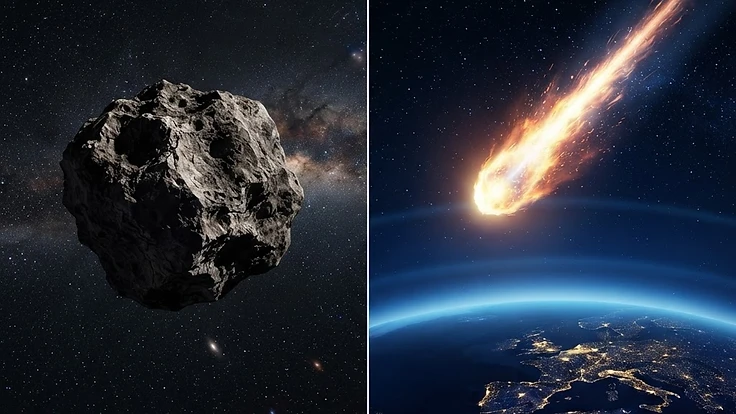
Many people use the terms asteroid and meteor interchangeably, yet they represent entirely different physical states. An asteroid is a rocky body orbiting the Sun, primarily located in the main belt between Mars and Jupiter. A meteor is simply the light phenomenon caused by a small piece of space debris entering the atmosphere.
Near-Earth Asteroid Watch
Powered by Flarient — embed this on your site →
Understanding these labels is essential for anyone interested in astronomy. While they share a common origin as remnants from the formation of our solar system, their behaviour and classification change depending on their location and trajectory. Distinguishing between asteroids and meteors helps us categorise the cosmic environment surrounding our planet.
The Science Behind It
Asteroids are essentially miniature planets that lack the size and spherical shape of true planetary bodies. They vary significantly in size, ranging from tiny boulders to massive rocks hundreds of kilometres across. According to NASA, many asteroids are found in stable orbits, though some are classified as a near-Earth asteroid if their path brings them closer to our own orbit.
When a fragment breaks off an asteroid or comes from a comet, it becomes a meteoroid. This object is still in space and has not yet hit our atmosphere. The transition happens the moment this fragment strikes the Earth's upper atmosphere at high velocity.
The intense friction causes the air to glow, creating the streak of light we call a meteor.
If the object is large enough to survive the passage through the atmosphere and hits the ground, it is then reclassified as a meteorite. This journey from space rock to atmospheric streak and finally to a ground specimen is the standard lifecycle. You can find detailed definitions for these stages in our glossary.
Real-World Implications
Large objects hitting Earth, such as the famous Chicxulub impactor 66 million years ago, represent a significant concern for planetary defence. Scientists constantly track the paths of space rocks to ensure we have adequate warning of a potential close approach. This monitoring is vital for global safety and the long-term preservation of infrastructure.
While meteors typically burn up harmlessly and provide a beautiful display in the night sky, their study helps us understand the composition of the early solar system. For those interested in historical data, the archive contains records of past atmospheric events. These occurrences remind us that Earth exists within a dynamic, moving cosmic neighbourhood.
What You Can Do
If you want to track space weather or incoming objects, you can use our live dashboard to stay informed about current conditions. Keeping an eye on the space-programs section allows you to follow missions that seek to land on or study these rocky bodies in detail. Engaging with scientific data provides a clearer picture of our place in the galaxy.
For those who love the night sky, checking local conditions is often the first step toward an amateur astronomy session. Our platform provides the data you need to distinguish between fleeting streaks and permanent celestial markers. You can even use our embeddable widgets on your own site to display real-time tracking data for your community.
Key Takeaways
Asteroids are stable, rocky objects orbiting the Sun, whereas meteors are temporary light events in our atmosphere. Every meteor was once a meteoroid, and any surviving piece that reaches the surface is a meteorite. These objects provide us with crucial information regarding the history of our solar system.
By keeping track of these celestial bodies, we can better appreciate the complex nature of our environment. Understanding the difference prevents confusion and promotes a more accurate view of space science. Exploring these topics further in our blog offers even more insight into the mysteries of the universe.
People Also Ask
What is the difference between a meteoroid and a meteorite?+
A meteoroid is a small piece of debris in space. Once it enters the Earth's atmosphere and glows, it is called a meteor. If the object is large enough to survive the transit and impacts the ground, it is officially classified as a meteorite.
Are all asteroids dangerous to Earth?+
No. Most asteroids orbit safely in the main belt between Mars and Jupiter. While some are categorised as near-Earth objects due to their orbital paths, NASA actively monitors these to determine if they pose any realistic threat of impact to our planet.
How fast do meteors travel when they hit the atmosphere?+
Meteors can enter the Earth's atmosphere at speeds ranging from 11 to 72 kilometres per second. This immense velocity creates significant friction with air molecules, which superheats the object and the surrounding air, creating the visible streak of light observed from the ground.
Continue Reading
Forecast These Questions
View all →Express your probability on these active forecast questions.