Distinguishing Between Asteroids and Meteors
While often used interchangeably in casual conversation, asteroids and meteors represent distinct stages of a celestial body's journey. Understanding these differences clarifies our place in the solar system.
Distinguishing Between Asteroids and Meteors
Space is vast, and the objects moving through it are defined largely by their location and their life cycle. Casual observers often conflate terms like asteroid, meteor, and meteorite, yet these labels identify very different physical realities in our solar system.
Near-Earth Asteroid Watch
Powered by Flarient — embed this on your site →
Clarifying these distinctions helps us better understand the dynamics of space. Whether we are discussing a near-Earth asteroid that requires monitoring or the brief flash of light from a meteor in our atmosphere, each term conveys essential information about size, composition, and potential impact.
The Science Behind It
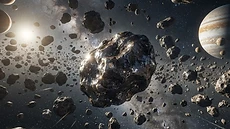
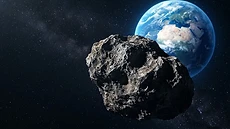
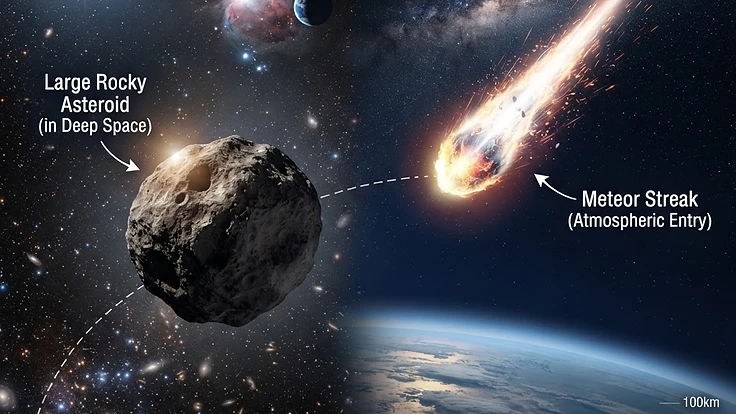
An asteroid is a rocky remnant from the early formation of the solar system. Most orbit the Sun between Mars and Jupiter, though some occupy near-Earth asteroid orbits that bring them closer to our own planet.
These bodies vary in size, ranging from mere metres across to hundreds of kilometres wide. Their composition often reflects the primitive materials that existed during the birth of the planets, making them vital subjects for researchers studying solar system history.
When a smaller fragment breaks away from an asteroid or a comet, it becomes a meteoroid. If this small rock enters Earth's atmosphere, the extreme heat caused by atmospheric friction creates a streak of light.
This brilliant flash is what we call a meteor. If the object is large enough to survive the passage through the atmosphere and reach the ground, we rename the remaining fragment a meteorite.
Real-World Implications
Distinguishing these objects is not just an academic exercise. Governments and space agencies rely on accurate terminology to assess risk and plan missions, ensuring we can detect potential threats well in advance.
Much like how we monitor the K-index to understand geomagnetic storms that might disrupt satellite communications, we track asteroids to maintain planetary defence. These efforts rely on precise observation data rather than speculation.
Understanding these phenomena is just as important as studying the sun's behaviour. You can explore how these solar interactions shape our environment by reading about [How Space Weather Influences Life on Earth](blog/how-space-weather-influences-life-on-earth) to see the broader picture of space hazards.
What You Can Do
Staying informed does not require a degree in astrophysics. You can familiarise yourself with the terminology using a reliable glossary to ensure you always have the correct context for space news.
If you are interested in the broader environment of our solar system, keeping an eye on live tracking tools is highly recommended. You can gain a better perspective on these cycles by exploring Humanity Has Successfully Landed on Multiple Asteroids to see how far our exploration capabilities have progressed.
Using accessible technology allows enthusiasts to participate in citizen science and stay updated on astronomical events. Whether you are observing the night sky for meteors or tracking solar activity, these habits turn abstract science into a tangible hobby.
Key Takeaways
Asteroids are the large, orbiting parents of the smaller fragments we see as meteors. By maintaining this distinction, we improve our ability to communicate about space phenomena accurately and responsibly.
Knowledge of these differences serves as a foundation for broader space literacy. As we continue to push the boundaries of exploration, understanding the objects that share our orbit remains a vital part of our collective human experience.
People Also Ask
What is the difference between a meteor and a meteorite?+
A meteor is the light phenomenon produced when a meteoroid enters the Earth's atmosphere and burns up due to friction. If any part of that object survives the journey and hits the ground, the remaining material is officially classified as a meteorite.
How large are most asteroids?+
Asteroids vary significantly in size. While the largest, Ceres, is about 940 kilometres in diameter, most asteroids are much smaller, ranging from a few metres to several kilometres wide. Scientists categorize them based on these dimensions to assess their potential threat level.
Where do most meteoroids come from?+
Most meteoroids are small fragments broken off from asteroids or icy debris shed by comets as they travel through the solar system. When Earth's orbit intersects with these debris trails, we experience meteor showers.
Continue Reading
Forecast These Questions
View all →Express your probability on these active forecast questions.