How Astronomers Determine the Scale of the Universe
Measuring the vast distances of the cosmos requires a layered approach, moving from basic geometry to the light of distant stars. We explore the methods that reveal the size of space.
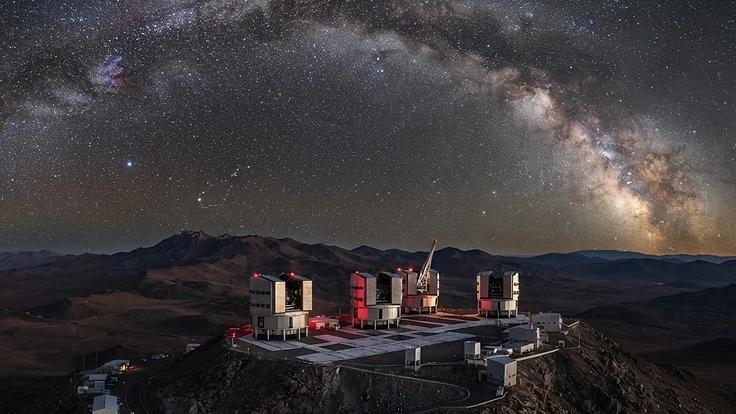
Measuring the Vast Distances of the Cosmos
Determining how far a star or galaxy sits from Earth is one of the most significant challenges in astrophysics. Because we cannot simply travel to these distant points with a measuring tape, astronomers rely on a creative sequence of methods known as the cosmic distance ladder.
Each rung of this ladder relies on the previous one to reach further into the void. By combining geometric precision with our understanding of stellar physics, scientists have mapped the scale of our universe with impressive accuracy.
The Science of Stellar Parallax and Standard Candles
For nearby stars, astronomers use a technique called parallax. This is the same effect you see when holding your finger at arm's length and alternating which eye you close, as the position of the finger shifts against the background.
By observing a star from opposite sides of Earth's orbit around the Sun, astronomers can calculate its distance based on the small change in its position. This method remains the gold standard for nearby objects, often cross-referenced with data from NASA space observatories.
Once stars move beyond the reach of parallax, we look to standard candles. These are objects with a known intrinsic brightness, such as Cepheid variable stars or Type Ia supernovae.
By comparing how bright these objects should be with how bright they appear from Earth, we can deduce their distance. It is much like estimating how far away a streetlamp is by knowing how much light it actually emits.
Real-World Implications of Cosmic Distance
Understanding the scale of space is not merely an academic exercise. Knowing exactly where celestial objects reside is vital for tracking any potential near-Earth asteroid that might cross our path.
This spatial awareness is also critical for satellite reentry and the physics of orbital decay, where we must predict the precise trajectory of objects returning through our atmosphere. Accurate distance measurements underpin everything from GPS navigation to global telecommunications.
Furthermore, these measurements allow us to study the expansion rate of the universe. By observing the light from distant galaxies, scientists can track how solar flares are significantly larger than Earth and how cosmic events influence the broader structure of space.
How You Can Contribute to the Conversation
If you find these cosmic scales fascinating, you can start by learning how to spot the effects of space weather from your own backyard. You might begin by checking a local aurora forecast to see if the solar wind is currently affecting our upper atmosphere.
While space distance is immense, the impact of solar activity is often much closer to home. You can even embeddable widgets on your own website to track live space metrics, keeping you connected to the data that defines our place in the galaxy.
For those who prefer a more tactile experience, keep an eye on our glossary to stay sharp on the latest terminology. Staying informed about the environment around our planet is the first step toward understanding the deeper mysteries of the universe.
If you'd rather leave the planning to someone else, [guided aurora tours](https://vi.me/HuXHi) across Iceland, Norway, Canada and Finland put you under the right sky with local experts who know exactly when to head out.
Key Takeaways
Astronomers measure the cosmos by layering different techniques, starting with the geometry of parallax for nearby stars. They then transition to standard candles to gauge the distance to far-off galaxies, building a ladder that spans billions of light-years.
These measurements are essential for our safety, technology, and fundamental understanding of how the universe grows. Whether tracking an asteroid or monitoring the K-index during a storm, the ability to measure space is central to our survival. We live in a vast, connected system where local events are just one part of a much larger story.
People Also Ask
What is the cosmic distance ladder?+
The cosmic distance ladder is a series of astronomical methods used to measure distances to objects in space. Each method builds upon the previous one, starting with parallax for nearby stars and moving to standard candles like Cepheid variables and Type Ia supernovae for deep-space measurements.
Can we measure the distance to every star?+
No, currently we cannot measure every star precisely. While the parallax method works well for stars within our galaxy, it becomes difficult as objects get further away. We rely on standard candles for more distant stars, which provide excellent estimates but inherently carry more uncertainty than geometric measurements.
How do we know how far away a galaxy is?+
Astronomers use standard candles, such as Type Ia supernovae, which have a known, uniform brightness. By measuring how dim these explosions appear from Earth, scientists can calculate their distance. This allows us to map the distribution of galaxies across the observable universe, including their recession speed due to expansion.
Continue Reading
Forecast These Questions
View all →Express your probability on these active forecast questions.