Solar Flares Can Induce Power Outages on Earth
Solar flares and coronal mass ejections drive geomagnetic storms that challenge modern power grids. Understanding the physics behind these events is essential for grid resilience.
Solar Flares Can Induce Power Outages on Earth
Solar activity shapes our technological landscape in ways most people rarely consider. While the sun provides the energy for life, its periodic outbursts can disrupt the electrical networks that power our homes, businesses, and critical infrastructure.
Live Solar Flare Monitor
Powered by Flarient — embed this on your site →
Disruptions typically occur when solar material reaches our planet, affecting systems that rely on stable magnetic fields. Understanding this relationship helps us manage risk during periods of high solar activity.
The Science Behind It
A solar flare is an intense burst of radiation originating from the release of magnetic energy associated with sunspots. These flares travel at the speed of light, reaching Earth in about eight minutes.
However, it is the coronal mass ejection, or CME, that poses the most significant threat to our power grids. These massive clouds of solar plasma travel at varying speeds, sometimes reaching up to 3,000 kilometres per second.
When these particles strike the Earth, they interact with our magnetosphere. If the solar magnetic field opposes our own, it triggers a geomagnetic storm, which we quantify using the Kp index.
The intensity of these storms can also be measured via the Dst index, where negative values indicate significant magnetic disturbances. You can learn more about these mechanisms in our glossary.
Real-World Implications
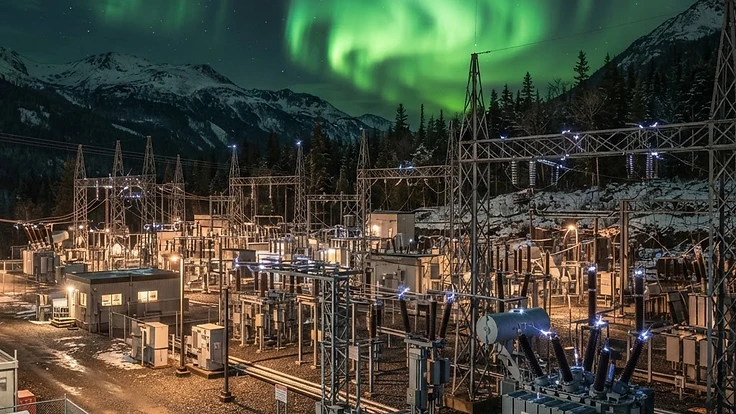
Geomagnetic storms induce electrical currents in long-distance conductors, such as high-voltage transmission lines. These geomagnetically induced currents can overwhelm transformers and lead to significant operational failures.
The historical precedent is set by the 1859 Carrington Event, a massive geomagnetic disturbance that caused telegraph systems to fail globally. In our modern era, a storm of that magnitude would have far-reaching consequences for power distribution and telecommunications.
As we progress through Solar Cycle 25, which began in December 2019, monitoring solar imagery is vital for grid operators. Intense storms can also affect satellite operations, leading to disruptions in GPS and high-frequency radio communications.
Regularly reviewing past events allows researchers to refine their modelling of potential grid vulnerabilities. Scientists constantly analyse how these space weather events threaten both orbital assets and terrestrial infrastructure, as detailed in our blog.
What You Can Do
Staying informed is the best defence against space weather-related disruptions. If you are an amateur radio enthusiast, consider using tools that track HF radio propagation to see how ionospheric changes impact your signal.
For those hoping to witness the atmospheric impact of these storms, such as the aurora, planning is essential. You might consider booking guided aurora tours in destinations like Iceland, Norway, Canada, or Alaska to maximise your chances of a successful viewing.
For those managing their own websites or community hubs, displaying live data can help others stay alert. You can embed on your site real-time data feeds that provide essential context during active solar cycles.
Keep track of your local conditions by checking for an aurora forecast before heading out. Being prepared means understanding when the environment above us is becoming increasingly active.
Key Takeaways
Solar activity is a natural cycle, not an unpredictable disaster. While solar flares release massive amounts of energy, power grid operators employ sophisticated mitigation strategies to maintain stability during geomagnetic storms.
By leveraging tools that provide real-time monitoring and analysis, we can better understand how the sun impacts our technology. Continued research and public awareness ensure that we can enjoy the beauty of the northern lights while keeping the lights on at home.
For observers
If this article prompts you to try watching or photographing sunspots (with appropriate solar filters and safety precautions), one accessible route is a compact astrophotography setup; From forecast to photograph.
Ad · Affiliate link. Flarient may earn a commission if you purchase through this link, at no additional cost to you.
People Also Ask
What is the difference between a solar flare and a CME?+
A solar flare is a burst of electromagnetic radiation, which arrives at Earth in about eight minutes. A coronal mass ejection, or CME, is a massive cloud of solar plasma and magnetic field that takes one to three days to reach Earth and causes geomagnetic storms.
How often do solar flares occur?+
Solar flare frequency correlates with the approximately 11-year solar cycle. During solar maximum, sunspot activity is high and multiple flares can occur daily. During solar minimum, the frequency and intensity of flares significantly decrease, though they can still occur occasionally.
Can solar storms damage home electronics?+
Most home electronics are generally safe from geomagnetic storms. These storms primarily affect large-scale, long-distance infrastructure like high-voltage power transmission lines, undersea cables, and long pipelines where large geomagnetically induced currents can build up.
Continue Reading
Forecast These Questions
View all →Express your probability on these active forecast questions.