Sunspots and Their Role in Shaping Space Weather
Sunspots are more than just dark patches on the solar surface. They are the primary drivers of solar activity, directly influencing space weather events that affect our technology and atmosphere.
Sunspots and Their Role in Shaping Space Weather
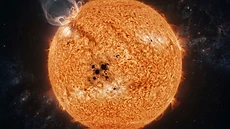
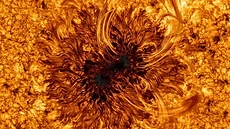
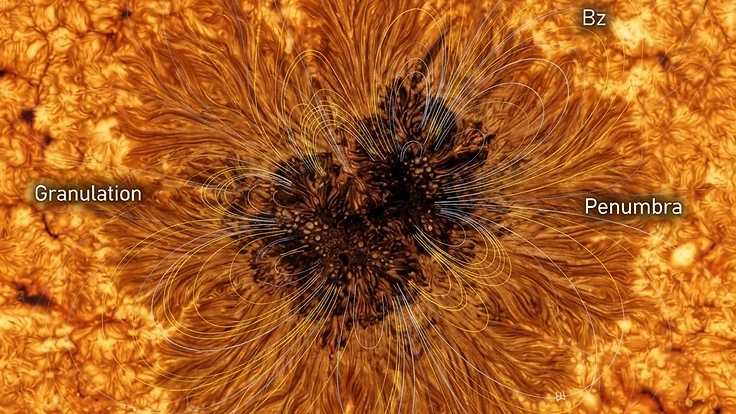
Sunspots appear as dark, relatively cool patches on the photosphere of the Sun. They are intense concentrations of magnetic field lines that inhibit the normal convection of hot plasma from the interior.
While they appear static from Earth, they act as the engine for solar weather. Understanding them helps us predict events that can disrupt satellites, power grids, and radio communication systems.
The Science Behind It
The solar cycle spans roughly 11 years, during which the number of sunspots waxes and wanes. Solar Cycle 25 began in December 2019, signalling a period of increasing magnetic complexity.
These spots are formed when magnetic field lines become twisted and tangled deep within the Sun. Eventually, this tension snaps and releases energy in the form of solar flares, which are classified by intensity as A, B, C, M, or X class.
Flares release electromagnetic radiation at the speed of light, while Coronal Mass Ejections (CMEs) launch charged particles into space. CMEs can travel at speeds up to 3,000 km/s, far faster than the standard solar wind of 400 to 700 km/s.
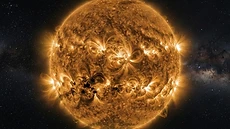
When these particles collide with the magnetic field of our planet, they trigger a geomagnetic storm. The intensity of these events is measured by the Dst index, where values like -100 nT correspond to a G3 storm. You can view high-resolution solar imagery to track these active regions as they rotate across the solar disc.
Real-World Implications
Space weather impacts modern life in ways we often take for granted. Strong solar eruptions can induce currents in long-distance power lines, potentially leading to transformer damage and grid instability.
Satellite operators must also remain vigilant, as increased drag from atmospheric heating can alter orbital trajectories. High-energy particles can cause single-event upsets in electronic components, which poses risks to both robotic craft and humans aboard the ISS at its 408 km altitude.
Navigation systems such as GPS rely on signals passing through the ionosphere. As discussed in our solar flares and the reliability of GPS navigation article, sudden ionospheric disturbances can degrade positioning accuracy significantly.
These impacts extend to aviation, particularly flights travelling at high latitudes. Pilots may experience communication blackouts during intense geomagnetic storm activity, necessitating changes to flight paths for safety reasons.
What You Can Do
Staying informed about solar activity is the best way to mitigate these risks. You can monitor the current space weather state to understand if a solar event might influence your area.
If you are an enthusiast of the night sky, checking the [local aurora forecast](/#local) is essential before travelling. For those seeking the best experience, we recommend booking guided aurora tours in locations like Iceland, Norway, Canada, or Alaska where expert guides help you navigate the best viewing conditions.
Those who run websites can also embed on your site to display live data for their own communities. Having access to real-time information allows you to anticipate potential disruptions before they manifest in your local power or communication systems.
Key Takeaways
Sunspots remain the most visible indicator of the internal magnetic machinations of the Sun. Their cycle defines the rhythm of our solar system and determines the frequency of space weather phenomena.
While we cannot stop solar flares or CMEs, our ability to model and track them has reached new levels of precision. By leveraging scientific data, we can protect critical infrastructure and better appreciate the celestial dance occurring 150 million kilometres away.
Learning to interpret solar activity data transforms these invisible forces into actionable knowledge. Keep exploring the blog to deepen your understanding of how these solar dynamics relate to the wider cosmic environment.
Field note
If the article makes you want to image sunspots or track active regions, one compact option for portable solar and night sky imaging is Explore a compact capture setup. It shows an accessible route from forecast to photograph.
Ad · Affiliate link. Flarient may earn a commission if you purchase through this link, at no additional cost to you.
People Also Ask
Do sunspots get hotter than the rest of the Sun?+
No, sunspots are actually cooler than the surrounding photosphere. They appear dark because they are about 1,500 to 2,000 degrees Celsius cooler than the solar surface. The intense magnetic fields within the spot inhibit the convective flow of hot plasma from the Sun's interior.
Can sunspots affect human health?+
There is no definitive scientific evidence linking sunspots or solar flares directly to human health issues. While solar activity can disrupt technological infrastructure and satellite navigation, it does not have a biological impact on the human body or long-term health.
How do we name sunspots?+
The National Oceanic and Atmospheric Administration assigns a unique four-digit number to each sunspot group as it rotates into view on the solar disk. This system allows scientists to track the evolution and movement of active regions across the Sun over time.
Continue Reading
Forecast These Questions
View all →Express your probability on these active forecast questions.