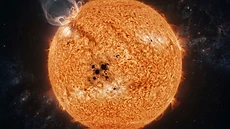
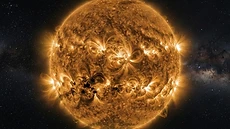
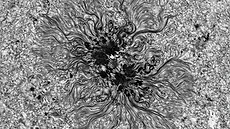
Sunspots and Their Fundamental Role in Shaping Space Weather
Sunspots are more than dark blemishes on the solar surface. They act as harbingers of solar activity, directly influencing the space weather that impacts our global technology and orbital infrastructure.
Sunspots and Their Fundamental Role in Shaping Space Weather
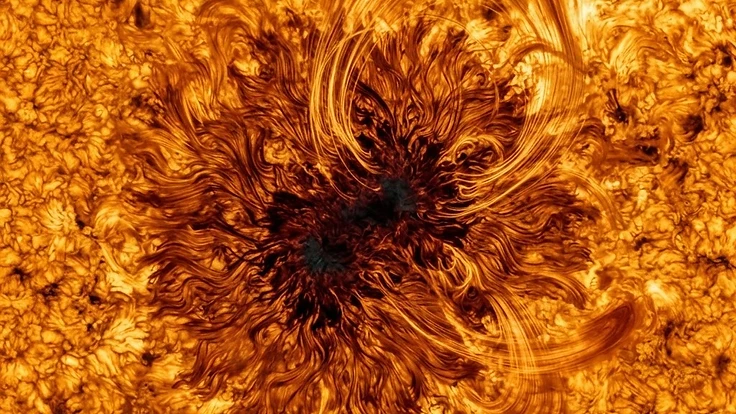
Sunspots are the dark, cooler regions on the surface of the sun that serve as visual indicators of magnetic turbulence. While they may appear minor from millions of kilometres away, these features are the primary source of the energy that drives space weather across our solar system.
Understanding how these regions function is vital for protecting the technologies we rely on daily. As we progress through Solar Cycle 25, which began in late 2019, observing these patterns helps us anticipate geomagnetic events that can disrupt satellites and power grids.
The Science Behind It
Sunspots occur where intense magnetic fields push through the solar photosphere. These fields are so strong that they inhibit the process of convection, preventing hotter material from rising to the surface and causing the spot to remain cooler than its surroundings.
Because the sun is a fluid, these magnetic fields become twisted and tangled over time. This tension eventually snaps and reconnects, releasing massive amounts of energy in the form of solar flares or coronal mass ejections. You can see detailed solar imagery of these dynamic events in our solar gallery to better understand the scale of solar activity.
While light from a flare travels at approximately 300,000 km/s, solar particles and magnetic structures move much slower. Coronal mass ejections, or CMEs, typically travel between 400 and 3,000 km/s. When these clouds of charged particles strike Earth, they interact with our magnetic field to create a [geomagnetic storm](/ #kp).
Real-World Implications
When a strong geomagnetic storm occurs, the consequences for modern technology are significant. High-energy particles can interfere with satellite electronics, degrade GPS accuracy, and cause electrical currents to surge in power grids, potentially leading to equipment damage.
Our reliance on orbital systems means that space weather is no longer a niche scientific interest but a critical infrastructure concern. Satellites at the altitude of the International Space Station, roughly 408 km, are particularly susceptible to the increased atmospheric drag caused by solar heating during peak solar cycles. For a deeper look at these differences, read how solar flares and coronal mass ejections are distinct solar events.
The most visible effect of these interactions is the [aurora](/ #aurora), which occurs when charged particles enter our upper atmosphere. While beautiful, these displays are the result of significant energy deposition into the geomagnetic field. Tracking this activity allows us to prepare for the fluctuations that impact radio communications and satellite navigation.
What You Can Do
Monitoring space weather is now accessible to everyone through modern digital tools. By staying informed about current solar indices, you can better understand how solar activity might impact local communications or your weekend travel plans.
If you want to view the best light shows, guided aurora tours in locations like Iceland, Norway, Canada, and Alaska offer unique opportunities to witness this phenomenon safely. It is also useful to keep a glossary of technical terms on hand to decode the complex data streams provided by agencies like the NOAA SWPC.
Websites can easily integrate these data streams using embeddable widgets to provide real-time updates to a broader audience. Staying educated on these cycles helps remove the mystery from solar phenomena and allows for proactive planning in an increasingly connected world.
Key Takeaways
Sunspots are the engines of solar weather, dictating the intensity of events that reach our planet. Their magnetic nature links directly to the energy released during flares and mass ejections, which in turn drive geomagnetic disturbances.
By observing the 11-year solar cycle, we can better forecast the risk to our power, navigation, and communication infrastructure. While we cannot prevent space weather, informed observation is our best form of defence. As our reliance on space-based technology grows, understanding these solar rhythms will remain an essential skill for the future.
A closer look
Sunspots are visible markers of the magnetic activity behind space weather, making solar observation a natural way to connect the science with the sky. For readers curious about documenting the Sun’s changing face, explore one way to capture the sky.
Ad · Affiliate link. Flarient may earn a commission if you purchase through this link, at no additional cost to you.
People Also Ask
Do sunspots directly affect Earth's temperature?+
While sunspots are cooler than their surroundings, they are associated with more active areas on the sun that emit more radiation. During periods of high sunspot activity, the total solar irradiance increases slightly, though these variations are generally too small to drive significant shifts in Earth's long-term climate.
How long do solar cycles last?+
Solar cycles have an average duration of approximately 11 years. This cycle is defined by the rise and fall of the number of sunspots and overall solar activity. We are currently in Solar Cycle 25, which started in December 2019 and is expected to reach its peak in the coming years.
What happens if a massive solar flare hits Earth?+
A massive flare, especially one accompanied by a coronal mass ejection, can cause widespread geomagnetic storms. These can induce currents in power lines, potentially causing blackouts, disrupt high-frequency radio communications, and cause satellite drag that alters the orbits of spacecraft operating in low-Earth orbit.
Continue Reading
Forecast These Questions
View all →Express your probability on these active forecast questions.