The Atmospheric Physics of Noctilucent Clouds
Noctilucent clouds are rare, electric-blue displays that illuminate the summer night sky. Understanding their formation reveals the delicate balance of our upper atmosphere.
The Formation of Noctilucent Clouds
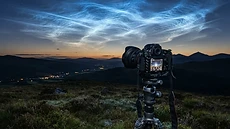
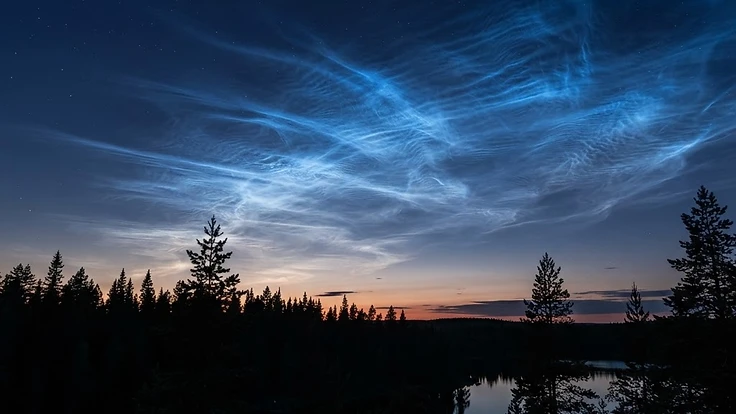
Noctilucent clouds are ethereal, luminous displays that appear in the high-latitude summer sky shortly after sunset or before sunrise. Unlike common weather formations, these clouds reside in the mesosphere, roughly 80 kilometres above the surface of the Earth.
They appear as shimmering, electric-blue veils against the dark backdrop of the night. Their existence requires a precise alignment of extremely cold temperatures, water vapour, and tiny particles of dust from meteors or space debris.
The Science Behind It
The mesosphere is typically too dry to support cloud formation. During the summer months, however, the atmospheric circulation patterns shift, causing air to rise and cool significantly at the poles.
This extreme cooling allows for the freezing of scant water vapour onto microscopic dust particles. This process, explored in depth within our The Atmospheric Physics of Noctilucent Clouds guide, creates the ice crystals responsible for the signature glow.
As the sun dips below the horizon, it continues to illuminate these high-altitude clouds. This backlighting creates the vibrant, nocturnal appearance that has captivated observers for over a century.
Real-World Implications
Studying these clouds provides a unique window into the dynamics of the middle atmosphere. Because they form only under specific conditions, they serve as a sensitive indicator of long-term climate shifts in the upper layers of our air.
Changes in the frequency or brightness of these displays can signal alterations in the concentrations of greenhouse gases or solar activity. While they do not directly disrupt ground-based infrastructure like a geomagnetic storm might, they remain vital for monitoring atmospheric health.
Researchers utilise them to model how energy moves through different levels of the sky. This knowledge helps improve weather modelling and our broader understanding of global climate systems.
What You Can Do
Observing these clouds requires patience and a clear view of the northern or southern horizon during late spring and summer. You do not need expensive equipment to see them, just a location free from light pollution.
If you find yourself travelling to dark-sky regions, you might also consider booking [guided aurora tours](https://vi.me/HuXHi) in places like Iceland, Norway, or Northern Canada. These trips offer an expert-led opportunity to witness the full range of high-latitude optical phenomena.
To better understand what else is happening in the sky, you can browse our glossary for more terms. Keeping an eye on live data helps you identify the best viewing windows for all kinds of celestial events.
Key Takeaways
Noctilucent clouds represent a rare interaction between terrestrial and space-borne materials. Their beauty is a reminder of the complexity hidden in the thin veil of our atmosphere.
By tracking these patterns, scientists gain essential data about the state of our climate. We encourage you to continue learning through our more articles section to deepen your engagement with the natural world. Stay curious about the skies above, as every clear night offers a potential view into the mechanics of the mesosphere.
Skywatching note
These high altitude clouds also offer a distinctive target for twilight skywatchers, especially at northern latitudes during summer. Readers who want to document their own displays can explore an observation setup suited to capturing unusual scenes in the night sky.
Ad · Affiliate link. Flarient may earn a commission if you purchase through this link, at no additional cost to you.
People Also Ask
Can noctilucent clouds be seen from the equator?+
Noctilucent clouds are rarely seen outside of high latitudes, typically between 50 and 70 degrees north or south. They require specific summer solstice conditions that do not occur near the equator, as the mesosphere there does not reach the extreme temperatures necessary for ice crystal formation.
Are noctilucent clouds the same as auroras?+
No, they are entirely different. Noctilucent clouds are made of physical ice crystals in the mesosphere, reflecting sunlight. Auroras are caused by high-energy particles from space interacting with gas atoms in the ionosphere and thermosphere, creating their own light through electromagnetic excitation.
Do noctilucent clouds harm the environment?+
Noctilucent clouds are a natural, harmless phenomenon. They are actually useful tools for scientists to study how the upper atmosphere changes over time. They do not pose any threat to the Earth or human technology, serving instead as a delicate indicator of atmospheric thermal trends.
Continue Reading
Forecast These Questions
View all →Express your probability on these active forecast questions.